#Product Trends
How to Choose a Hydrophone: Sensitivity, Bandwidth, Directionality and Front-End Matching
How to Choose a Hydrophone: Sensitivity, Bandwidth, Directionality and Front-End Matching
A sensitivity number is not a complete listening specification
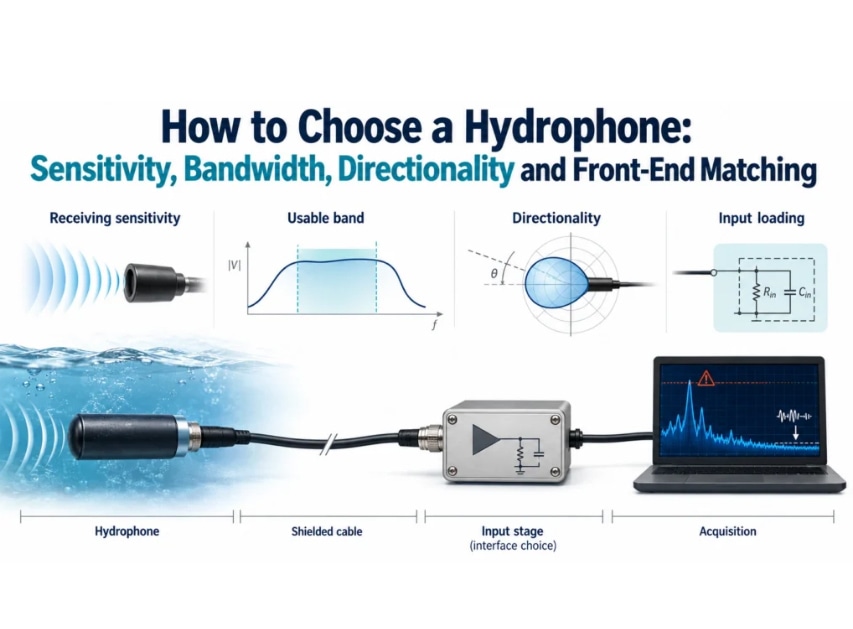
A hydrophone converts underwater sound pressure into an electrical signal. For sound recording, machinery-noise studies or environmental monitoring, choosing the receiving element is only one part of designing the measurement chain. A sensitive element connected to an unsuitable input can lose low-frequency response, pick up interference or overload the recorder. A clean-looking waveform can still have the wrong pressure scale.
Before comparing models, decide whether the task is event detection, relative spectral comparison or measurement of absolute sound-pressure levels. These tasks require different evidence. State the frequency band, weakest useful signal, largest expected event, deployment arrangement and recording duration. Do not treat a catalogue listening distance as a universal detection range: source strength, propagation, background noise, bandwidth and the detection criterion all affect the result.
Read receiving sensitivity with its reference conditions
Voltage receiving sensitivity is the ratio of output voltage to incident sound pressure. It can be expressed in V/Pa or as a logarithmic level, commonly dB re 1 V/µPa. A negative value in that convention is normal; it does not mean negative pressure or poor performance. With the same reference and conditions, a less negative value represents more output voltage per unit pressure, but not necessarily lower system noise or a better recording.
A meaningful comparison also identifies frequency, direction of incidence, acoustic-field convention, electrical load, cable and whether a preamplifier is included. Open-circuit element sensitivity and the sensitivity of a loaded, amplified assembly are not interchangeable. Pressure calibration and free-field calibration describe different conditions. The National Physical Laboratory’s hydrophone calibration services distinguish receiving sensitivity, directional response and electrical impedance measurements; one measurement does not establish all three.