#Product Trends
Transit-Time Flow Transducer Pairing: Timing, Waveforms and Temperature
Transit-Time Flow Transducer Pairing: Timing, Waveforms and Temperature
The useful question is whether the pair preserves the time difference
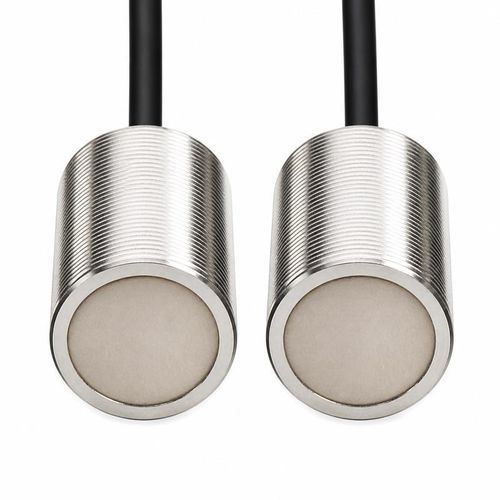
Two liquid-flow transducers can have similar resonance curves and still produce an unwanted zero-flow offset in a finished measurement channel. Conversely, slightly different received amplitudes do not automatically make a pair unusable. For transit-time flow measurement, the decision is whether the complete upstream and downstream acquisitions deliver a stable, interpretable propagation-time difference over the intended operating conditions.
This is an OEM pairing problem, not a general incoming-inspection tutorial. It involves two transducers, their mounting, the liquid path, cables, transmit/receive switching, gain and the time estimator. A pair should therefore be evaluated with a defined measurement strategy. Recording only two nominal frequencies or one room-temperature signal amplitude leaves the most important question unanswered.
Separate fluid transit time from the measured system delay
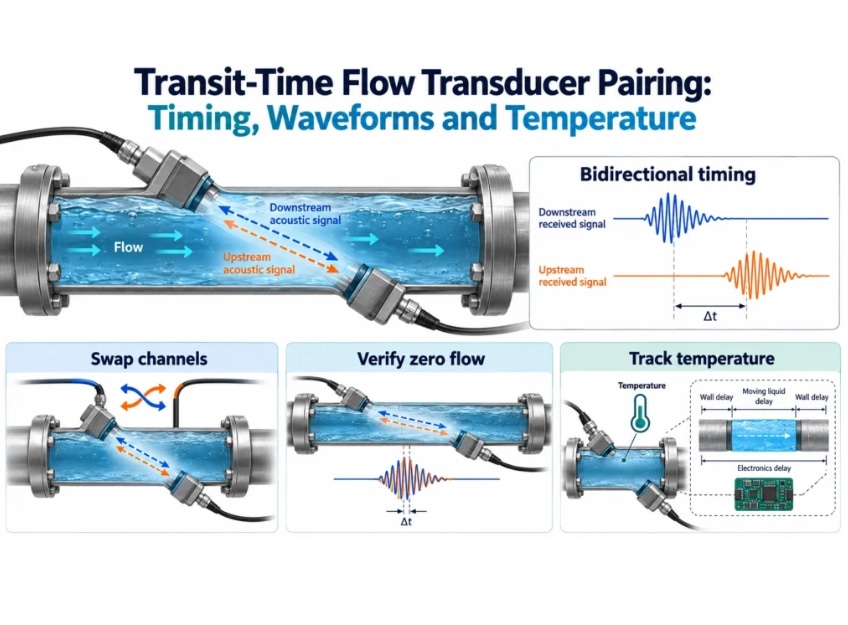
For an ideal straight acoustic path of length L in a uniformly moving fluid, let c be sound speed and v the axial flow velocity. If the path makes an angle θ with the flow axis, the fluid-only times are:
tdown = L / (c + v cos θ); tup = L / (c – v cos θ).
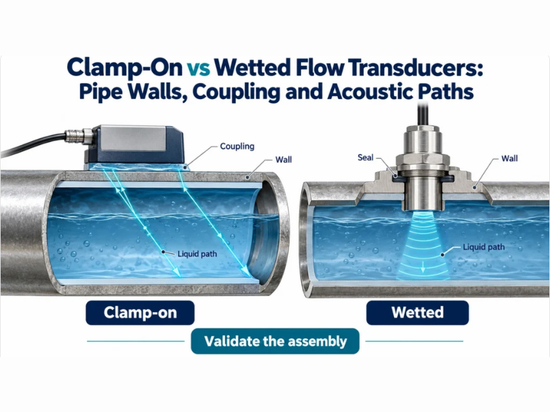
For flow velocity small relative to sound speed, the difference is approximately Δt = tup – tdown ≈ 2Lv cos θ / c². These expressions explain why a small directional timing difference matters. They are not a complete calibration equation for a real flow channel. Wedges, pipe walls, matching layers and electronics can add delay; they must not simply be treated as part of the moving-fluid path L.
The comparison of transit-time and Doppler flow measurement covers the underlying method choice. Here the focus is narrower: identifying which part of the difference belongs to flow and which part comes from directional asymmetry or changing test conditions. Common delay and differential delay have different consequences; total travel time alone cannot separate them.