#Industry News
Sensor application for testing valve seat rings
Acoustic quality testing on valve seat rings
Small, almost invisible material cracks must be detected in valve seat rings. This is accomplished in just a few milliseconds using acoustic sensors from ds automation, Schwerin. If process fluctuations occur, the resonance analysis parameters can be adjusted accordingly.
The feed system manufacturer Ifsys, Großbardorf, must inspect valve seat rings for gas and gasoline engines for small, nearly invisible material cracks. “Until now, we primarily used a mechanical testing device for this purpose, with the disadvantage that good parts without cracks were sometimes damaged,” explains Rigobert Zehner, Managing Director and Sales Manager of Ifsys GmbH.
For a new engine generation, two types of rings are produced for gas and gasoline engines from different materials. Therefore, a gas ring must never be fed into the assembly line for a gasoline engine, or vice versa. “However, this can happen during the loading of the feed system by an operator,” says Rigobert Zehner. “We wanted to eliminate that risk.”
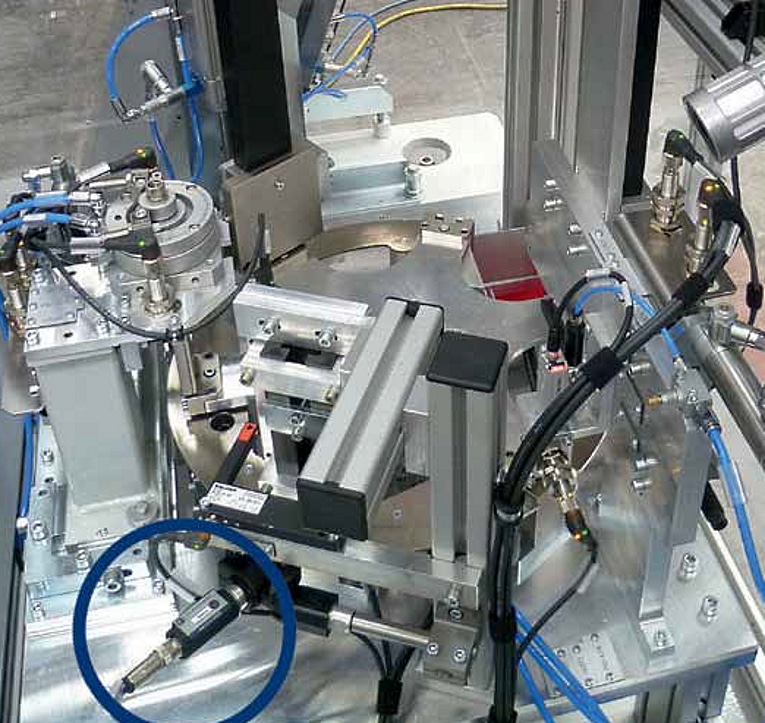
In cooperation with ds automation in Schwerin, a solution was sought for crack testing that also accounts for material and component differentiation directly in the production process. The inspection is cost-effective and fast (several parts per second) using the compact dsound USS4 series acoustic sensors from ds automation GmbH. The microphone and all signal processing hardware are integrated into the sensors, so no additional external devices are required. The sound profile of good valve seat rings is stored in the sensor as a training file and compared with the incoming parts. Thanks to the part memory, it is possible to feed mixed test parts or switch the sensor between different parts without retraining.
Manufacturer and user developed a low-maintenance excitation method. The test pieces are excited using a defined compressed air pulse on an impact plate and measured resonantly in free fall. The inspection itself takes only a few milliseconds, and the acoustic sensors provide an immediate, delay-free good/bad evaluation via a digital output.