#Product Trends
Titanium Turnings Briquette Machine for UK Metal Recyclers | ENERPAT
In the UK metal recycling industry, titanium turnings are considered one of the most difficult metal scraps to handle. Compared with steel or aluminum chips, titanium turnings have lower bulk density, higher elasticity, and are usually mixed with cut
In the UK metal recycling industry, titanium turnings are considered one of the most difficult metal scraps to handle. Compared with steel or aluminum chips, titanium turnings have lower bulk density, higher elasticity, and are usually mixed with cutting fluids. This leads to several operational challenges for recyclers, including inefficient storage, high transport cost, low furnace yield, and environmental compliance pressure.
For UK and European recyclers, additional requirements also apply: equipment must comply with EU health and safety regulations, and the briquetting system must provide sufficient pressure to form stable, high-density briquettes from high-hardness materials such as titanium.
ENERPAT provides a dedicated vertical titanium turnings briquetting solution designed specifically for these industrial conditions.
1. Application Background: Why Titanium Turnings Are Difficult to Recycle
In practical recycling operations, titanium turnings typically present the following characteristics:
Low bulk density: loose chips occupy large storage space and are difficult to stack.
High elasticity and hardness: ordinary briquetting machines often cannot reach stable compaction.
Oil contamination: cutting fluids reduce scrap value and increase environmental handling costs.
Low furnace recovery: loose or poorly compacted titanium often leads to oxidation loss during melting.
In many UK recycling plants, titanium turnings are still collected in loose form or simply baled into blocks, which does not fundamentally solve density and yield problems.
2. ENERPAT Vertical Titanium Turnings Briquette Machine – Technical Overview
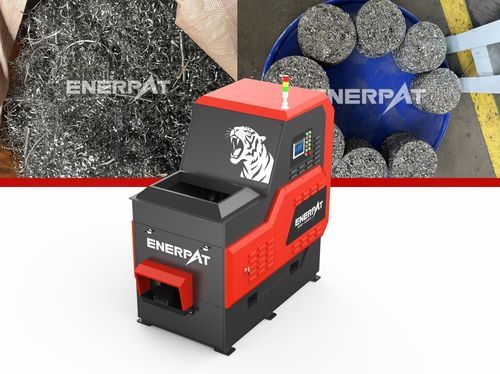
The ENERPAT vertical titanium turnings briquette machine is specifically engineered for high-hardness non-ferrous metal scraps. It is mainly used to compress titanium and titanium alloy turnings into dense cylindrical briquettes, improving handling efficiency and metallurgical recovery.
Core Technical Configuration (Typical)
Item Configuration
Pressing force 250 mt / 400 mt / 500 mt (optional)
Briquette diameter 80 mm / 100 mm
Control system Siemens PLC
Operation interface Siemens touch screen
Feeding system Dual horizontal & vertical screw
Mold material Imported tool steel (Germany Dilling)
Oil separation Integrated hydraulic de-oiling system
Certification CE, ISO, EU safety compliance
Note: Final configuration depends on scrap type, throughput requirement, and site conditions.
3. Engineering Advantages for Titanium Scrap Processing
3.1 High-Pressure Compaction for Hard Materials
Titanium turnings require significantly higher forming pressure than common steel or aluminum chips. The ENERPAT vertical system is designed for high-load continuous operation and can provide sufficient forming force for high-hardness alloys, enabling the production of mechanically stable briquettes.
3.2 Integrated Oil Separation System
During briquetting, cutting fluids are mechanically squeezed out and collected through the hydraulic system. This reduces oil content in the briquettes and allows recovered fluids to be reused or treated separately, supporting environmental compliance and operational cost control.
3.3 Imported Mold System
The compression chamber uses high-strength imported tool steel molds with thread + bolt fixing structure. This design simplifies maintenance and allows faster replacement compared with welded or monoblock molds commonly used in standard machines.
3.4 EU-Compliant Automation and Safety
The machine is equipped with Siemens PLC and industrial-grade touch screen. All electrical and hydraulic systems follow EU industrial safety standards, making the equipment suitable for long-term operation in European recycling facilities.
4. Briquetting vs Baling for Titanium Turnings
Comparison Briquetting Baling / Blocking
Final form Cylindrical briquettes Rectangular blocks
Density Higher and more uniform Medium
Furnace performance Better melting behavior Higher oxidation risk
Oil removal Integrated de-oiling Usually not available
Scrap value Higher Medium
Equipment cost Medium–high Lower
For titanium and titanium alloy scraps, briquetting is generally preferred when recyclers focus on metallurgical yield and resale value, not only volume reduction.
5. UK Case: Practical Application Scenario
Customer Profile
A UK-based metal recycling company specializing in high-value non-ferrous scraps, mainly collecting titanium turnings from aerospace and precision machining suppliers.
Project Requirements
The customer’s key concerns were:
Ability to handle high-hardness titanium chips.
Compliance with EU safety standards.
Effective oil separation.
Stable briquette quality for downstream melting.
Solution Provided
After evaluating both block balers and briquetting systems, the customer selected the ENERPAT vertical titanium turnings briquette machine due to:
Higher achievable material density.
Integrated de-oiling function.
Siemens-based automation.
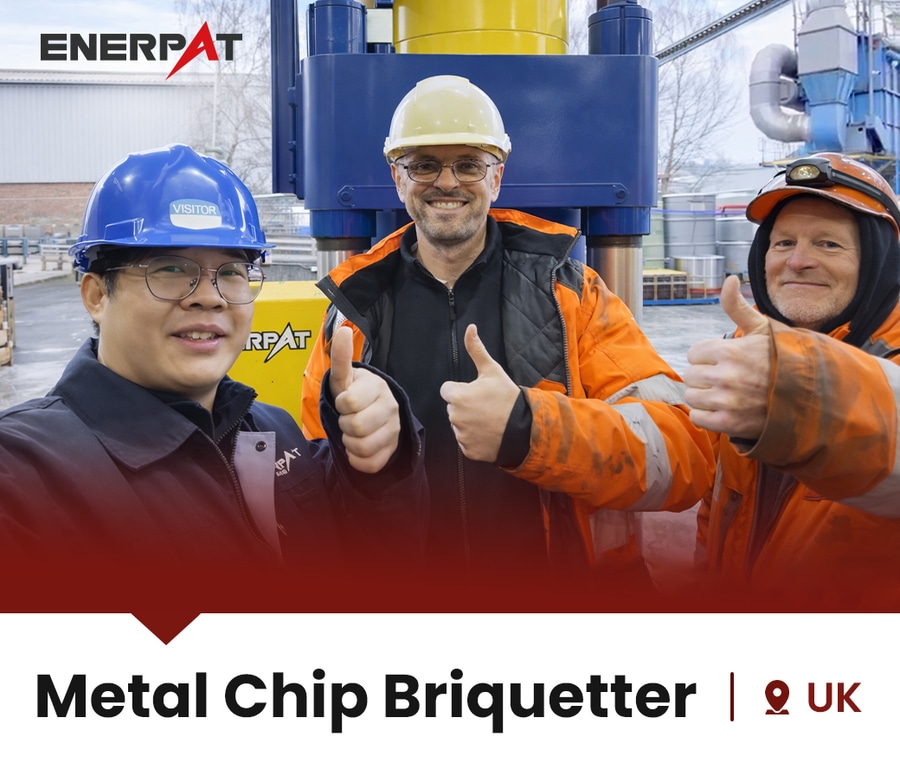
Availability of on-site installation support.
ENERPAT provided:
Equipment layout drawings.
Compression chamber structure diagrams.
Control system configuration details.
On-site installation and commissioning.
Operational Feedback (Qualitative)
After commissioning, the customer reported:
Significant reduction in storage volume.
Improved handling and transport efficiency.
More stable melting performance.
Higher acceptance by downstream smelters.
(All performance indicators depend on scrap morphology, oil content, furnace type, and operating parameters.)
6. Why ENERPAT for Titanium Briquetting
From an engineering and project delivery perspective, ENERPAT’s advantages include:
Long-term focus on metal recycling equipment.
Dedicated solutions for high-hardness materials.
EU-compliant electrical and hydraulic systems.
Use of international industrial components.
On-site service capability for European projects.
For recyclers dealing with titanium turnings, the key value is not only volume reduction, but process stability, compliance, and downstream recovery performance.
7. FAQ – Titanium Turnings Briquetting
Can titanium turnings really be briquetted?
Yes. With sufficient forming pressure and appropriate mold design, titanium turnings can be compressed into mechanically stable briquettes.
What pressure is typically required?
Titanium generally requires higher forming force than steel or aluminum. Exact requirements depend on chip size, alloy type, and oil content.
Is oil separation necessary?
For high-value titanium recycling, oil separation is strongly recommended to improve scrap quality and meet environmental standards.
Briquetting or baling – which is better?
Briquetting provides higher density and better melting behavior, while baling has lower investment cost but limited metallurgical benefits.