#Product Trends
Mexico Case Study: How a Mexican Recycling Company Improved Aluminum Can Processing Efficiency to 3 Tons per Hour with an ENERPAT Hopper Type Metal Baler
Mexico Case Study: How a Mexican Recycling Company Improved Aluminum Can Processing Efficiency to 3 Tons per Hour with an ENERPAT Hopper Type Metal Baler
The Real Challenge: Why Aluminum Can Recycling Became a Bottleneck
For this Mexican recycling company, the problem was not collecting aluminum cans — it was what happened after collection.
As local aluminum can consumption continued to rise, the volume of loose aluminum cans entering the facility increased rapidly. These cans were lightweight but extremely bulky. Inside the warehouse, loose cans occupied large amounts of space, leaving little room for other recyclable materials and limiting further business expansion.
Transportation created another headache. Trucks reached their volume limit long before hitting their weight capacity. More trips were required, logistics costs increased, and material delivery schedules became harder to control. Over time, low storage efficiency and high transportation costs began to directly affect overall operational efficiency and profit margins.
The customer needed a practical way to reduce volume, improve logistics efficiency, and keep costs under control.
Customer Background
The customer is a professional metal recycling company based in Mexico, specializing in the collection, sorting, and processing of aluminum cans and other recyclable metals. The company supplies recycled aluminum materials to local smelters and downstream manufacturers and plays an important role in the regional recycling supply chain.
With a stable recycling volume and long-term growth expectations, the company began looking for a more efficient aluminum can baling solution to support future expansion.
Key Requirements from the Customer
High-Throughput Aluminum Can Processing
The customer processes a large quantity of aluminum cans every day. Any new aluminum can baler needed to handle continuous operation without frequent downtime.
Their target was clear: a stable processing capacity of 3 tons per hour.
By compressing loose cans into dense bales, the customer aimed to:
Free up valuable warehouse space
Prevent material backlogs during peak recycling periods
Improve loading efficiency for transportation
Environmental Compliance and Cost Control
Mexico’s environmental regulations for industrial recycling operations are becoming increasingly strict. The customer required equipment that could operate cleanly and comply with local environmental standards.
At the same time, the investment needed to make economic sense. The customer expected the solution to:
Reduce warehouse space requirements
Lower transportation frequency and fuel costs
Increase the recycling rate and resale value of aluminum cans
The goal was simple: environmental compliance and economic return at the same time.
Automation, Safety, and Reliable Operation
Manual processing was no longer sustainable. Relying heavily on labor increased costs and introduced safety risks.
The customer wanted an automatic metal baler capable of handling the entire process — from feeding and compression to bale discharge — with minimal manual intervention.
A reliable control system, real-time monitoring, and built-in safety protection were also essential to ensure stable long-term operation and reduce maintenance downtime.
Solution: ENERPAT AMB-H2014-250T Hopper Type Automatic Metal Baler
Why a Hopper Type Metal Baler?
After evaluating the customer’s site conditions, recycling volume, and operational goals, ENERPAT’s technical team recommended a hopper type metal baler rather than smaller manual or semi-automatic solutions.
For lightweight materials like aluminum cans, continuous feeding and high compression force are critical. A hopper type baler allows large volumes of loose material to be processed efficiently without constant operator involvement — exactly what this customer needed.
Equipment Overview
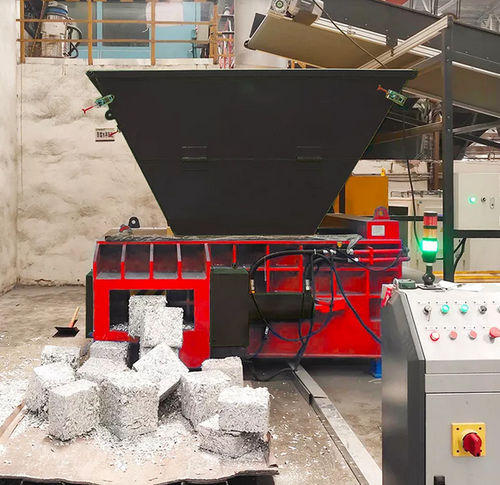
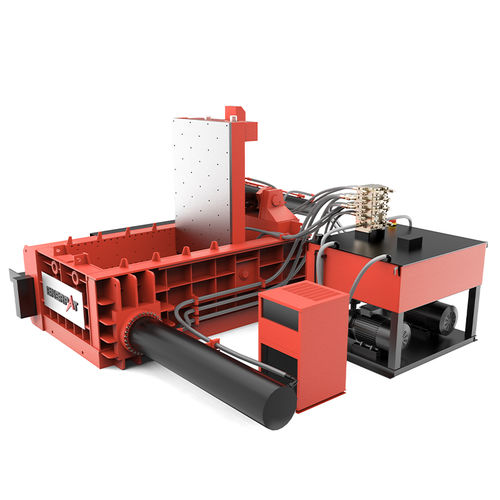
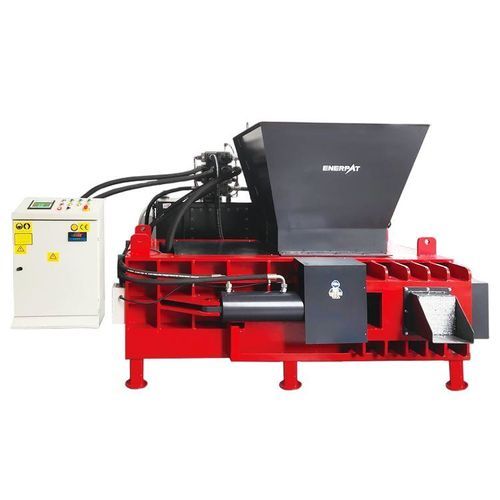
The selected solution was the ENERPAT AMB-H2014-250T hopper type automatic metal baler, a model specifically designed for lightweight metal scrap such as aluminum cans, non-ferrous metal chips, and metal shavings.
With a compression force of 250 tons, the baler can quickly transform loose aluminum cans into high-density, uniform bales that are easy to store and transport.
Key Benefits Delivered to the Customer
Stable 3 Tons per Hour Processing Capacity
The large-capacity hopper supports continuous feeding, eliminating frequent stops for manual loading. This allows the aluminum can baler to operate smoothly and consistently, even during peak recycling periods.
As a result, the customer achieved a stable aluminum can processing capacity of 3 tons per hour, significantly reducing material accumulation on-site.
Improved Storage and Transportation Efficiency
After compression, aluminum cans are formed into dense, regular bales. Storage space requirements were dramatically reduced, and trucks could be loaded closer to their rated capacity.
Fewer trips, lower fuel costs, and faster material turnover quickly translated into measurable operational savings.
Clean Operation and Environmental Compliance
The baler features a closed processing design that helps control dust and noise during operation. This supports compliance with local environmental regulations while creating a cleaner and safer working environment.
By improving the recycling efficiency of aluminum cans, the customer also reduced waste and strengthened their commitment to sustainable recycling practices.
Automation and Intelligent Control
Equipped with a Siemens / Schneider intelligent control system, the baler supports fully automatic operation from feeding to bale discharge.
Operators can monitor key parameters such as motor load, hydraulic oil temperature, and operating time in real time via a touchscreen interface.
Built-in fault diagnostics and alarm functions help maintenance teams quickly identify issues like pressure abnormalities or motor overload, minimizing downtime and maintenance costs.
Results: From Bottleneck to Scalable Operation
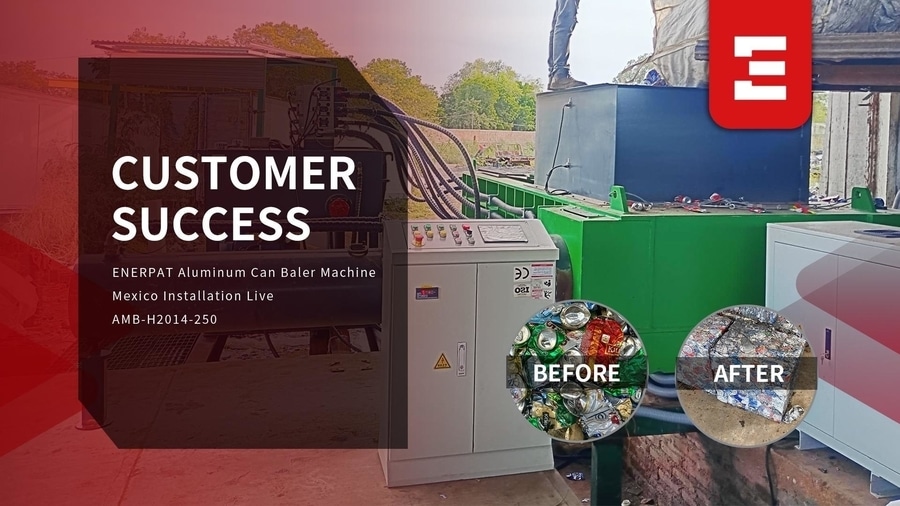
Before installing the aluminum can baler, loose cans slowed down storage and transportation. After implementation, the customer gained a more efficient, scalable recycling process that supports long-term growth.
What changed most was not just speed — it was control. Control over space, logistics, costs, and daily operations.
Looking for a Reliable Aluminum Can Baling Solution?
If your recycling operation is facing challenges such as low aluminum can storage efficiency, high transportation costs, or increasing automation requirements, ENERPAT can help.
Contact ENERPAT today to explore a customized aluminum can baler or metal baler solution designed to improve efficiency, reduce costs, and support sustainable recycling operations.