#Product Trends
Lightning Impulse Generator: Choosing a System That Holds Up Across Every Buyer Type
Ask five different buyers what they need from a lightning impulse generator and you'll get five different answers. A transformer factory running routine type tests cares about how fast the unit recharges between shots. A third-party testing lab cares
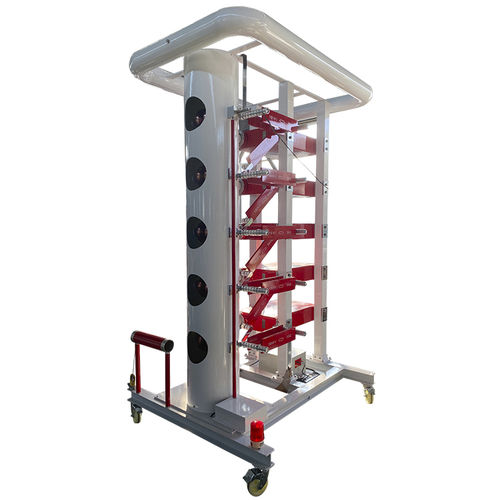
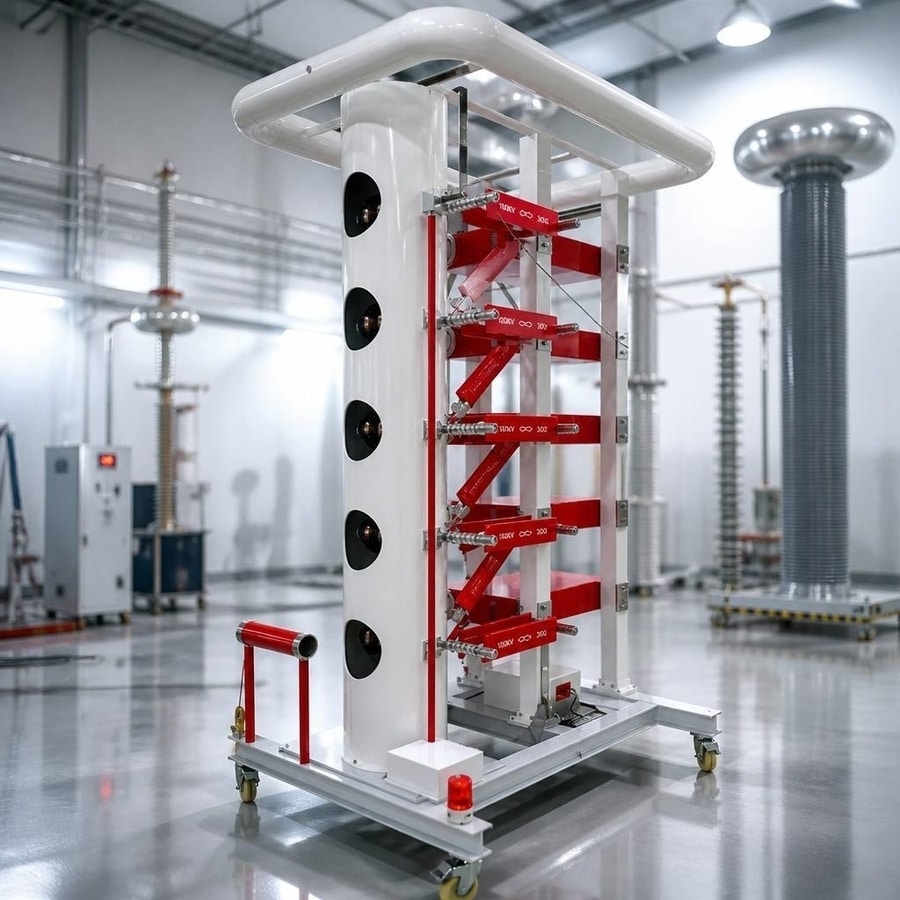
Every lightning impulse voltage generator, from a compact 5kJ bench unit to an 800kV/80kJ tower system, runs on the same Marx principle: capacitors charge in parallel, then discharge in series through triggered sphere gaps to produce the standard 1.2/50μs full wave, with a 2–6μs chopped wave available where a truncation device is fitted. What separates a dependable build from a marginal one is rarely the topology — it's execution. Voltage utilization factor is the number worth asking about directly: a well-built system holds above 85% for lightning waves and 80% for operating waves even under capacitive load, while a poorly matched circuit bleeds efficiency the moment you connect a real transformer winding instead of a no-load test point.
A 3-stage, 300kV/30kJ configuration illustrates this well. With single pulse capacitors around 2.0μF per 100kV stage and roughly 0.666μF total impact capacitance, a properly tuned unit reaches a synchronous misfire rate under 2% with a triggering range of at least 20% — numbers that matter more than the headline kV figure once you're running back-to-back tests on bushings or insulator strings under GB/T 16927 or JB/T 7616. For labs handling mixed workloads, a duty cycle rated for continuous operation every 120 seconds above 70% of rated voltage keeps throughput reasonable without shortening component life.
For power equipment manufacturers, this translates directly into fewer retests per production batch. For testing laboratories and universities, it means fewer calibration disputes when a 100MS/s, two-channel acquisition system with sub-1% amplitude error is already built in rather than bolted on. For grid companies and EPC contractors managing substation construction schedules, automated ball-gap adjustment and constant-current charging control cut commissioning time — and matter more on-site than they ever do in a demo.
Certifications are the last filter worth applying. ISO 9001 manufacturing, CE marking, and a genuine third-party calibration certificate (CNAS-stamped where required) separate manufacturers built for repeat utility and OEM business from ones selling a single unit and disappearing. Huazheng Electric, a State Grid-qualified manufacturer based in Baoding, builds its impulse generator lines around exactly this checklist — voltage utilization, synchronization accuracy, and measurement compliance first, headline voltage second.
The right lightning impulse generator isn't the one that looks most impressive on a spec sheet. It's the one that produces the same clean waveform on test number two hundred as it did on test number one.