#Product Trends
0.1 Hz VLF High Voltage Generator for Cable and Motor Hipot
0.1 Hz VLF High Voltage Generator for Cable and Motor Hipot
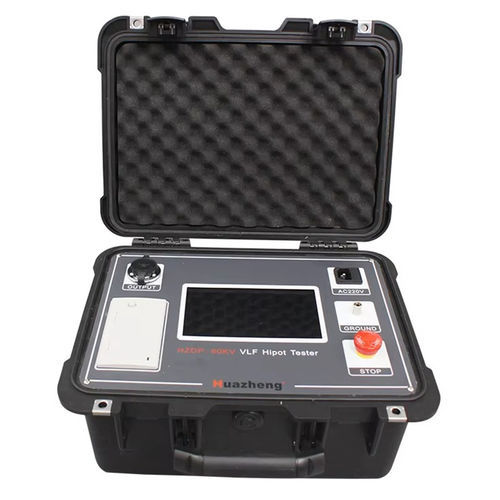
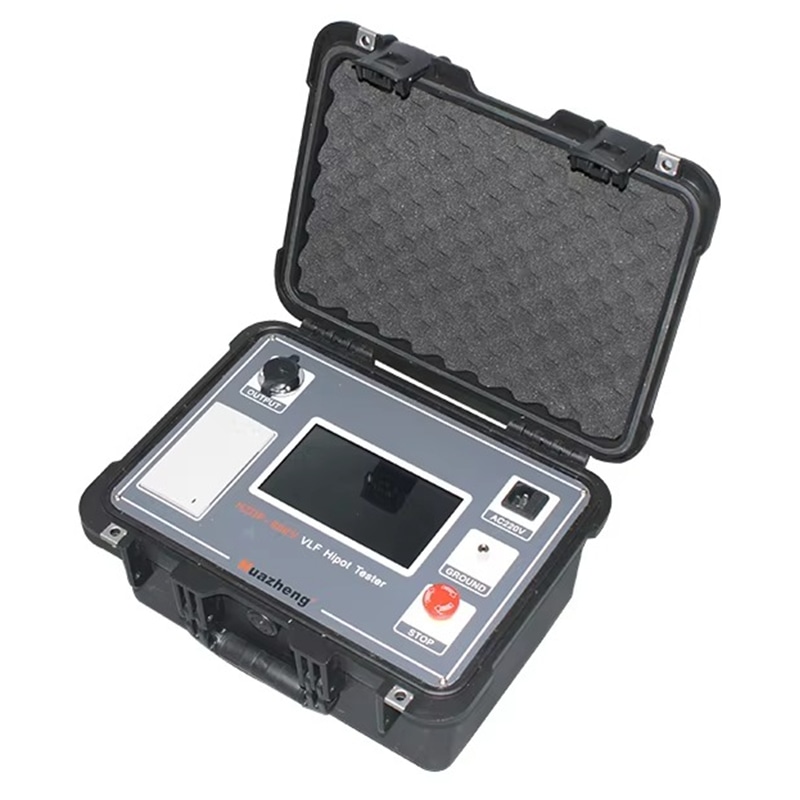
Portable 0.1 Hz VLF hipot tester with 7-inch touch screen, 0.1–0.01 Hz frequencies and auto protection for XLPE cables, motors and generators. A field VLF hipot tester for 35 kV-class XLPE cable and rotating machines: automatic ramp, four test frequencies, and a load table you should read before you leave the depot.
0.1 Hz VLF High Voltage Generator for Outdoor Cable and Machine Hipot
Field hipot work fails for two boring reasons: the set is too heavy, or the cable is longer than the nameplate capacitance. This 0.1 Hz VLF high voltage generator is the current-generation answer to both. It is a digital frequency-conversion VLF hipot tester for electrical equipment with large insulation capacitance — power cable, power capacitors, and large or medium generators and motors — in line with DL/T 849.4-2004 and the Chinese method for VLF withstand on 35 kV and below XLPE cable.
Control is a 7-inch capacitive touch screen on an ARM7 processor with high-speed AD sampling and background software. Chinese and English sit in the same menu. Wiring is the usual HV, ground and test object. After that the sequence is automatic: boost, hold, measure, protect, reduce. Over-voltage and over-current (HV and LV sides) trip in 10 ms or less. The controller talks to the high-voltage unit at low voltage through photoelectric isolation, which is the arrangement you want when the output is tens of kilovolts and the operator is standing in a cable trench.
Output frequencies are 0.1 Hz, 0.05 Hz, 0.02 Hz and 0.01 Hz. Maximum load is 0.5 µF at 0.1 Hz, 1.1 µF at 0.05 Hz, 2.2 µF at 0.02 Hz and 5.5 µF at 0.01 Hz. If a long feeder will not run at 0.1 Hz, drop the frequency rather than fighting the set. Measurement accuracy is 3%. Positive and negative peak error is ≤3% ±3 kV. Waveform distortion is ≤5%. A high/low-voltage closed-loop keeps the output from riding up with capacitance — the old “capacity rise” problem on some open-loop boosters.
Indoor or outdoor, −10 °C to +40 °C, humidity up to 85% RH. Mains is 220 V ±5%, 50/60 Hz. A portable generator will work if it is stable and generally above 3 kW at 220 V ±5% / 50 Hz. Records store automatically and print on site. The mechanical first-generation VLF boosters were large and failure-prone. This one is meant to leave the van without a crane.
It will not replace a tan-delta diagnostic van or a 50 Hz resonant system on a factory acceptance bay. For preventive withstand on MV cable and rotating machines, the useful part is smaller: a portable VLF hipot tester, four frequencies, and a protection loop that actually opens.
Send the cable voltage class and approximate length. We will confirm frequency, load and a quotation.