#Product Trends
What a Flash Point Apparatus Actually Measures
A flash point apparatusreports a method result, not a universal temperature. See how closed-cup Tag, Pensky-Martens and Abel Flash Point Testers differ for fuels and solvents.
A flash point apparatusreports a method result, not a universal temperature. See how closed-cup Tag, Pensky-Martens and Abel Flash Point Testers differ for fuels and solvents.
Labs treat flash point as if it were a fixed property, like density at 15 C. It isn't. A flash point apparatus is measuring a procedure: a cup of a stated size, a lid that either traps vapor or lets it go, a heating rate written into a standard, and an ignition source applied on a schedule. Change the apparatus and the temperature moves. ASTM says this in plain language — flash point is a function of the instrument and the method, not a molecular constant.
That is the first filter when someone types "flash point tester" into Google. The useful question is not "which machine looks modern," but "which method is named on the spec sheet."
Closed-cup flash point instruments are the ones that show up in GHS classification, OSHA flammable-liquid rules, and shipping papers (ADR, IMDG, IATA). The lid keeps vapor over the sample, so the flash usually appears at a lower temperature than an open-cup run. Cleveland open-cup work (ASTM D92) still has a job — lubricating oils, bitumen, fire point — but it is the wrong reading if the task is labeling a drum.
Three closed-cup families cover most petroleum and solvent benches:
Tag closed cup, ASTM D56 Flash Point Apparatus . Thin liquids, viscosity below 5.5 mm2/s at 40 C (or 9.5 mm2/s at 25 C), expected flash point below 93 C. Typical fill is 50 mL. No stirrer in the classic Tag procedure. Aviation turbine fuel specs still treat D56 as the referee method.
Pensky-Martens closed cup, ASTM D93 / ISO 2719 flash point apparatus. Diesel, residual fuels, used oils, liquids that skin over. Larger cup, a stirrer, heating rates that change with Procedure A, B or C.
Abel closed cup flash point apparatus , ISO 13736 / IP 170. Solvents, paints, petroleum spirit. More common on European benches than in U.S. fuel labs.
Do not average these numbers. Do not let software print a "D56 equivalent" from a D93 run and treat it as D56. ASTM D1655 is blunt about aviation turbine fuel: correlated flash point results are not allowed.
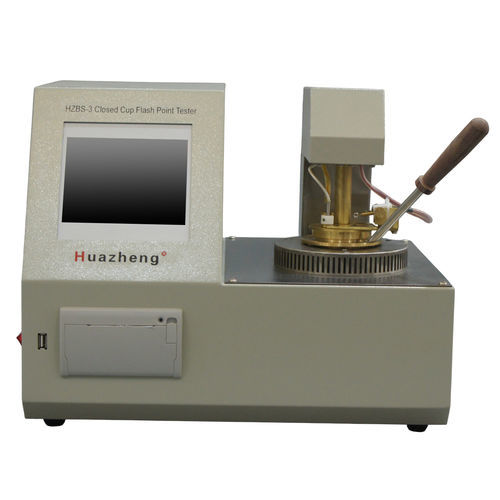
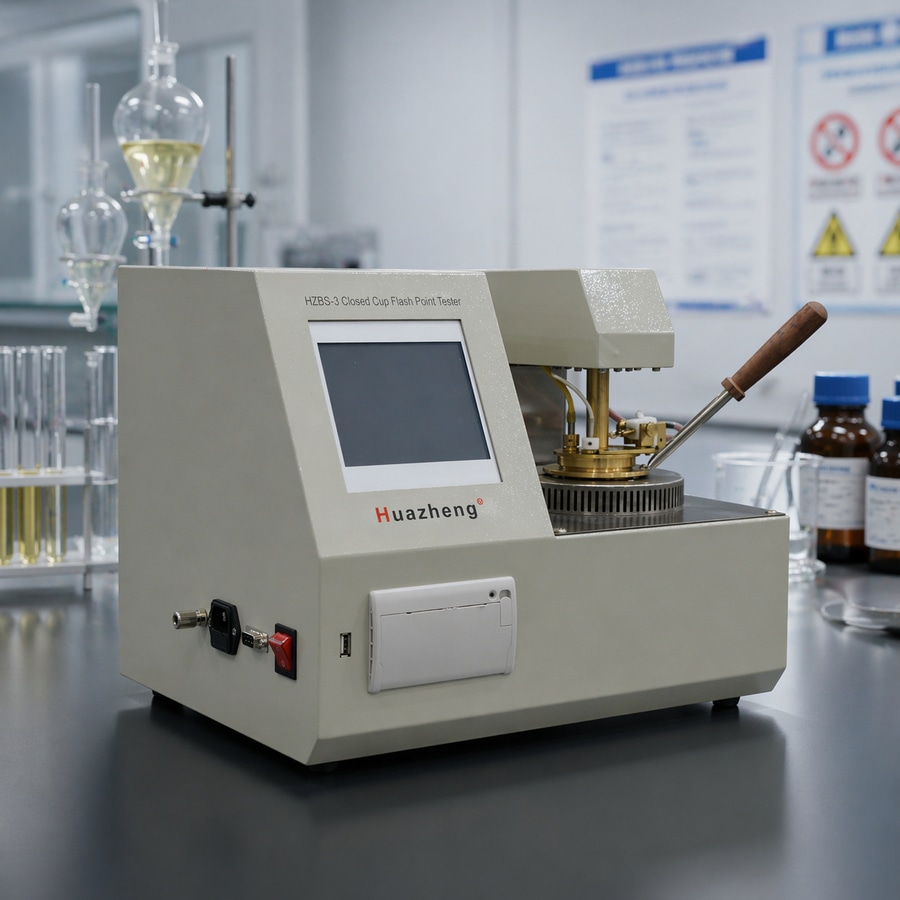
On a working bench the sequence is repetitive on purpose. Fill the cup, fit the lid, heat at the method rate, apply the igniter, and wait for a flame that actually races across the surface. A blue halo around the test flame is not a flash — halogenated solvents throw that halo often enough to fool a tired operator. Then correct the observed temperature to 101.3 kPa. An automatic flash point apparatus takes over the ramp, the ignition timing, the detection and the barometric math. Manual units still pass audits; they just leave more of that judgment with the person standing there.
If the liquid is low-viscosity and the specification cites ASTM D56, the right purchase is a Tag closed-cup flash point apparatus. Diesel, used oil, and anything carrying suspended solids belong on Pensky-Martens. Mixing the two is how labs end up with numbers they cannot defend.