
#Product Trends
Introducing Smart Reactive Power Compensation in EV Fast Charging
REG1K0135P2
In DC fast charging, every kilowatt counts—but not all grid power is used efficiently. Power Factor (PF), the ratio of active (useful) power (kW) to apparent power (kVA), typically ranges from 0 to 1 and reveals a key inefficiency: reactive power (VAR). Apparent power is the vector sum of both active and reactive power, representing the total available grid capacity.
Active power is always positive, flowing from the source to the load to perform useful work, while reactive power simply oscillates between the grid and the device itself, generating heat, wasting energy, and potentially triggering utility penalties for poor PF. The increase of reactive power causes PF to drop, indicating poor power utilization.
Where Reactive Power Loss Hits Hardest?
High Power Charging (HPC) systems: As 400 kW+ ultra-fast charging systems become essential in modern infrastructure, the growing number of charger modules inside can generate substantial reactive power losses under light-load or standby conditions. This not only degrades grid power quality but has also led to utility penalties for many charging station operators. Traditionally, DC charger integrators addressed this by adding AC contactors to disconnect the AC input from all modules in such scenarios—a solution that raises system costs and compromises reliability.
HPC highway stations: When multiple EVs charge simultaneously during travel peaks, load demand can swing sharply between a few hundred kW and several MW within seconds. These rapid active/reactive power fluctuations cause unstable PF or even severe PF drops. Poor PF not only wastes grid capacity but also can trigger utility penalties.
Urban fleet depots and heavy-duty truck charging sites: During evening bus or truck returns, all charging points run at full load. The concentrated charging demand already strains grid capacity, and reactive power drawn by charging systems further reduces transformer capacity for active power. Operators must either stagger charging (delaying readiness) or risk transformer overload.
On-grid hybrid charging sites with solar PV and battery storage: Midday solar generation can cause local voltage rise, while evening fast charging leads to voltage dips. Utilities often require distributed energy resources to provide voltage regulation support through reactive power injection or absorption, but conventional inverters and charger modules operate at a fixed PF. In these cases, dynamic PF control and reactive power compensation are essential for voltage stabilization and compliance with grid dispatch requirements.
Basically, the available grid capacity is fixed and shared between active and reactive power. Active power charges EVs, while reactive current produces unnecessary heat, wastes energy, and reduces the usable portion of grid capacity. In severe cases, it can even interfere with other equipment. Therefore, reactive power compensation is vital to offset this waste, improves active power utilization, and maximizes available capacity.
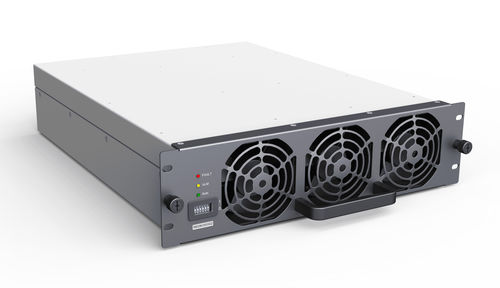
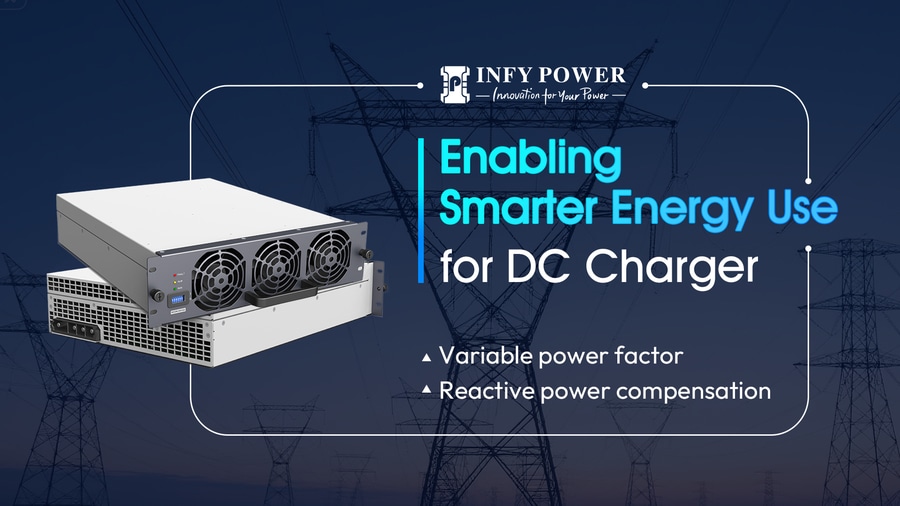
To address these challenges, Infypower introduces the 40kW G2 VPF charger module — REG1K0135P2, purpose-built for smart PF regulation and reactive power compensation for EV charging stations. Unlike other VPF charger modules that can only offset their own reactive power in standby status or cannot compensate the reactive power of other equipment when idle, our REG1K0135P2 supports four distinct operating modes:
1. Standard Charging Mode
Primarily focuses on EV fast charging with low reactive power compensation priorities
PF performance: > 0.9 (no load), > 0.95 (> 5% load), > 0.99 (> 50% load), > 0.999 (full load).
2. Constant PF Mode
Settable PF range from 0.8 lead to 0.8 lag.
Reactive power dynamically changes with active power (up to 40 kW).
Ideal for European markets, where high reactive power from other equipment lowers site PF. It helps meet strict grid standards and reduces reactive power losses. Certain grid standards require charger modules to support PF regulation by allowing the system to compensate for the reactive power from other equipment, thereby improving the overall grid PF and reducing reactive power losses.
3. Pure Reactive Power Compensation Mode
Operates solely as a static VAR compensator when not charging.
Outputs or absorbs reactive power on demand to compensate for other equipment, enhancing grid stability during idle periods.
Reactive power can be set directly from −40 kVar to +40 kVar, with control error < 4% and < 0.2 kVar.
4. Charging + Reactive Power Compensation Combined Mode
Enables EV charging while actively compensating reactive power.
Delivers a total apparent power of 40 kVA with active power output and reactive power compensation when the input voltage is between 320 Vac and 530 Vac.
Easy reactive power compensation value setting throughout the charging process.
Why Infypower VPF charger modules matter for DC charger makers and charge point operators?
• Higher Grid Utilization → Deliver more kW of active power without upgrading transformers or feeders.
• Penalty Avoidance → Maintain PF ≥ 0.99 under dynamic loads.
• Regulatory Compliance → Meet regional grid code PF requirements.
• Value-Added Services → Offer VAR support to utilities in idle hours.
With its full-SiC design, the REG1K0135P2 achieves peak efficiency over 97.5% and industry-leading power density of > 65 W/in³, ultimately reducing the footprint and weight of charging piles. Combining intelligent PF control with reactive power compensation, it bridges the gap between HPC performance and grid-friendly operation — enabling EVSE integrators to deliver both high charging speed and high power utilization in a single solution.