
#Product Trends
Unlocking HPC Growth with 218 kWh BESS
ICB218kWh
The race for high-power charging (HPC) infrastructure is accelerating across Europe and North America, propelled by evolving EV technologies and charging demand. Battery capacities of average new BEVs are approaching 100 kWh, and 4C charging is becoming mainstream. There is a clear preference for 350 kW / 400 kW public chargers.
Regulations such as the EU’s Alternative Fuels Infrastructure Regulation (AFIR) are pushing this transition further—requiring TEN-T core network sites to provide at least 400 kW total power, one socket rated at 150 kW, and 350 kW+ chargers for eHDV corridors every 60 km.
Yet, Charge Point Operators (CPOs) confront a fundamental constraint: existing grid infrastructure cannot support rapid HPC expansion.
Where CPOs Meet Gridlock?
· Grid Limitations: In major European markets, grid congestion and long permitting times remain key bottlenecks. Limited grid power is now available for HPC hubs and the grid expansion often take 2–5 years. Transformer upgrades demand substantial capital investment and a lead time of at least two years.
· Space and Workforce Constraints: Urban locations lack adequate space for new HPC installations, while shortages of qualified technicians and service engineers further impede deployment progress.
· Demand Charge Impacts: For existing HPC sites, high peak loads translate directly into costly demand charges, eroding profitability and increasing total cost of ownership.
The All-in-One Grid Buffer: Built for HPC Flexibility
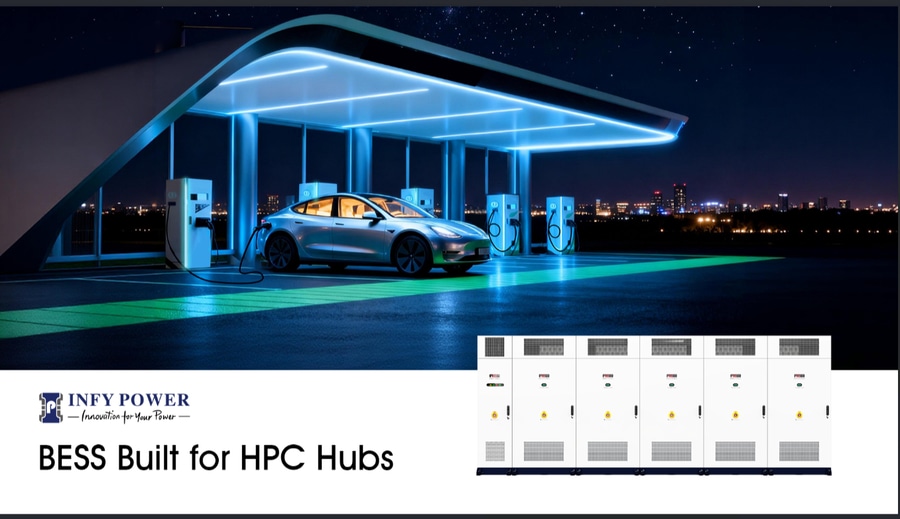
Infypower's ICB218kWh Battery Energy Storage System is especially designed for HPC CPOs seeking to overcome grid limitations as well as to increase clean energy utilization. The all-in-one system is available in 218 kW / 218 kWh (1P) and 120 kW / 241 kWh (0.5P) configurations, enabling CPOs to balance peak demand, buffer charging loads, and avoid costly grid upgrades.
Six-Layer Full-Lifecycle Safety Protection
Safety is embedded in every level of the system:
1. Cell-Level Security: CATL LFP cells (285 Ah) with 8,000+ cycles at 70% SOH
2. Advanced BMS: Real-time safety detection and thermal runaway warnings of the entire battery system, certified to IEC 60730-1 (Annex H) Class B standards
3. UL 9540A-Certified Battery Pack: Equipped with fully submerged aerosol fire-suppression unit.
4. Cabinet-Level Safety: UL 9540A and NFPA 68 certified enclosure with smoke, temperature and humidness detection, multiple combustible gas detection, explosion-proof board, cabinet-level fire suppression unit, explosion vent, emergency fan and reserved fire water access for emergency use.
5. Chain Reaction Prevention: High-temperature-resistant fiberglass sidewalls (~1000 °C) prevent cabinet-to-cabinet fire spread.
6. Eco-safe Design: RoHS, REACH and EU 2023/1542 compliant; IP67 battery pack prevents electrolyte leakage into the environment and containment sump interface is reserved for refrigerant leakage in the event of thermal runaway.
From transport to the end-of-life, every layer of safety ensures asset protection, operational reliability, and environmental compliance.
Full-Stack In-House Design for Seamless Hardware-Software Integration
· In-House Liquid-Cooled Battery Pack: It adopts advanced multi-side large-area liquid cooling (4.5 x conventional bottom-cooling area) and achieves IP67 high protection.
· In-House PCS: Full-SiC PCS design achieves ≥98.7% peak efficiency and ≥98.25% full-load efficiency with 62 W/in³ power density, significantly saving energy consumption and installation space.
· In-House EMS: Exceptional anti-overload and anti-reflux response within 1.5 seconds
· In-House BMS: Real-time safety monitoring and warnings
This unified approach ensures robust performance, reduced maintenance, and effortless site deployment.
Scalable, Flexible, and Renewable-Ready
With building-block modular design, the 218kWh BESS enables straightforward scalability to multi-megawatt configurations through multiple cabinets paralleled side by side or back to back. This facilitates MW-scale HPC hub development even in locations with very limited transformer capacity, eliminating the need for transformer upgrades.
It also supports both on-grid and off-grid operations, ensuring that HPC is accessible in most grid conditions. It can seamlessly integrate PV inputs, enabling CPOs to increase clean energy usage while enhancing grid stability. Through participation in grid service programs such as demand response and frequency response (FCR, aFRR), HPC operators can also monetize flexibility—turning stored energy into new revenue opportunities.
In general, grid bottlenecks should not define the pace and scale of e-mobility. Infypower’s 218 kWh BESS empowers CPOs and fleet operators to deploy fast-charging infrastructure today—not years from now—bridging the gap between grid readiness and EV adoption goals.
By combining deep-rooted power electronics, full-lifecycle safety, and modular flexibility, it transforms battery storage from a supporting asset into a strategic enabler of the next era of massive electrified transport.