
#Product Trends
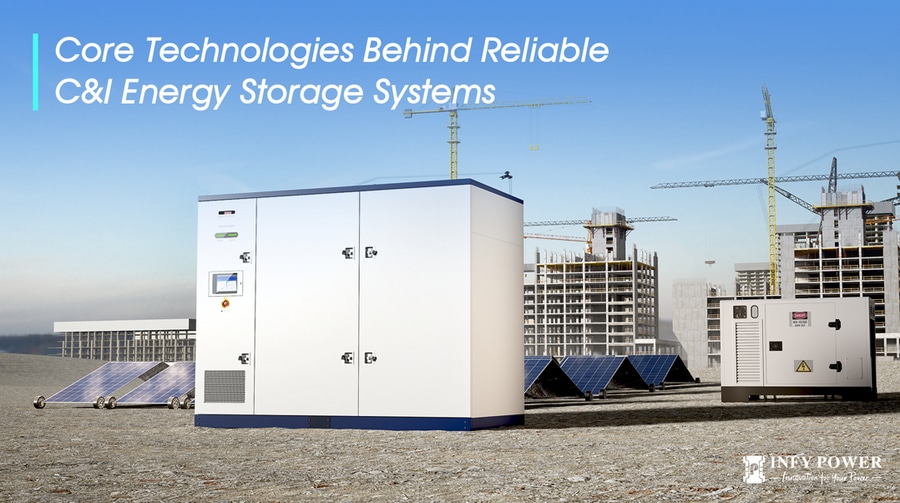
Core Technologies Behind Reliable C&I Energy Storage Systems
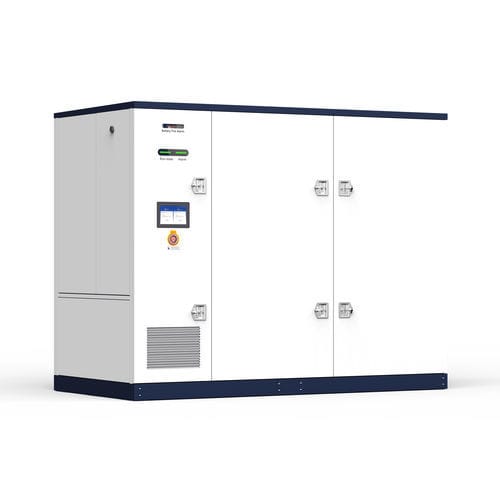
ICB218kWh
To meet the demands of global commercial and industrial energy storage, modern BESS relies on integrated core technologies for high safety, stability and full-scenario adaptability. This article systematically introduces six key technical strengths: high-reliability LFP PACK integration, high-efficiency PCS, intelligent liquid cooling, hierarchical BMS management, local & cloud EMS platform and multi-level fire protection design. Together, these technologies enable stable operation in harsh climates, meet global certification standards, and deliver cost-effective, long-cycle energy storage solutions for global markets.
Core Technology 1: LFP Cell & High-reliability PACK Integration
The battery cell is the core energy carrier of the entire system, determining lifespan, safety boundary, and whole-life O&M cost. Currently, long-cycle lithium iron phosphate (LFP) cells have become the only mainstream choice for global C&I storage, abandoning lead-acid and other low-performance batteries completely.
Global promotion core advantages
Excellent thermal stability, extremely low thermal runaway risk, fully adapting to high-temperature climates in Europe, Southeast Asia, the Middle East, and Australia. Long cycle life over 6,000+ times~8,000+ times, supporting high-frequency daily charge and discharge for industrial continuous operation. Wide temperature working range, strong resistance to external harsh weather interference.
Key highlight: High-standard PACK integration process technology
Core principle: High-quality battery cells alone cannot guarantee reliable energy storage performance. The PACK integration process directly determines on-site operational safety and long-term battery decay rate.
Full consistency cell screening: Strictly sort and match all cells according to voltage, internal resistance and actual capacity, effectively eliminating the battery cluster “bucket effect” and ensuring balanced overall performance.
Uniform temperature and current layout design: Adopt optimized internal wiring and structural layout to achieve balanced temperature distribution and consistent current flow, preventing local current accumulation and abnormal overheating risks.
Enhanced environmental and mechanical protection structure: Equipped with upgraded insulation, shockproof, dustproof and waterproof design, fully adaptable to outdoor factory installation, mechanical vibration from on-site vehicles, and rainy, humid coastal working conditions.
Global standard compliance certification: The entire PACK production and assembly process fully complies with UL, IEC, TUV and other international mainstream safety standards, meeting local grid connection requirements and factory site acceptance specifications worldwide.
INFYPOWER Battery Pack
Core Technology 2: High-efficiency PCS
PCS (Power Conversion System) is the energy bridge between battery clusters, factory loads, and public grids, and is the core equipment that determines system efficiency and grid compatibility.
INFYPOWER technical configuration
The BEG1K0110G is a bidirectional ACDC power module designed for C&I BESS, second-life battery, and microgrid applications. It supports both on-grid and off-grid operation, with up to 16 units in parallel on-grid or 8 units off-grid, enabling flexible capacity expansion from small charging stations to large-scale systems. Conformal coating and glue filling provide reliable protection against moisture, salt fog, and dust, making it ideal for harsh outdoor environments. It maintains stable full-power operation under extreme high temperatures. Its operating temperature spans from -40°C to +70°C, extending the full-service cycle and greatly reducing on-site maintenance workload.
Practical core functions
High AC-DC conversion efficiency reduces internal power consumption effectively and boosts actual power generation benefits. It features built-in multi-region grid compliance, fully meeting voltage and frequency standards for Europe, Southeast Asia, the Middle East, Latin America and other regions. Equipped with robust low-voltage ride-through and anti-interference performance, it prevents unstable grid fluctuations from causing accidental system off-grid.
INFYPOWER PCS MODULE
Core Technology 3: Intelligent Liquid Cooling Thermal Management System
Temperature control is the key pain point of energy storage operation. High temperature accelerates battery aging, while low temperature reduces discharge capacity. Traditional air cooling has high energy consumption, poor heat dissipation uniformity, and is easy to accumulate dust, which is not suitable for long-term outdoor operation.
Mainstream high-end solution: liquid cooling technology for battery + PCS
Closed-loop liquid cooling pipelines precisely regulate the temperature of each cell, maintaining cell temperature differences within a safe and efficient range. Adopting multi-dimensional large-area liquid cooling technology, the cell temperature difference is controlled within 3°C. In high-temperature conditions, the system enables automatic heat dissipation to sustain full power operation without performance degradation. Compared with air cooling solutions, liquid cooling drastically cuts system energy consumption, extends battery service life by over 20%, and mitigates dust accumulation as well as wind and rain erosion on-site. The liquid-cooled battery pack features IP67 protection, fully suited for industrial use in desert, coastal and tropical environments.
Core Technology 4: Full-dimensional BMS Battery Management Algorithm
In the all-in-one industrial and commercial energy storage system, the hierarchical distributed BMS serves as the core foundation to ensure safe, efficient and long-life operation of batteries. Its layered control design simplifies operation and maintenance, and enhances overall system stability. This article elaborates on the standard three-tier BMS architecture for on-site engineering applications.
Level 1: Cell Supervisory Unit (CSU)|Cell Layer Control
Positioning: The bottom-layer hardware of the entire BMS, directly connected to battery cells and modules, acting as the sensory nerve of the energy storage system.
Core Functions
High-frequency real-time sampling of cell voltage and module temperature to capture subtle operating changes;
Perform active and passive cell balancing to eliminate voltage inconsistency and reduce capacity degradation;
24/7 real-time monitoring of overvoltage, undervoltage, and overheating; upload early fault alarms to the upper controller;
Collect low-voltage signals and provide reliable high-voltage isolation to ensure basic electrical safety.
Level 2: Battery Slave Unit (BSU)|Pack Layer Control
Positioning: The core data hub of a single battery pack, responsible for coordinating all internal CSU units and bridging bottom data and upper commands.
Core Functions
Aggregate all cell voltage and temperature data, accurately calculate pack-level SOC and SOH;
Control high-voltage contactors and fuses to manage pack power-on, power-off, and real-time fault isolation;
Monitor pack current and insulation resistance to prevent leakage risks and short-circuit hazards;
Execute protective actions immediately once receiving fault commands and ensure safety at the individual pack level.
Level 3: Battery Management Unit (BMU)|Cluster Layer Control
Positioning: The middle-layer core controller of the energy storage system, managing the entire battery cluster and coordinating all connected packs.
Core Functions
Collect operating data from all BSUs in the cluster and unifiedly manage cluster-wide real-time status;
Manage cluster high-voltage loops and high-voltage breaking devices to support safe cluster switching and connection;
Dynamically distribute charging and discharging power to balance the load of each battery pack and avoid local overheating and overload;
Respond to top-level scheduling orders and perform cluster-level protection against overload, short circuit, and thermal runaway risks.
INFYPOWER BMU UNIT
Core Technology 5: Local EMS + Cloud EMS Intelligent Energy Management Platform
BESS stations often lack professional energy storage operation and maintenance personnel. The intelligent EMS system enables one-stop automatic operation and global remote management, effectively reducing overseas labor costs. Local EMS ensures on-site real-time control and safety protection, while cloud EMS provides remote monitoring, data analysis and strategy optimization. Their coordinated operation delivers rapid on-site response and efficient cloud management.
Local EMS (Local Energy Management System)
The Local EMS is installed inside the energy storage cabinet. It manages the battery, PCS, and EV chargers in real time. It controls when to charge and discharge based on battery status, load demand, and grid conditions. Even without an internet connection, it can independently run safety protections like anti-overload and anti-fault. It also performs peak shaving, dynamic capacity expansion, and off-grid backup. The Local EMS sends all operating data to the Cloud EMS via 4G and receives optimized strategies from the cloud. This design ensures fast response (milliseconds), high reliability, and remote management capability — all without losing local control.
Cloud EMS (Cloud Energy Management Platform)
The Cloud EMS is a smart online platform for managing energy storage and EV charging sites. It supports millions of devices at the same time. The platform integrates equipment management, site management, energy management, and operations management into one system. It analyzes battery capacity, time-of-use electricity prices, and load demand to automatically optimize charge and discharge strategies — maximizing revenue. Key features include real-time monitoring, big data reporting (daily/monthly/yearly), and intelligent dispatch. The platform also supports multiple operators with separate, secure accounts. CPOs can perform remote maintenance, adjust strategies, and review earnings — all without going to site.
Core Technology 6: Fire Extinguisher System Design
This energy storage system is equipped with a complete five-level hierarchical fire protection solution, fully adapted to the operational safety requirements of liquid-cooled energy storage power stations. The whole system adopts real-time monitoring, early warning, active intervention, rapid fire suppression and physical isolation linkage logic. It cooperates with BMS, multiple detectors and diversified firefighting equipment to comprehensively prevent battery thermal runaway and fire spread, ensuring full-cycle safety of on-site energy storage equipment and personnel.
Level 1: Cell-level Safety Protection
Adopt high-performance CATL LFP energy storage cells with specifications of 3.2V 285Ah and a long cycle life of 8000 cycles @70% SOH. Equipped with high-frequency data acquisition modules to real-time monitor single cell voltage and multi-point module temperatures, accurately capturing minor operating fluctuations of cells. All-round active and passive equalization management is adopted to balance cell voltage difference steadily and guarantee basic cell operating safety.
Level 2: BMS Active Fire Prevention & Control
Relying on the professional BMS fire protection control unit, the system continuously collects core parameters including cell temperature, voltage and internal resistance to accurately identify early thermal runaway signs. It executes active intervention measures such as current limiting, charge-discharge prohibition and circuit disconnection to suppress potential risks at the source. Meanwhile, all alarm signals are synchronously uploaded to EMS and cloud platform to realize full-link early warning and source safety prevention.
Level 3: PACK-level Integrated Fire Protection
Dedicated high-sensitivity gas detectors are built inside each battery pack to real-time detect internal combustible gas and smoke concentration. Matching perfluorohexanone directional fire suppression devices will precisely spray extinguishing agent once secondary fire alarm is triggered. Cooperated with PACK pressure relief valves, it rapidly discharges high-pressure and high-temperature gas to curb fire spread inside a single PACK. The whole PACK system has passed authoritative UL 9540A thermal runaway propagation certification.
Level 4: Cabinet-level Active Fire Suppression & On-site Emergency Protection
The cabinet is fully equipped with smoke and combustible gas detectors. Once gas concentration exceeds the safety threshold, the exhaust valve automatically opens for ventilation and pressure relief to eliminate explosion hazards. Audible and visual alarms are linked to remind on-site staff of rapid evacuation, and external emergency stop switches support one-click power cut-off for emergency shutdown. Dual fire extinguishing configuration is adopted: aerosol devices release fire extinguishing medium within 14 seconds to put out initial fires instantly; integrated water-based fire pipelines and standard interfaces can connect to external fire water sources for continuous cooling and fire containment to prevent large-scale fire escalation.
Level 5: High-temperature Resistant Physical Isolation Barrier
The interior of the energy storage cabinet is filled with high-efficiency flame-retardant and heat-insulating materials, which can withstand extreme high temperature up to 1000℃ to form a solid closed physical safety barrier. If the front multi-stage fire prevention and suppression measures fail, this layer can completely confine flames and high heat inside the faulty single cabinet, block cross-cabinet heat conduction and flame diffusion, and effectively prevent cascading thermal runaway and large-scale safety accidents of the whole station.
From cell-level monitoring to system-level protection, every core technology jointly builds a comprehensive safety and efficiency system for BESS. Optimized thermal management, intelligent energy scheduling and layered fire suppression greatly reduce operation risks and life-cycle costs. Fully compliant with global industrial standards, the solution adapts to high-temperature, coastal and desert environments. Continuous technological iteration will further boost the value of distributed energy storage, supporting global enterprises in achieving low-carbon transformation and flexible energy management.