
#Product Trends
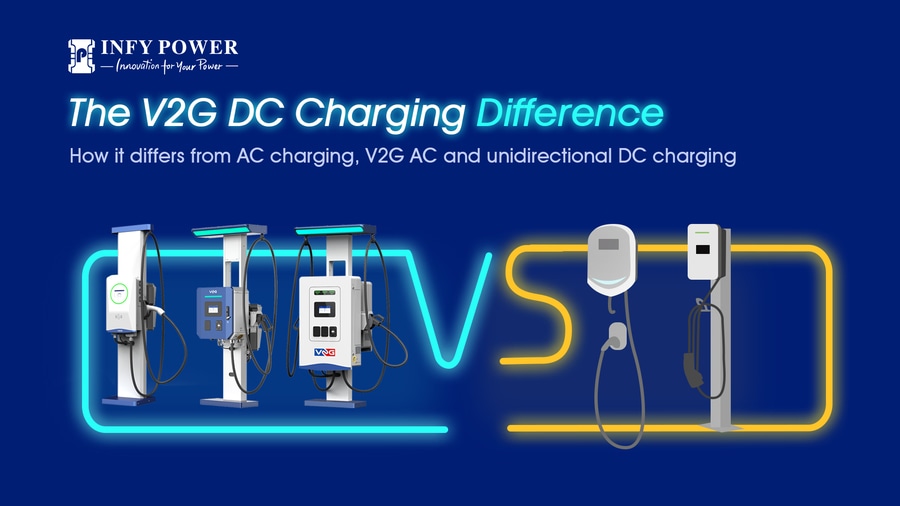
The V2G DC Charging Difference
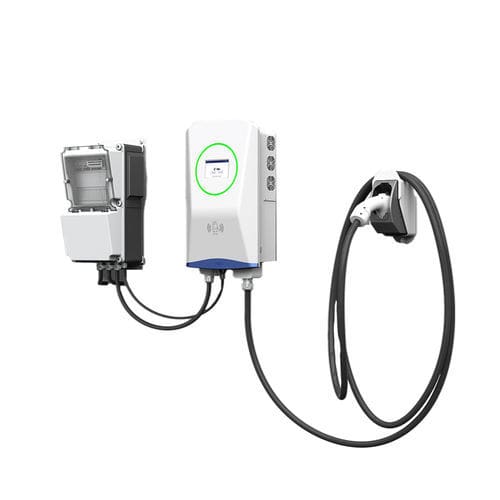
EXP07K1E
The evolution of charging interfaces and protocols has been a key driver in advancing EV charging technology. Standardized interfaces such as CCS (Combined Charging System) and NACS (North American Charging Standard) have unlocked DC fast high-power charging (HPC) and greater global interoperability. Meanwhile, communication protocols like ISO 15118 (“Plug & Charge”) and OCPP 1.6J have transformed the user experience by enabling seamless authentication, payment, and network integration. Emerging technologies like Vehicle-to-Grid (V2G) bidirectional charging and ISO 15118-20, are reshaping the EV ecosystem and redefining how EVs interact with energy systems and the grid.
This article explores the key differences among charging methods and the distinct advantages of Infypower V2G DC charging.
1. AC Charging: The Slow Lane
AC charging—whether Level 1 or Level 2—relies on the EV’s onboard charger (OBC) to convert AC power from the grid into DC for the battery.
▪️Process: Grid AC → EV OBC → Battery DC
▪️Connector: Type 1 (SAE J1772) in North America, Type 2 in Europe
▪️Power: 7kW/11kW/22kW
▪️Speed: Full charge in 8+ hours
▪️Application: As power is capped by the OBC, it’s best suited for overnight residential or daily workplace charging.
2. Unidirectional DC Charging: From Fast to Ultra-Fast, Yet One-Way
DC fast charging bypasses the OBC, delivering DC power directly to the battery.
▪️Process: Grid AC → External DC Charger → Battery DC
▪️Connector: CCS1, NACS, CCS2, MCS, CHAdeMO, GB/T
▪️Power: Typically from 30 kW to hundreds of kW and up to MW
▪️Speed: 30–60 minutes for ~80% charge of most EVs
▪️Application: Widely deployed at public charging hubs, destination locations and along highways.
▪️Limitations: Despite its speed, it remains unidirectional—energy flows only from grid to vehicle, with no capability to discharge back to the grid or provide backup power in emergencies
3. V2G AC Charging: Bidirectional, but Limited by the Vehicle
V2G AC enables bidirectional energy flow, but depends entirely on the EV’s bidirectional OBC.
▪️Charging: Grid AC → Vehicle Bidirectional OBC → Battery DC
▪️Discharging: Battery DC → Vehicle Bidirectional OBC → Grid AC (home loads)
▪️Connector: Type 1 (SAE J1772) in North America, Type 2 in Europe
▪️Flexibility: Enables energy to be exported back to the grid or used to power homes.
▪️Limitations:
1> Capped by OBC capacity (typically 7–11 kW; up to 22 kW in rare cases)
2> Primarily suited for residential use
3> Requires EVs with bidirectional OBC capability
4> Relies solely on bidirectional OBC to realize charge/discharge
4. Our Solution: V2G DC Charging—Scalable & Flexible
V2G DC charging shifts conversion and intelligence from the vehicle to the bidirectional DC charging station. Internal bidirectional charger modules handle both EV charging and discharging directly, bypassing the OBC.
▪️Charging: Grid AC → Charger’s Built-in Converter → Battery DC
▪️Discharging: Battery DC → Charger’s Built-in Converter → Grid AC (or home/business/load)
▪️Connector: CCS1, NACS, CCS2, CHAdeMO, GB/T
▪️Applications: Residential, commercial, fleet, and grid services
▪️Key Advantages:
1> Scalable Power: Modular design allows power expansion from a few kilowatts to hundreds, ideal for both passenger cars and commercial fleets. This is crucial for commercial vehicles and fleet operations.
2> Vehicle Agnostic: Does not rely on OBC; works with ISO 15118-20–compliant vehicles.
3> Reliable: Power conversion happens outside the EV, ensuring greater durability and stability.
At Infypower, our V2G DC portfolio spans from single-phase 7 kW residential solutions to 132 kW three-phase commercial systems, supporting CCS1, CCS2, and CHAdeMO standards. Higher power can be scaled flexibly. These solutions cover both on-grid and off-grid V2G and V2H applications, with flexible charge/discharge scheduling available locally or via any third-party backend. Ultra safety is built in through features such as anti-reflux protection, which prevents unintended power discharge to the grid.
Unlocking New Value Streams
With bidirectional functionality, V2G DC charging transforms EVs into dynamic energy assets that deliver:
✔️ Grid Stability: Rapid frequency regulation and peak shaving support.
✔️ Economic Benefits: Enable fleet operators and EV owners to sell energy back during peak demand.
✔️ Energy Resilience: Provide backup power for homes, businesses, or critical infrastructure during outages.
✔️ Emergency Readiness: Supply reliable power during disasters or events.
The Future is Bidirectional
EVs are no longer just vehicles—they are mobile batteries capable of reshaping the energy landscape. V2G DC charging unlocks speed, flexibility, and scalability—empowering individuals, fleets, and utilities alike.
At Infypower, we deliver advanced V2G DC solutions that turn EVs into more than transportation—they become a cornerstone of a cleaner, smarter, and more resilient grid.
Ready to explore how our V2G DC charging can drive your business and power our future? Let’s shape the future of energy together.