
#Product Trends
Redefining HPC Hubs through Distributed Scalability
EXP600K3
As electric buses, trucks, and commercial fleets take the lead in global electrification, EV infrastructure is evolving to deliver higher power, support heavier operational loads, and adapt to a wider range of deployment scenarios. Traditional all-in-one systems struggle to balance scalability, space efficiency, and multi-vehicle load management — challenges that define today’s high-power charging (HPC) transition.
Infypower’s split-type HPC solution is purpose-built for this new era of e-mobility. By combining a modular power matrix with a distributed system architecture, it redefines power delivery at charging hubs — making them more efficient and more adaptable than ever.
Scalable & Flexible Power Architecture
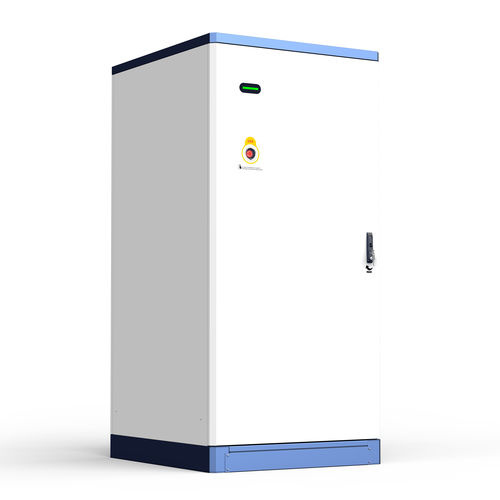
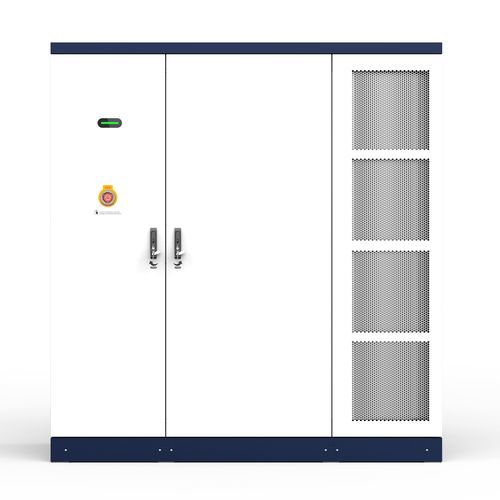
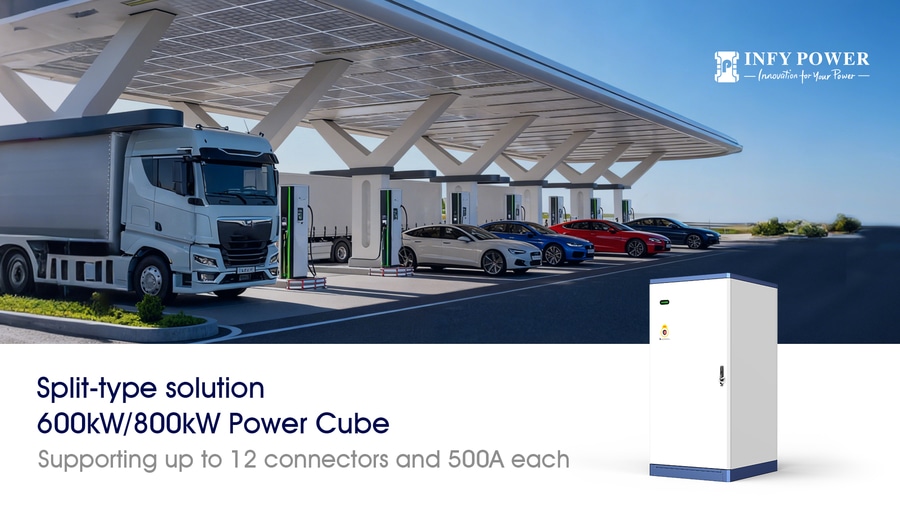
At its core lies our high-performance Power Cube, available in both IP65 liquid-cooled and IP54 air-cooled configurations. Each cabinet provides up to 600 kW or 800 kW output, incorporating a maximum of twenty in-house developed charger modules in parallel:
• Liquid-cooled 30 kW charger module
• Air-cooled 30/40 kW charger module
• Air-cooled 40 kW VPF module
This modular setup enables seamless scalability and flexible power— from hundreds of kilowatts to several megawatts for diverse deployments, such as private fleet depots, large bus terminals and public highway corridors. With 60 or 80 kW power granularity, this system allows dynamic load management and flexible power distribution among all connectors adapting to different use cases. This aims to optimize energy utilization and minimize CAPEX by allowing more vehicles to charge simultaneously with less installed power.
Distributed System for Maximum Flexibility
The system adopts a distributed architecture, separating the Power Cabinet from Charging Dispensers. This design saves space, enhances layout flexibility, and simplifies maintenance.
Each power cabinet features up to 12 DC output channels and can power up to 12 connectors, enabling simultaneous charging for the same number of EVs. In addition, the terminals come in multiple versions and can be customized for different applications:
IP55 liquid-cooled floor-standing dispenser, supporting maximum CCS2 500A and GB/T 600A liquid-cooled ultra-fast charging.
IP55 air-cooled floor-standing dispenser ensuring zero noise and reliable operation.
IP65 overhead dispenser ideal for bus depots and heavy-duty charging stations where space is limited.
Seamless User Experience
Every floor-standing dispenser integrates a front-facing interface with a 7-inch LCD touchscreen and intuitive navigation, as well as optional cable management and light bar configurations, ensuring accessibility, convenience, and clear user guidance at any time of day. Throughout the charging period, the dispenser remains quiet — up to 55 dB for floor-standing type and virtually silent for overhead type— while constantly delivering ultra-fast charging.
High-Power Charging for All Scenarios
Supporting global standards, the split-type HPC system delivers up to 600A 1000V output via liquid-cooled cables, enabling fast and reliable charging for electric trucks, buses, and passenger vehicles alike.
Boasting ultimate flexibility and scalability, this system fits a wide variety of use cases:
• En-route charging – Power long-distance journeys with high-speed charging along highways, keeping logistics fleets and intercity transport on schedule.
• Fleet charging – Serve multi-vehicle depots from delivery vans and long-haul trucks to school buses and city buses, all managed under one intelligent power system.
• Destination charging – Offer efficient charging at commercial destinations such as shopping centers, service areas and workplaces, turning every stop into a convenient recharge.
Redefining HPC Infrastructure for the Future
By combining modular power cabinets, distributed architecture, dynamic energy management and flexible terminals, Infypower’s split-type HPC solution sets a new benchmark for scalable and flexible e-mobility infrastructure.
It’s not just about high-speed charging — it’s about building future-ready charging hubs that adapt to evolving technologies, user demands, and grid conditions, accelerating global journey toward zero-emission transport.