
#Product Trends
Why 6mA DC Detection Matters in EV Charging: IVY MD0630T01A-Z RCMU for Safer, More Compact EVSE
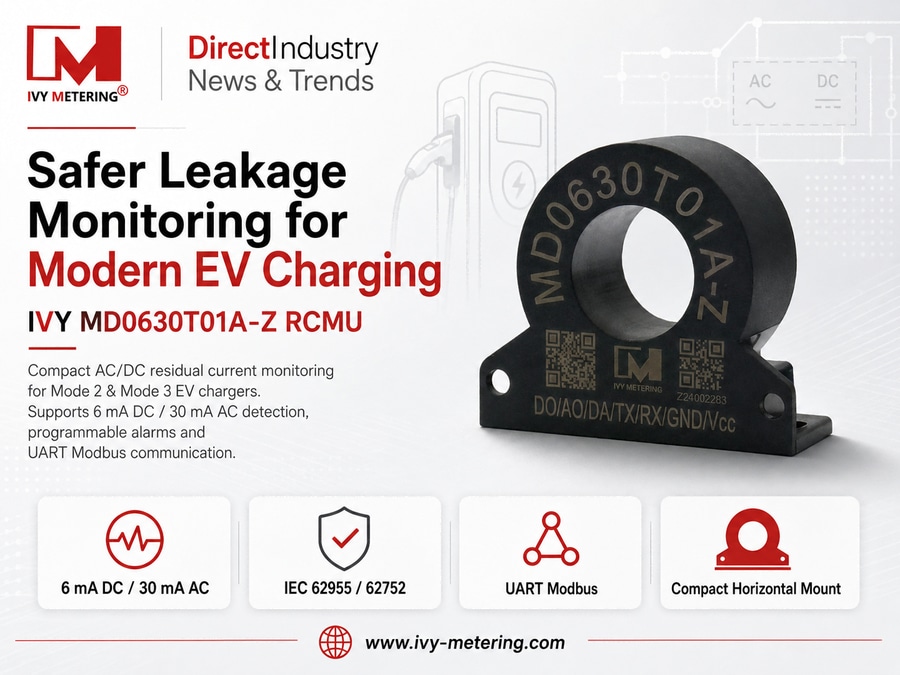
A compact AC/DC residual current monitoring unit designed for Mode 2 and Mode 3 EV charging, with 6mA DC / 30mA AC detection, programmable alarms and UART Modbus communication.
As EV charging infrastructure expands across homes, workplaces and public networks, electrical safety is becoming a design issue that charger manufacturers must address at component level. Policy initiatives such as Europe’s AFIR are accelerating charger deployment, while IEC standards define the protection architecture needed inside charging equipment. This makes residual current monitoring an increasingly important part of modern EVSE design.
One of the key challenges is smooth DC residual current. In an AC charging system, DC fault current can affect the operation of upstream residual-current protection. IEC 62955 specifically covers residual direct current detecting devices (RDC-DDs) for permanently connected Mode 3 EV charging, while IEC 62752 covers in-cable control and protection devices for Mode 2 charging. For charger designers, reliable AC/DC leakage detection is therefore not simply an added feature—it is part of building a standards-oriented safety chain.
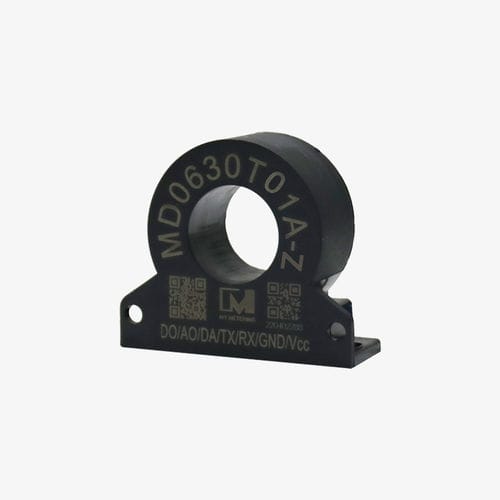
IVY METERING’s MD0630T01A-Z is a compact Residual Current Monitoring Unit (RCMU) developed for EV charging applications. It monitors both AC and DC residual current, with typical protection thresholds of 30mA AC and 6mA DC. The sensor supports readable leakage-current data, programmable alarm values and multiple alarm outputs, helping the charger controller identify abnormal current conditions quickly.
Designed for compact EVSE hardware, the MD0630T01A-Z uses a horizontal pin-mount structure and integrates self-monitoring and test functions. UART communication with Modbus protocol allows leakage information to be incorporated into the charger’s control logic, diagnostics and maintenance system. IVY lists certification to IEC 62955 / IEC 62752 / IEC 61851-1 requirements, together with CE-EMC and other market certifications for the series.
For system integrators, the value of an RCMU is also architectural. Instead of treating leakage protection as a large standalone component, the monitoring sensor can work together with the EVSE controller and a relay, contactor or other disconnection device. The RCMU itself is the sensing and monitoring element; final disconnection is performed by the charger’s protection system. This approach can support more compact wallbox and charging-module designs while giving engineers greater flexibility in the overall protection layout.
The same AC/DC residual-current monitoring principle can also be applied in other power-electronics environments such as photovoltaic inverters, UPS systems and industrial equipment where insulation faults and DC leakage need to be detected early.
As EV charging products become smaller, smarter and more integrated, safety components must evolve in the same direction. With compact installation, AC/DC residual-current detection, programmable alarms and digital communication, the IVY MD0630T01A-Z provides EV charger manufacturers with a practical building block for safer and more connected charging equipment.