
#Industry News
Ultra High Purity Gas Delivery System: Design Principles, Components, and Industrial Applications
Ultra High Purity Gas Delivery System: Design Principles, Components, and Industrial Applications
Ultra High Purity Gas Delivery System: Design Principles, Components, and Industrial Applications
Ultra high purity gas delivery systems represent a critical enabling technology in industries where even trace-level contaminants can compromise product quality, process yield, or safety. An ultra high purity gas delivery system is engineered to transport specialty and process gases from source containers to points of use while maintaining purity levels typically in the range of 99.999% (5N) to 99.9999% (6N) or higher, with impurity concentrations controlled at parts-per-billion or parts-per-trillion levels. These systems are indispensable in semiconductor manufacturing, advanced materials synthesis, pharmaceutical production, and analytical instrumentation.
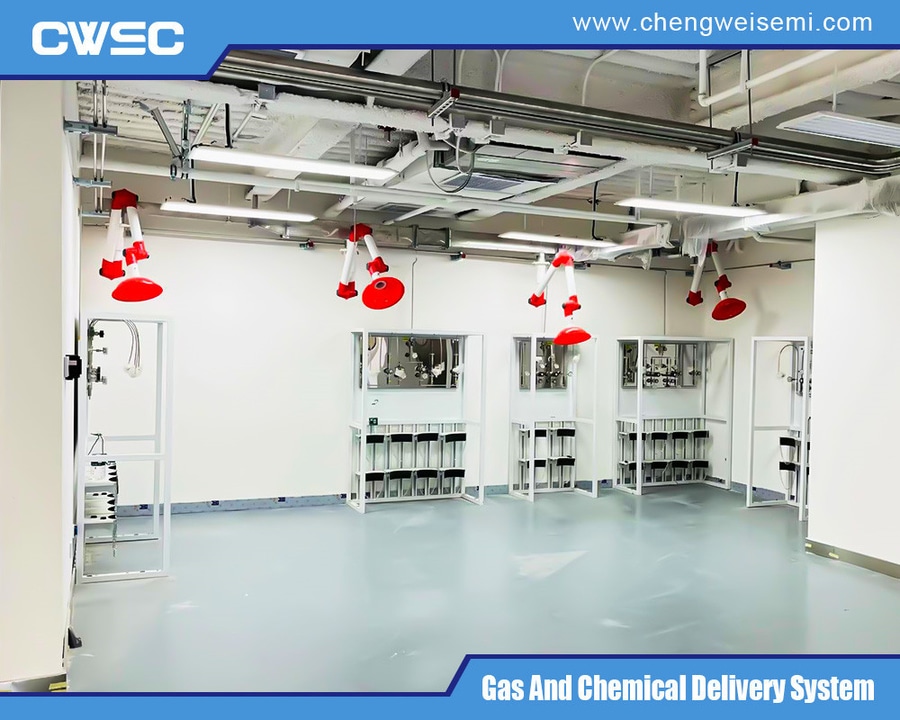
ultra high purity gas delivery system
ultra high purity gas delivery system
Fundamentals of Ultra High Purity Requirements
Gases such as nitrogen, argon, helium, hydrogen, oxygen, and various reactive specialty gases are routinely required at ultra high purity. In semiconductor fabrication, residual moisture, oxygen, hydrocarbons, or metallic particles at concentrations above a few parts per billion can introduce defects in epitaxial layers, gate oxides, or interconnects. Consequently, the ultra high purity gas delivery system must prevent contamination from the cylinder or bulk source through every segment of the distribution network.
Purity is maintained through a combination of material selection, surface preparation, component design, and continuous monitoring. The system architecture typically begins at the gas source—high-pressure cylinders, tube trailers, or bulk liquid tanks—and ends at the process tool or laboratory instrument. Between these points lie pressure regulators, purifiers, filters, valves, tubing, fittings, and exhaust or vent systems, all designed and assembled under controlled conditions.
Core Components of an Ultra High Purity Gas Delivery System
A complete ultra high purity gas delivery system consists of several interdependent subsystems.
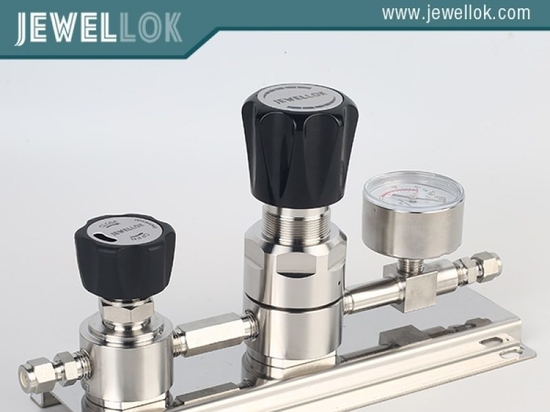
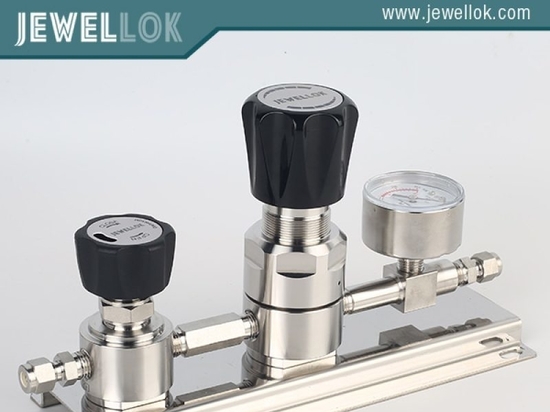
Source and Primary Regulation. Specialty gas cylinders are fitted with high-integrity valves, often diaphragm or bellows-sealed designs, to minimize internal volume and eliminate elastomeric seals that can outgas. Primary regulators reduce cylinder pressure while preserving purity; they employ electropolished stainless-steel bodies, metal-to-metal seals, and minimal wetted surface area. For bulk systems, vaporization and primary purification stages may be integrated at the source.
Purification and Filtration. Inline gas purifiers remove residual impurities such as moisture, oxygen, hydrocarbons, and carbon dioxide. Getter-based, catalytic, or adsorption purifiers are selected according to the gas chemistry. Particle filters rated at 0.003 µm or finer capture aerosols and metallic particles generated by valves or regulators. These components are typically constructed from 316L stainless steel or advanced alloys with internal surfaces finished to less than 10 µin Ra (roughness average) and electropolished to reduce adsorption sites.
Distribution Network. The backbone of the ultra high purity gas delivery system is the tubing and fitting network. Seamless 316L or 316L VIM/VAR stainless-steel tubing with electropolished internal surfaces is the industry standard. Orbital welding or metal-gasket face-seal fittings (VCR-style) create leak-tight, low-particulate joints. Dead-leg volumes are minimized through careful layout to prevent stagnation and subsequent contamination. For highly reactive gases, specialized materials such as Hastelloy or coated tubing may be employed.
Secondary Regulation and Point-of-Use Delivery. At the point of use, secondary regulators, mass-flow controllers, and isolation valves provide precise pressure and flow control. These devices must exhibit low leak rates (typically <1×10⁻⁹ atm·cc/s helium), minimal particle generation, and resistance to corrosion. Automatic switchover manifolds ensure continuous supply when multiple cylinders are used, incorporating purge sequences that prevent ambient air intrusion.
Monitoring and Control. Continuous purity monitoring is achieved through residual gas analyzers, moisture sensors, oxygen analyzers, and particle counters integrated into the ultra high purity gas delivery system. Pressure transducers, temperature sensors, and flow meters feed data to supervisory control systems that trigger alarms or automatic shutdowns when parameters deviate from set points. Purge and vent systems, often using nitrogen or argon, maintain positive pressure or facilitate safe evacuation of process lines.
Design and Fabrication Considerations
Successful implementation of an ultra high purity gas delivery system demands rigorous attention to materials science, fluid dynamics, and clean manufacturing practices. Surface roughness directly influences adsorption and desorption of impurities; electropolishing followed by passivation creates a chromium-rich oxide layer that reduces reactivity. All components are cleaned, dried, and packaged under cleanroom conditions, often certified to ISO Class 5 or better.
Helium leak testing to rates below 1×10⁻⁹ atm·cc/s is standard for both individual components and completed assemblies. Particle counting under flowing gas conditions verifies cleanliness. Material compatibility must be evaluated for each gas: hydrogen requires attention to embrittlement, while corrosive gases such as hydrogen chloride or ammonia necessitate specialized alloys or coatings.
System layout prioritizes short, continuous runs with gradual bends to minimize pressure drop and turbulence that could generate particles. Thermal management prevents condensation in lines carrying gases with high dew points or cryogenic sources. Safety interlocks, excess-flow valves, and toxic-gas monitoring are integrated where hazardous gases are handled, ensuring that purity objectives do not compromise personnel or facility safety.
Applications Across Industries
In semiconductor manufacturing, ultra high purity gas delivery systems supply process gases for chemical vapor deposition, etching, ion implantation, and annealing. Yield improvements of several percentage points have been attributed to reductions in gas-borne contaminants. In the pharmaceutical and biotechnology sectors, these systems deliver nitrogen and oxygen for inerting, sparging, and bioreactor control, where microbial or chemical purity is paramount. Analytical laboratories rely on ultra high purity carrier and detector gases for gas chromatography and mass spectrometry to achieve low detection limits. Emerging applications in additive manufacturing, quantum computing research, and fuel-cell production further expand the demand for reliable ultra high purity gas delivery systems.
Operational Best Practices and Maintenance
Long-term performance of an ultra high purity gas delivery system depends on disciplined operational procedures. Cylinder change-outs follow strict purge protocols using purified inert gas to eliminate air ingress. Periodic certification of purity at multiple points in the network detects degradation of purifiers or filters. Component replacement schedules are based on cumulative gas volume processed rather than calendar time alone. Documentation of material certificates, weld maps, and leak-test records supports quality audits and process troubleshooting.
Challenges and Continuous Improvement
Despite mature technology, challenges remain. Particle generation from mechanical wear of valves and regulators, permeation through polymer seals (where still used), and cross-contamination during gas switching require ongoing engineering attention. Cost pressures drive efforts to reduce footprint and energy consumption while maintaining performance. Advances in sensor technology enable real-time impurity detection at lower concentrations, allowing predictive maintenance rather than reactive replacement.
Materials research continues to explore new alloys, surface treatments, and additive-manufactured components that further reduce internal surface area and improve weldability. Integration with facility management systems and digital twins supports optimization of flow rates, pressure stability, and purity across large multi-tool installations.
ultra high purity gas delivery system
ultra high purity gas delivery system
Conclusion
An ultra high purity gas delivery system is far more than a collection of pipes and valves; it is a carefully engineered continuum designed to preserve the integrity of gases from source to process. Through selection of appropriate materials, precision fabrication, rigorous cleaning, and continuous monitoring, these systems achieve the purity levels demanded by modern high-technology manufacturing. As device geometries shrink, analytical sensitivities increase, and new applications emerge, the performance requirements placed on ultra high purity gas delivery systems will continue to rise. Engineers and facility designers who master the principles outlined here will be positioned to deliver reliable, contamination-free gas supplies that underpin product quality and process capability for years to come.
For more about ultra high purity gas delivery system, you can pay a visit to Chengwei Semiconductor at https://www.chengweisemi.com/product/ for more info.