
#Industry News
The Real-World Role of Mohs Scale in Sandblasting Applications
Explore how understanding Mohs hardness can improve blasting performance, protect materials, and help you choose the right abrasive for every surface treatment challenge.
In the surface treatment and abrasive blasting industry, performance is often determined by microscopic interactions — between media and material, between surface and structure. Among the many factors that dictate the outcome of a sandblasting process, hardness is one of the most critical. But what does “hardness” actually mean in practical terms? And how does the Mohs scale — originally developed in 1812 for minerals — translate to modern-day industrial blasting applications?
Understanding the Mohs scale is not just academic; it's essential for choosing the right abrasive media, protecting the integrity of substrates, and optimizing both cost and surface results.
What Is the Mohs Hardness Scale?
The Mohs scale is a qualitative scale ranking materials based on their scratch resistance. It ranges from 1 (talc) to 10 (diamond), with each step representing a mineral’s ability to visibly scratch those beneath it. In sandblasting, this translates to the ability of one material (abrasive) to alter the surface of another (substrate) — either by cutting, etching, or cleaning.
While the scale is simple, its implications are powerful. The relative hardness between media and target material determines not just effectiveness, but also surface quality, material loss, media consumption, and even safety.
Why Mohs Hardness Matters in Abrasive Media Selection
In sandblasting, harder isn’t always better. Choosing an abrasive with a Mohs hardness significantly higher than the workpiece can lead to excessive wear, deep surface roughness, or even structural damage. Conversely, a media that is too soft may fail to clean or profile the surface adequately.
Here’s where Mohs hardness becomes a guiding principle:
* For cleaning soft metals like aluminum or copper, abrasives in the 5–6 range are typically preferred.
* For removing rust or coatings from harder steel surfaces, abrasives with a hardness around 6–8 are more suitable.
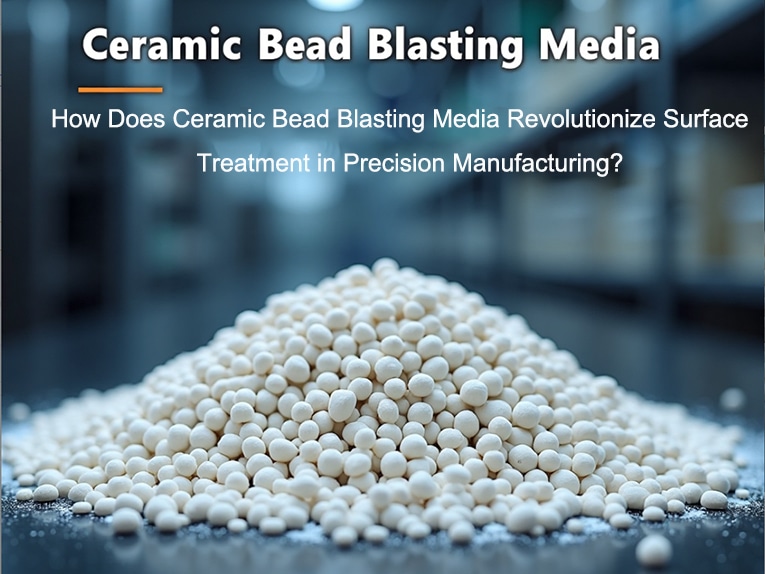
* For precision surface finishing or delicate substrates, abrasives like ceramic beads with moderate hardness offer balance — enough to clean without damaging.
Abrasive Media and Their Typical Mohs Ratings
Common blasting materials include:
Glass beads – ~6 Mohs
Aluminum oxide – ~9 Mohs
Steel grit – ~7 Mohs
Ceramic beads – ~6.5–7 Mohs
Silicon carbide – ~9–9.5 Mohs
Plastic media – ~3–4 Mohs
This variety enables users to match the right hardness level to their application, whether it’s aggressive removal or delicate finishing.
Surface Integrity, Reusability, and Mohs Hardness
The internal structure and hardness of the blasting media also influence recyclability and performance consistency. Harder media, such as aluminum oxide or silicon carbide, tend to fracture and degrade faster during use. This produces more dust, leads to inconsistent blasting patterns, and increases operational costs.
Medium-hardness abrasives like ceramic beads offer a sweet spot: sufficient hardness to perform effectively on metals and composite surfaces, yet durable enough to be recycled dozens of times without significant fragmentation. Their Mohs hardness ensures consistent energy transfer while maintaining substrate integrity.
Balancing Performance and Surface Outcome
The goal of blasting isn’t just to remove contaminants or coatings — it’s also to prepare a surface with the correct roughness profile for downstream processes like painting, bonding, or coating. Here again, Mohs hardness plays a decisive role.
Too hard a media may create an overly rough surface, leading to coating failures or increased material consumption. Too soft a media may leave the surface inadequately prepared, risking poor adhesion.
By selecting an abrasive with a Mohs hardness closely aligned to the substrate, technicians can ensure optimal adhesion, minimal surface distortion, and greater process repeatability.
The Future of Precision Blasting and Material Science
As industries like aerospace, automotive, medical device manufacturing, and additive manufacturing evolve, so too does the need for precision in every step of material processing. Mohs hardness is becoming more than a reference — it’s a design parameter for choosing the right media for targeted results.
Modern blasting operations increasingly rely on media with engineered hardness, consistent structure, and traceable performance data. This shift empowers users to treat surfaces scientifically, not just mechanically.
Conclusion: More Than Just a Number
Mohs hardness is more than a historical scale or a scratch test — it is a practical, real-world indicator of how materials interact under pressure, abrasion, and impact. For blasting professionals, understanding and applying Mohs hardness can mean the difference between efficient surface preparation and costly rework.
When the goal is controlled abrasion, precise surface texturing, or consistent cleaning, the right hardness can unlock superior results. At the intersection of science and craftsmanship, Mohs hardness is a tool of knowledge — and a benchmark for excellence.
Tags
Mohs hardness in sandblasting
abrasive media hardness guide
ceramic bead blasting
surface treatment precision
industrial abrasives
blasting media comparison
abrasive selection tips
Mohs scale practical use
shot peening material choice
surface finish optimization