#Product Trends
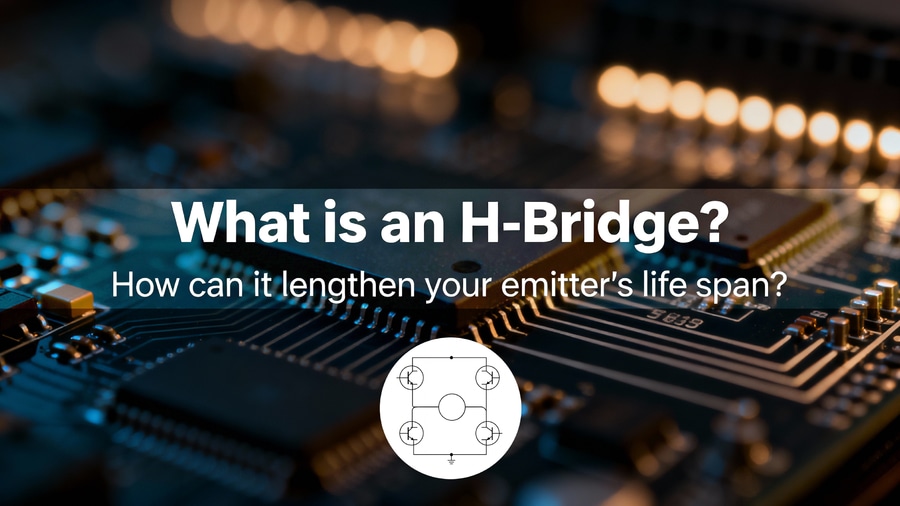
What is an H-Bridge?
One of the most common questions in gas sensing design is how long infrared emitters can reliably operate, especially when driven at around 1 watt.
Since emitter stability directly affects measurement accuracy, extending their service life is a crucial design priority.
A well-established method for improving longevity is to drive the emitter through an H-bridge that carries out scheduled polarity reversal. This helps counteract the gradual wear that occurs when current flows in only one direction, minimizing electrode erosion, filament imbalance, and uneven heating. Left unchecked, those effects would reduce output power and introduce drift over time.
The H-Bridge Explained
-An H-bridge uses paired transistors to control current direction. In one state, current flows from supply positive to emitter negative. In the opposite state, the flow is reversed.
-If the emitter is always driven in the same direction, the same sections of the filament and contacts bear the highest stress. This accelerates wear.
-Alternating polarity distributes electrical and thermal load more evenly across the filament. Therefore, by switching direction at defined intervals, usable life is extended.
The Role of Switching Frequency
The H-bridge switching frequency (how often the polarity reversal occurs) is a critical design parameter. Switching too slowly may not adequately balance filament stress, allowing gradual degradation to continue on one side. Switching too quickly can introduce thermal cycling losses, electrical noise, or EMI issues that affect measurement stability.
In most NDIR applications, the switching frequency is optimized to match the thermal response of the emitter. The goal is to achieve full heat distribution without causing excessive thermal fluctuation or mechanical stress. Typical designs use reversal frequencies synchronized with the measurement cycle or at a low multiple thereof, ensuring that polarity balance is maintained over time without affecting signal modulation or detector response.
Impact on NDIR Platforms
NDIR systems are often designed to operate components near their performance limits in order to achieve high efficiency and strong signal-to-noise ratio. As a result, emitter durability is very important for overall reliability.
Integrating polarity reversal with a properly tuned switching frequency provides greater long-term stability and reliability of the IR source. It minimizes drift, uneven heating, and radiative loss - improving the robustness and repeatability of the sensing system.
Your Micro-Hybrid NDIR experts are always working for longer emitter life and more stable performance. Visit the online shop today or contact them directly to discover how to take your gas measurement technology into new spaces.