#Product Trends
Central kitchens and collective catering
securing cold chain performance from production to delivery
Central kitchens are often perceived as large-scale food production units. In reality, they
operate as fully-fledged logistics hubs, responsible for delivering compliant meals every day
to dozens, sometimes hundreds, of satellite sites such as schools, nurseries, hospitals,
nursing homes, and corporate facilities.
For logistics and transport managers, the cold chain is not just a technical requirement; it is
the most critical operational risk. A temperature breach does not only result in product loss. It
can lead to serious health consequences for vulnerable populations and expose operators to
regulatory sanctions or legal liability.
The challenge is therefore twofold: ensuring strict compliance while maintaining operational
efficiency at scale.
A highly constrained logistics environment
Central kitchen logistics operate under extreme time pressure. Meals must be produced,
packaged, dispatched, delivered, and consumed within tightly defined time windows dictated
by service schedules. This constraint is compounded by strict temperature requirements
depending on the distribution model.
In hot chain distribution, meals must be maintained above +63°C from the end of cooking
until service. In chilled distribution, meals must be rapidly cooled to below +10°C within 2
hours (in line with HACCP principles) and then maintained between 0°C and +3°C until
reheating on site. In extended chilled systems, meals are produced several days in advance
and stored at low temperatures, increasing production flexibility but also extending exposure
time.
Each model requires precise control, dedicated equipment, and rigorously documented
processes.
scaling complexity : volume variability and multi-site
distribution
Central kitchens must also handle significant volume fluctuations. Demand can drop sharply
during school holidays, spike during seasonal peaks such as year-end periods, or increase
unexpectedly due to external events. This variability requires a logistics system that is both
robust and adaptable, without compromising cold chain integrity.
At the same time, distribution networks are inherently complex. A mid-sized central kitchen
typically serves between 20 and 200 delivery sites, each with its own constraints. Route
planning, fleet sizing, and equipment allocation must be optimized daily, while ensuring that
all deliveries remain within compliance thresholds.
Closed-loop logistics : a critical but often overlooked
constraint
Unlike traditional delivery models, central kitchen logistics operate in a closed-loop system.
Containers, gastronorm trays, and insulated roll cages are not disposable—they must be
retrieved, cleaned, checked, and reintegrated into the next production cycle.
This creates an additional layer of operational complexity. Delays in returns, missing
equipment, or insufficient cleaning processes can directly impact the ability to fulfill
subsequent deliveries. As a result, reusable container management becomes a key
performance driver, requiring traceability systems, standardized procedures, and tight
coordination between production, transport, and receiving teams.
Regulatory compliance : non-negotiable requirements
Central kitchens operate under strict regulatory frameworks, including the European
“Hygiene Package,” which mandates full implementation of HACCP principles and
continuous temperature monitoring throughout the logistics chain.
Temperature thresholds are clearly defined and must be maintained at all times. For
example:
● minced meat: ≤ +2°C
● fresh meat: ≤ +4°C
● chilled prepared meals: between 0°C and +3°C
● frozen products: ≤ -18°C
● hot meals: ≥ +63°C
Any temperature deviation must be recorded and corrected immediately. This implies
continuous monitoring across storage, preparation, transport, and delivery stages.
The role of insulated equipment in cold chain control
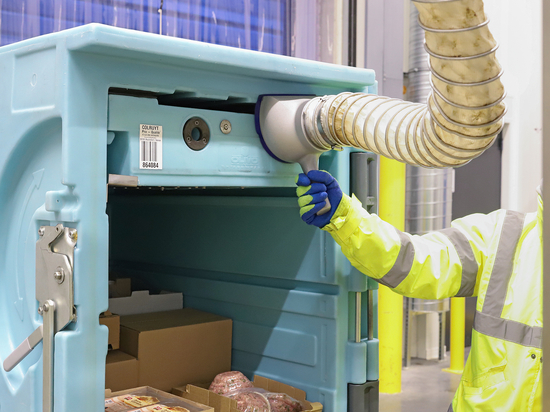
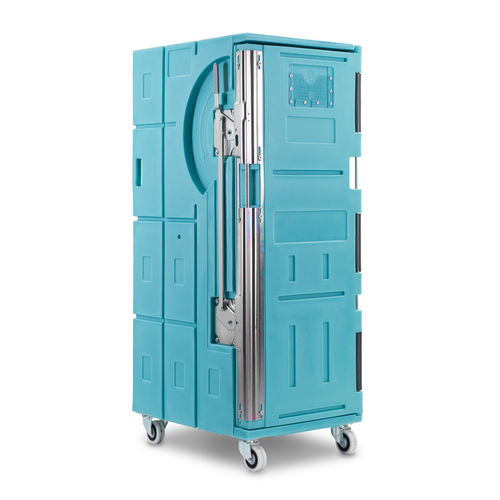
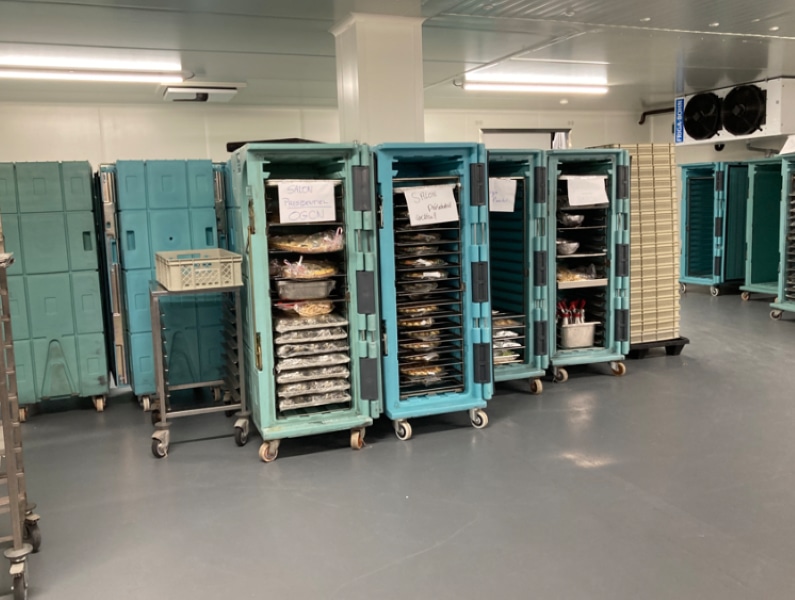
In chilled distribution systems, insulated roll containers are the backbone of logistics
operations. These units combine high loading capacity with strong thermal autonomy,
typically maintaining temperatures between 0°C and +3°C for 12 to 20 hours, depending on
configuration.
Beyond their thermal performance, these containers fundamentally reshape logistics
organization. They act as mobile temperature-controlled buffers, reducing reliance on fixed
cold storage infrastructure at delivery sites. In some cases, they allow facilities—particularly
in healthcare, education, or social services—to limit or even avoid investment in dedicated
cold rooms.
This approach delivers a dual benefit: lower infrastructure costs and greater operational
flexibility, especially in multi-site or space-constrained environments.
Mobility is another key advantage. Equipped with wheels, these containers facilitate handling
across the entire logistics chain, from loading to on-site delivery, reducing manual strain and
improving efficiency. Certified ATP performance ensures that their thermal capabilities are
measurable, auditable, and compliant with regulatory expectations.
Eutectic plates : enabling autonomous cooling
Eutectic plates are widely used as a reliable, passive cooling source. Preconditioned in cold
rooms for at least 24 hours, they store cooling energy that is gradually released inside the
container.
Their temperature range can be adapted to specific use cases. Plates designed for +4°C are
suitable for chilled meals, while those designed for -18°C enable frozen product transport.
This flexibility allows operators to manage multi-temperature flows within a single logistics
system.
Operational risk : equipment fleet management
Managing fleets of insulated containers, eutectic plates, and trays is a critical operational
challenge. Missing equipment, unavailable containers, or improperly conditioned cooling
elements can disrupt entire delivery rounds.
Best practices include maintaining accurate inventory tracking, implementing systematic
cleaning and inspection processes, ensuring equipment traceability, and keeping buffer
stock to absorb operational variability.
Without these controls, even well-designed logistics systems become fragile.
Optimizing distribution : from route planning to
digitalization
Efficient multi-site delivery requires intelligent route sequencing. Delivering the most distant
or most constrained sites first helps maximize thermal autonomy. Some operators also
optimize costs by sharing transport resources in low-density areas.
Container sizing must also be adapted to each site to reduce empty space and improve load
efficiency. At the same time, reverse logistics, retrieving empty containers, trays, and
discharged eutectic plates, must be planned with the same rigor as outbound flows.
Digital tools are increasingly essential in this context. Transport Management Systems
optimize routes, real-time tracking ensures operational visibility, and electronic proof of
delivery secures compliance. Temperature monitoring platforms centralize data, facilitating
audits and reducing administrative burden.
Use case : delivering 100 sites with controlled cold
chain logistics
Consider a central kitchen serving 100 schools within a 50 km radius, producing meals
under chilled conditions. The objective is to deliver all sites before 10:30 AM, maintaining
temperatures between 0°C and +3°C, using 5 vehicles and 40 insulated roll containers.
The solution relies on strict process control. Eutectic plates are recharged for 24 hours in
advance, requiring a rotation system. Containers are loaded early in the morning, around
5:30 AM, in a temperature-controlled environment. Delivery routes are sequenced to
prioritize the most distant sites, and temperature data loggers are placed in each container.
Empty containers are collected during the next delivery cycle, ensuring continuous flow.
The outcome is a 100% compliant delivery rate, full temperature traceability for each
batch, and optimized logistics costs achieved without relying on active refrigeration during
transport.
Turning compliance into a competitive advantage
For central kitchen operators, investing in high-performance insulated equipment and robust
traceability systems is not optional. It is a prerequisite for operational continuity and
regulatory compliance.
However, beyond compliance, cold chain mastery can become a strategic differentiator. The
ability to demonstrate full traceability, consistent performance, and zero incident rates
provides a strong competitive advantage in both public and private catering tenders.
Next step : assess your cold chain performance
If your organization operates a central kitchen or manages multi-site food distribution, the
key question is not whether your cold chain is compliant—but whether it is optimized.
A structured assessment can help you identify:
● vulnerabilities in your current logistics flows
● opportunities to reduce infrastructure dependency
● ways to improve thermal performance and traceability
Get in touch to evaluate your current setup and identify practical levers to secure
and optimize your cold chain operations.