#Industry News
Effects of fast fashion on the environment: How your clothes affect the plane
Effects of fast fashion on the environment: How your clothes affect the plane
Effects of fast fashion on the environment: How your clothes affect the plane
The fast fashion industry is under intense scrutiny. This is not surprising, given the effects of fast fashion on the environment, which include pollution, carbon emissions and excessive waste. Moreover, we cannot close our eyes to a reality: their manufacture is often linked to the exploitation of people, including the use of child labour, in workplaces with dangerous working conditions.
Why is fast fashion so popular?
Consumers find fast fashion a panacea: fashionable clothes at affordable prices. And fast fashion brands are taking advantage of this desire; they know that they will sell more if they produce clothes inspired by the latest trends, and that they will make more profit if they can bring these goods to market at low prices. That’s why they design, produce and sell their clothes in extremely short cycles, making it easier for consumers to buy the much-desired fashionable clothes for little money.
This is the only advantage, for their clientele, of a production and consumption model that focuses on fast, low-cost manufacturing. Because the truth is that this industry is nowadays in the eye of the storm, awakening little by little a greater concern among citizens, due to its negative environmental and social impact.
What are the effects of fast fashion on the environment?
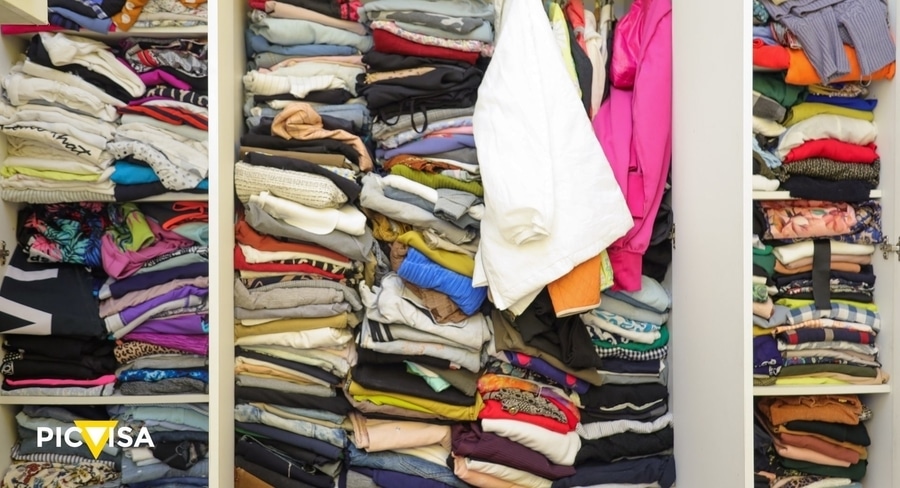
Summer is coming and it will be full of new styles. And for yet another season, advertising will encourage us to buy more fashion. And we will want to buy cheap, cheaper, move on, wear more and throw away more. According to UN data, in the last decades people buy 60% more clothes and wear them for half the time. As a result, the impact of fast fashion feeds the triple planetary crisis: more pollution, more waste and more human exploitation.
Among the most alarming effects of fast fashion on the environment is the accelerated production that leads to excessive use of natural resources. The fashion industry is responsible for 20% of global water waste. Making a pair of jeans can consume about 7,000 litres, while a T-shirt can require 1,000 litres. In addition, plastic fibres pollute the oceans and the wastewater from these factories contains more toxic dyes. Fast fashion is big business and it doesn’t stop, nor do the environmental and social costs, which are growing as much as the large landfills in developing countries such as Ghana.
Let us listen to the experts, for whom there is another way: a circular economy for the textile sector, with less waste, less pollution, more reuse, more recycling… Let us listen to those who warn us: unless we improve the way we make, use and dispose of clothes and other clothing products, 134 million tonnes of textile waste will be generated by 2030.
Characterised by accelerated production and consumption cycles, the impact of fast fashion leaves a high carbon footprint along the entire value chain. In fact, due to mass production and the intensive use of resources at every stage – from raw material extraction to manufacturing, distribution and waste disposal – this business model contributes approximately 10% of global greenhouse gas emissions, according to information gathered by the ZEO Platform.
By requiring constant production to keep up with trends and meet consumer demand, the role of this fashion in climate change is dramatically relevant, highlighting the urgency of adopting good practices at all stages of production. It is urgent to look for more sustainable alternatives in the fashion sector, either through the optimisation of production processes, the use of recycled materials or the implementation of disruptive models that help to move from a linear to a circular economy.
Social and ethical concerns
If pollution and increased waste are worrying, the precarious working conditions for factory workers in developing countries are no less so. Let’s stop contributing to human exploitation; outsourcing manufacturing to developing countries is the great perversity of fast fashion companies. These corporations set up their factories in countries where labour regulations are lax or insufficiently enforced, resulting in working conditions that do not respect human rights. This ensures that this industry is a success, albeit only for those who invest in it.
Subject to extremely tight deadlines, manufacturers are unscrupulous, and in addition to not respecting a fair wage policy, they do not even ensure adequate safety conditions, with very hard working hours. All this is evidence of a very serious negative human impact within these supply chains.
Moreover, in this context, child labour is often used. This is demonstrated by journalistic investigations such as the one carried out by National Geographic, a magazine that revealed how fast fashion manufacturers move their production to countries where labour can be exploited at low cost, with few legal restrictions and without the minimum guarantees to protect the integrity of the workers. People’s health, rights and dignity often take a back seat in favour of cost-cutting and profit maximisation.
Consumers make the difference
The fast fashion business model raises ethical and social questions, and reinforces the need to promote legislative changes and corporate initiatives that are committed to ethical and sustainable fashion, where both the well-being of workers and the environmental impact are valued. Fortunately, more and more consumers are becoming aware of this reality.
At PICVISA, we believe it is a priority to progress towards a more sustainable and circular textile industry, as defined by the European Commission in its Circular Economy Action Plan. In particular, its Strategy for Sustainable and Circular Textiles aims that, by 2030, all textile products sold on the European market will be durable, recyclable and made with respect for social rights and the natural environment.
By facilitating smart waste management and recycling with our advanced sorting and material separation technologies, PICVISA plays a key role in the transition from a linear to a circular economy. Because our solutions help to reduce the use of raw materials, reduce waste generation and improve water efficiency. And from our blog we always encourage to consume clothes made from recycled fibres and slow fashion, which prioritises quality, durability and ethical production.
Consuming these clothes means making a small effort to protect nature and reduce the effects of fast fashion on the environment. Let’s not forget that we have the freedom to choose. Before buying throwaway clothes, we should buy quality clothes that are more durable and even healthier for our skin. Fortunately, it is encouraging to see that more and more people are choosing to buy sustainable and long-lasting fashion; to protect the environment; to reduce their textile waste; and to end the exploitation of vulnerable people.