#Product Trends
Innovative technologies for hard-to-recycle plastics
Innovative technologies for hard-to-recycle plastics
Innovative technologies for hard-to-recycle plastics
According to the OECD, the world’s annual plastic production could build 45,500 Eiffel Towers — and with plastic waste, another 35,000. Yet recycling certain plastics remains a significant challenge. Fortunately, innovative technologies are emerging that transform hard-to-recycle plastics into valuable resources used to manufacture a wide range of new products.
Understanding the challenge of hard-to-recycle plastics
Why are some plastics so difficult to recycle? The reasons lie in their chemical composition, complex structures, and frequent contamination with other materials or food waste. Recycling is also hindered by the lack of suitable infrastructure to collect and process these materials effectively.
Let’s take a closer look at why recycling plastic is difficult, especially in the case of hard plastics that are commonly found in our daily lives.
Common types of hard plastics and their challenges
Certain plastics are particularly complex to recycle. Here are some of the most common types and the reasons why:
Policarbonate (PC). Known for its high impact resistance and transparency, it’s used in safety glasses, screens, and windows. It is 100% recyclable through both mechanical and chemical processes, although specialised facilities are often required.
Polyvinyl chloride (PVC). Used in pipes, profiles, and cables, PVC is a versatile yet potentially hazardous plastic during manufacturing. It is one of the most difficult to recycle plastics due to its chlorine content and chemical additives.
Polyethylene terephthalate glycol (PETG). A well-known copolymer widely used in 3D printing. While it can be recycled, it requires specialised facilities, making hard plastic recycling a more complex process.
Acrylonitrile butadiene styrene (ABS). Commonly used in electronic components, car parts, and toys. Recycling ABS is challenging, especially when mixed with other polymers.
High-density polyethylene (HDPE). Found in milk bottles, detergent containers, toys, and bins. Although recyclable, HDPE requires careful separation and cleaning to ensure high-quality recycled material.
Polymethyl methacrylate (PMMA). Used in windows, signage, and lighting products. It can be recycled through mechanical processes such as grinding, washing, and remelting, or via advanced depolymerisation methods that break it down into its original monomers.
Polypropylene (PP) – Lightweight and heat-resistant, used in food packaging, boxes, and automotive parts. However, polypropylene is hard to recycle because it’s often mixed with other plastics like polyethylene (PE), reducing the quality and purity of the recycled output.
Innovative technologies transforming hard plastic recycling
The recycling industry is evolving rapidly, driven by advanced methods that make difficult-to-recycle plastic more manageable and valuable. Below are the most innovative technologies transforming the way we recycle hard plastics.
Chemical recycling and depolymerisation Chemical recycling breaks down polymers into their basic molecular components. Through pyrolysis (heating without oxygen) or gasification (controlled oxygen exposure), plastics that cannot be mechanically recycled — such as multilayer packaging or degraded materials — are converted into virgin-quality raw chemicals.
Depolymerisation is particularly promising for plastics like PMMA and PET, as it allows recovery of monomers that can be reused to manufacture high-quality new materials.
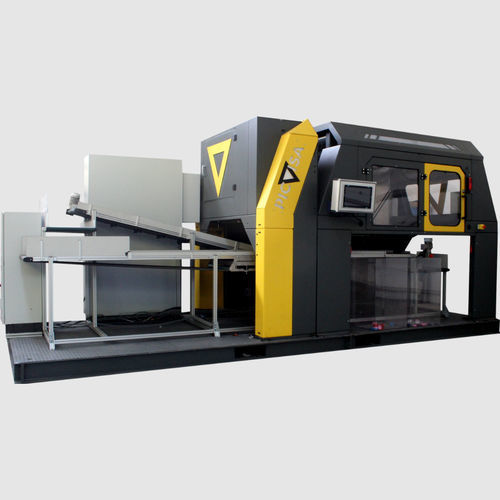
Artificial intelligence (AI), robotics and spectroscopy. AI can differentiate between different types of plastics (PET, HDPE, PVC, LDPE, PP, PS), as well as detect their colors and contamination levels. Spectroscopy not only allows to detect and separate with high accuracy and speed different types of plastics for automatic sorting, it also facilitates the quantification of polymers, which is essential, as the mixing of plastics can detract from the quality of the recycled product. PICVISA provides the plastic recycling industry with solutions that are a benchmark in efficiency and quality assurance of the final product: the ECOPACK and ECOFLAKE optical sorting systems.
Chemical recycling and depolymerisation Chemical recycling breaks down polymers into their basic molecular components. Through pyrolysis (heating without oxygen) or gasification (controlled oxygen exposure), plastics that cannot be mechanically recycled — such as multilayer packaging or degraded materials — are converted into virgin-quality raw chemicals.
Depolymerisation is particularly promising for plastics like PMMA and PET, as it allows recovery of monomers that can be reused to manufacture high-quality new materials.
Enzymatic and bio-based recycling solutions.
Biological and enzyme-based recycling technologies use microorganisms — such as bacteria and fungi — and their enzymes to break down plastics into simpler, more recyclable compounds.
These methods are more sustainable as they operate at lower temperatures, consume less energy, and avoid toxic solvents. Specialised enzymes are already being used to degrade polymers like PET, while combining recycled monomers with bio-based building blocks enables the creation of new bioplastics.
Nuclear technologies. The gamma ray and electron irradiation allows complex plastics to be degraded, cross-linked or grafted at the molecular scale. Thus, recycling is more efficient and materials with improved properties are obtained.
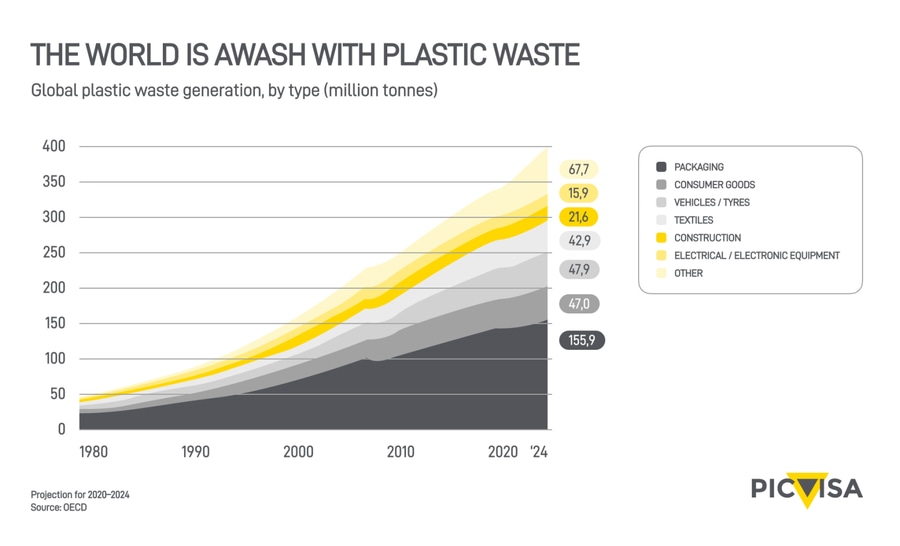
Global plastic waste generation by type
How recycling companies manage difficult-to-recycle plastic?
Beyond technological innovation, recycling companies also rely on specialised collection systems to recover materials that cannot be placed in standard recycling bins. These services focus on identifying, sorting, and processing hard-to-recycle plastics using both mechanical and chemical routes.
Companies are also improving their operational processes to increase the value of mixed plastic waste, ensuring that even complex materials contribute to a more circular and sustainable plastics economy.
FAQs: understanding why plastics are difficult to recycle
Why are plastics hard to recycle?
Because there are so many types of plastics, each with distinct chemical properties and melting points. When different plastics are mixed, they cannot be processed together efficiently, leading to costly and sometimes impossible separation. Food residues, labels, inks, and adhesives also contaminate plastics, reducing the quality of recycled materials and causing large volumes of potentially recyclable waste to be discarded.
Why is recycling plastic difficult?
Because of their extreme chemical durability and slow degradation. Most plastics are not broken down by microorganisms. And, instead of disappearing, they fragment into smaller and smaller pieces (microplastics and nanoplastics), which persist in the environment for hundreds, even thousands of years, contaminating soil, water and living organisms.
Why is polypropylene difficult to recycle? Although it is technically recyclable, it is difficult to achieve due to a combination of economic and logistical factors that result in a very low overall recycling rate (1%). Separating and sorting it is not easy, as PP is used in a huge variety of articles and is often mixed with other types of plastics, such as polyethylene (PE), within the same product. Separation in recycling plants is complex and costly. It is less cost-effective to process PP than other higher-value plastics such as PET or HDPE. In addition, food waste, paper labels and inks contaminate it. And each time PP is melted and reprocessed, its long polymer chains shorten, which degrades its mechanical properties (it becomes more brittle and loses rigidity).
Why are plastic bags difficult to recycle? Made of low-density polyethylene (LDPE) or HDPE, they are difficult to recycle because they clog machines. They easily become entangled in rollers and automated sorting equipment, stopping the operation and forcing frequent manual stops for cleaning. They often arrive heavily contaminated with organic residues, labels or liquids, which degrades the quality of the polyethylene material, making it unsuitable for standard reprocessing.
Are hard plastic packaging materials recyclable? Not all of them. Expanded polystyrene (EPS), such as Styrofoam, and PVC are very difficult to recycle.
The challenge posed by plastics that are difficult to recycle is being met thanks to increasingly sophisticated and sustainable technologies that make it possible to transform this waste into valuable new resources. However, much remains to be done to close the loop and reduce the environmental impact of plastic. At PICVISA we are working to help close this gap(more information).