#Industry News
The role of plastic recycling companies in reducing ocean pollution
The role of plastic recycling companies in reducing ocean pollution
Plastics recycling
The role of plastic recycling companies in reducing ocean pollution
Understanding the problem: What is ocean pollution and why it matters
Oceans are essential for life on Earth and play a vital role in regulating the global climate. Almost one million known species inhabit them. Oceanic phytoplankton, the foundation of the marine food chain, performs photosynthesis, producing more than half of the oxygen we breathe while absorbing carbon dioxide (CO₂).
Crucial for food and human wellbeing, the oceans make up 90% of the Earth’s habitable space. Finding effective ways to stop ocean pollution by reducing plastic waste and protecting marine life is one of the most significant contributions recycling companies can make to environmental preservation.
Alarm over ocean pollution
A combination of chemicals and waste, mostly from land-based sources, is carried into the ocean. This solid waste not only harms or kills marine animals through ingestion or entanglement but also interferes with navigation safety and disrupts the food chain. Plankton, fish, crustaceans and mammals ingest plastic fragments — macroplastics or microplastics — directly from the water, mistaking them for food.
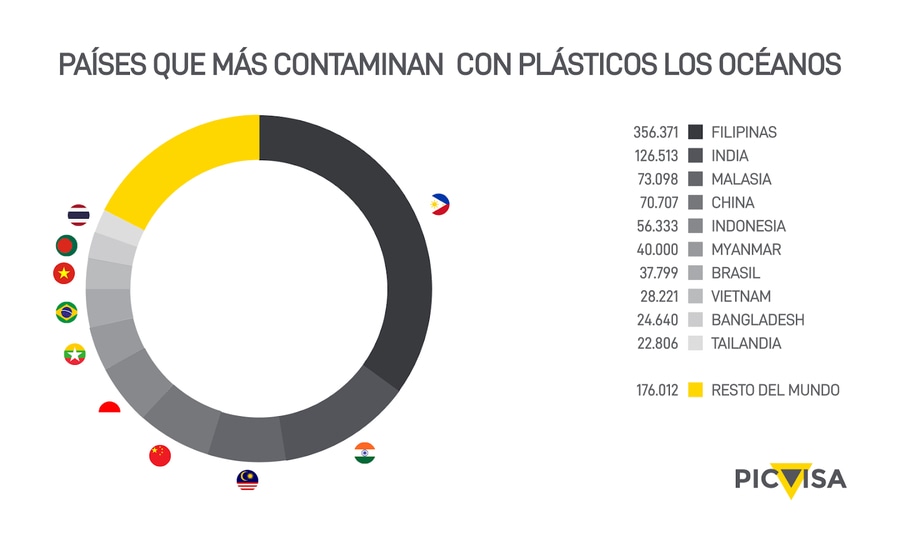
Marine pollution negatively impacts the global economy, with plastic being the most damaging waste material. According to the World Economic Forum, between 75 and 199 million tonnes of plastic pollute our oceans. Microplastics have been found in fish consumed by humans, posing potential health risks. Asia is responsible for 81% of ocean plastic pollution.
image 2
Graph 1: Countries contributing most to ocean plastic pollution. The graph shows the annual tonnes of plastic waste entering the oceans by country. Source: Lorens J.J. Meijer, via science.org (2021).
Main sources of plastic pollution in the ocean
Bottles, bags, fishing nets and tiny particles are the main culprits of ocean plastic pollution. The most significant sources include:
Single-use plastics and packaging waste
Coastal tourism and recreational activities lead to single-use plastics (such as packaging, straws and cups) being abandoned on beaches or boats, eventually ending up in the sea.
Cosmetics and personal care products
Exfoliants, toothpaste and gels often contain microplastics or microbeads that are washed into the ocean.
Industrial and fishing waste
Fishing nets, ropes and plastic gear lost or discarded at sea cause the phenomenon known as ghost fishing — the unintentional capture of marine life.
Industrial spills and plastic pellets
Small plastic pellets used as raw material often spill during production or transportation, contributing to marine contamination.
Poor waste management and lack of recycling systems
Insufficient waste management allows plastics carried by wind or rain to reach rivers and oceans.
Synthetic clothing and textile washing
Plastic fibres such as polyester and nylon are released during washing and end up in the sea through wastewater.
Effective solutions to marine pollution
How to stop ocean pollution? Here are some key ways to prevent it:
Reduce single-use plastics as established by EU regulations, and avoid buying products containing microbeads. Supermarkets play a key role in sustainable packaging: besides complying with waste regulations, they should promote bulk sales and accept reusable containers.
Support legislation aimed at reducing plastic production and waste, such as the EU directive banning certain single-use plastics.
Recycle to prevent more plastics from reaching the ocean and to reduce the circulation of virgin plastic.
Join or organise clean-up activities on beaches or rivers.
Raise awareness among others about the problem and its solutions.
Recycling more efficiently is essential. A leader in sorting and recycling solutions, PICVISA provides technology for identifying and separating all types of plastics through systems such as ECOPACK and ECOFLAKE.
ECOPACK automatically sorts and separates multiple types of materials according to their composition (NIR), colour (VIS) and shape (deep learning). Thanks to its multispectral vision system, it can be configured to adapt quickly to new materials entering the waste stream.
ECOFLAKE separates different types of plastic flakes with exceptional precision and efficiency, using high-definition RGB CMOS cameras combined with NIR technology.
Ocean plastic recycling companies: driving change
Leading the transition towards a circular economy, several companies are spearheading innovation in ocean plastic recycling:
PureCycle – Specialises in transforming plastic waste into a renewable resource, providing high-quality recycled resin that allows customers to offer sustainable solutions and promote plastic circularity.
Ecoalf – Its Upcycling the Oceans project works with more than 3,000 fishermen in 40 ports to collect marine debris. Around 80% is turned into recycled thread for making sustainable clothing and accessories.
Iberostar Group – Through its Wave of Change programme, it has eliminated over 10 million single-use plastics and promotes marine research and reef restoration.
Lidl – Removed plastic bags from all its stores, preventing 100 million bags per year from entering circulation.
The Running Republic – Produces sportswear using recycled fabrics made from bottles and ocean plastic waste.
Sea2see – Manufactures sunglasses and watches from plastics collected on beaches and in ports.
The future of ocean conservation
Currently, only 9% of plastic waste is recycled. Plastic pollution could quadruple by 2050, potentially exceeding the total mass of fish in the oceans. To prevent this, we must reduce disposable plastic use, support the circular economy, and promote ocean clean-ups and environmental awareness, according to WWF Spain and the European Parliament.
In addition to investing in biodegradable plastics, stricter regulations are needed to manage pollution effectively.
Proper waste sorting and management are key to enabling the reuse of plastic materials. At PICVISA, we provide solutions to marine plastic pollution through advanced recycling technologies. Our portfolio includes robots, computer vision and artificial intelligence systems for sorting plastics efficiently by polymer type and colour.
With its technology, PICVISA aims to accelerate the shift from a linear to a circular economy. Let’s take care of our oceans together.