#Product Trends
What is hyperspectral imaging? Applications in waste classification
What is hyperspectral imaging? Applications in waste classification
Hyperspectral imaging (HSI) is a powerful tool that analyses different light spectra to identify and quantify the composition of materials, creating detailed, pixelated images. The use of special cameras and sensors allows detailed information to be collected on the composition and characteristics of objects and materials deposited for recycling, facilitating more accurate, efficient and sustainable sorting.
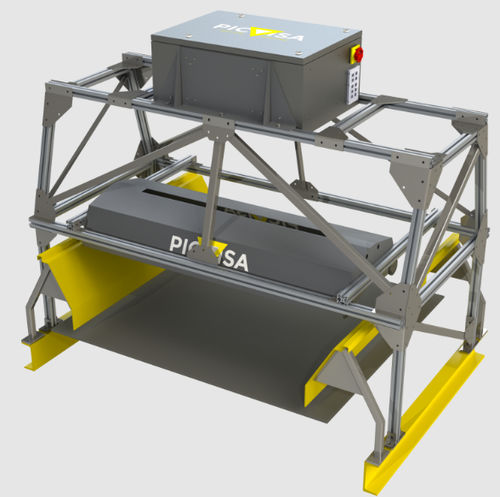
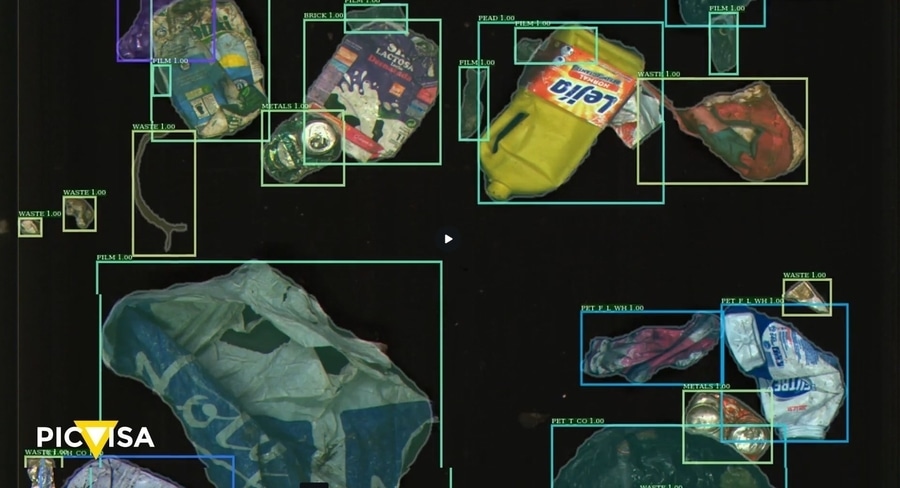
PICVISA equipment is equipped with HSI with NIR (near infrared) technology, combining the ability of hyperspectral imaging to capture spatial information with the ability of NIR spectroscopy to obtain chemical information. Always at the forefront, our high-precision machine vision systems allow materials to be identified and separated by their chemical composition, shape and colour.
How the hyperspectral image is interpreted (HSI)
Hyperspectral imaging captures and analyzes hundreds of spectral bands of the electromagnetic spectrum (from visible to infrared and ultraviolet), identifying materials more accurately than conventional photography. High spectral resolution identifies and analyzes unique fingerprints (spectral signatures) of materials, with details not visible to the naked eye, facilitating sorting for waste recycling.
image
Compared to monochrome cameras, which obtain grayscale images, color cameras combine three images, one for red, one for green and one for blue values. In other words, the color image is composed of three RGB channels. They therefore have three times as much data. With multispectral imaging cameras, the dimension increases and information from several wavelengths is obtained. In contrast to these cameras, which are used to detect some differences in composition, hyperspectral imagers can include the entire electromagnetic spectrum, in bands adjacent to each other; they are equipped with sensors capable of perceiving hundreds of wavelengths inside and outside the visible spectrum. Hyperspectral imaging is characterized by recording chemical or physical information accurately and reliably, in real time (Source: bcnvision.es).
Advantages of hyperspectral imaging
Compared to multispectral camera technologies, those using hyperspectral imaging have greater benefits derived from their main difference: spectral resolution, which, being higher, identifies materials more accurately and detects subtle changes. Advantages of hyperspectral vision:
Remote sensing. As it does not require physical interaction, it examines materials without damaging them.
Obtaining detailed information. Unlike conventional RGB cameras, hyperspectral cameras capture hundreds of bands of data, revealing the chemical and molecular composition of each pixel in an image, allowing multiple substances to be identified. Each pixel contains data that can identify, for example, high-density bodies (such as metals) and low-density bodies (organic debris).
Identification of invisible substances. Hyperspectral imaging can detect and classify materials and compounds that are invisible to the human eye, which is crucial for detecting contaminants, impurities or defects.
Real-time analysis. By performing inspections with immediate results, operational efficiency is improved.
High precision. It provides detailed data that facilitate qualitative and quantitative analyses; materials are identified, classified and characterized with enormous reliability. And thanks to hyperspectral microscopy, it is possible to capture and process images and obtain detailed chemical and physical information of samples at the microscopic scale.
Diversity of applications. Seeing beyond the visible spectrum allows this technology to be used in different sectors and production processes.
Easy implementation. Allows for agile integration into existing process lines, streamlining adoption and automation of tasks.
HSI applications
Hyperspectral imaging technology is proving key in a variety of industries. For example:
Medicine. It provides valuable information to improve the diagnosis and treatment of diseases.
Defense, security and forensics. Distinguishes and detects camouflaged targets that may be invisible to the eye or thermal vision, and can even identify targets at distances of 1.5 kilometers.
Agriculture. It is used, for example, to capture and analyze detailed information on crop health and composition.
Environmental monitoring. Identifies and quantifies water quality, presence of sediments, vegetation health, pollutants…
Mineralogy. With hyperspectral analysis, minerals can be identified and mapped without the need for excavation.
Hyperspectral imaging in waste sorting and recycling
In recycling, hyperspectral imaging improves waste sorting, allowing to detect and separate with high accuracy and speed different types of waste, for automatic sorting. These are its key applications:
Waste segregation. Facilitates the separation of paper, glass, metals, plastic fragments, etc. in municipal solid waste and demolition waste streams.
Classification of plastics. It identifies and separates various polymers, even in complex blends, which is crucial for subsequent reuse and for optimizing high-speed recycling processes.
Identification of contaminants. Detects the presence of non-recyclable materials within recycling streams, ensuring the purity of recovered materials.
Recovery of valuable metals and compounds. When recycling electronic waste, it identifies and separates precious metals and other valuable compounds.
Classification of organic waste. It helps to separate them from inorganics, improving processing efficiency.
Non-destructive analysis in real time. It allows to characterize and measure materials without damaging them.
Challenges and opportunities
Still, there are challenges to be met. That’s why R&D in hyperspectral imaging technologies continues unabated, with advances in miniature, low-cost airborne hyperspectral sensors and advanced space-based sensors. A major challenge is managing the large volume of data collected, which complicates its analysis.
Today, work is underway on a comprehensive review of platforms, sensors and cameras for hyperspectral data processing and analysis. Advances in this technology are essential to foster a circular economy and progress towards a more sustainable world. At PICVISA we decided to adopt this valuable spectral imaging technology for our equipment, in line with our strong commitment to innovation and to using the most advanced tools to implement them in recycling.