#Industry News
Challenges and solutions in the polystyrene recycling industry
Challenges and solutions in the polystyrene recycling industry
Other materials recycling
Challenges and solutions in the polystyrene recycling industry
From solving waste collection issues to implementing emerging technologies, the recycling industry is facing interesting challenges in tackling polystyrene (PS) recovery. Innovative solutions are essential for an industry committed to driving the circular economy.
What is polystyrene and why is it so widely used?
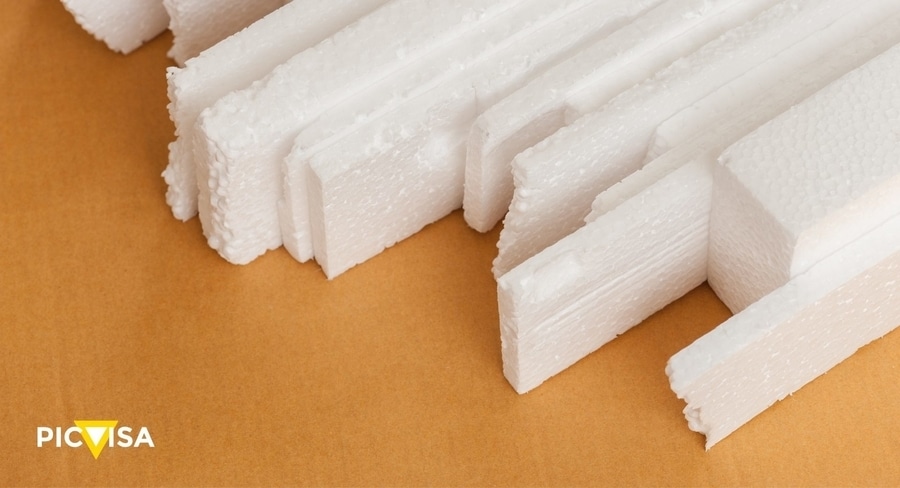
PS is a thermoplastic polymer derived from petroleum. Due to its properties and relatively low cost, it can be found in various forms, mainly as expanded polystyrene (EPS) – lighter, with a pellet texture and open cells, absorbs more moisture and is cheaper, ideal for packaging and general insulation – and extruded polystyrene (XPS), whose closed-cell structure makes it denser, smoother, more moisture-resistant and better insulated, perfect for roofs, floors and areas exposed to water.
As a versatile, lightweight, moisture-resistant, shock-absorbing and economical material, polystyrene is commonly used for the packaging of products, when it is required to maintain their temperature. In its expanded and extruded form, it is used as an aggregate in construction materials, mainly for thermal insulation.
Polystyrene packaging and its applications
Because of its good shock absorption and thermal insulation properties, PS is ideal for packaging fresh or hot food (meat, fish, ice cream), for making food trays…. It is also used to make disposable polystyrene cups and plates, although it will soon no longer be used for this purpose; remember the draft regulation that plans to ban, as of January 1, 2030, certain single-use plastic packaging.
PS will most likely continue to be used for yogurt pots and desserts. And in horticulture, for transporting plants, making trays for seedbeds and supports for hydroponic cultivation.
In its expanded form (EPS) – 98% air – it is an indispensable protective material for packaging household appliances, electronic products, fragile items or personal protective equipment. In pharmacy, it offers hygiene and insulation for storing and/or transporting medicines, vaccines, test tubes, reagent containers; and in cosmetics, for packaging creams, ointments, convenience products for travelers, etc.
Can polystyrene be recycled?
Recycling polystyrene is complex and expensive, especially the recycling of expanded polystyrene foam. An added problem is its low density (it contains air bubbles) and its potential contamination by food residues, oils… In the case of building site insulation panels, because it is mixed with cement and adhesives, which complicates this recycling.
Polystyrene must be deposited in a specific container, which in Spain is yellow. Recycling a small polystyrene box is easy, what is difficult is to dispose of a large piece of polystyrene; whoever finds it difficult to break it, in order to fit it in the appropriate container, should take it to a clean point.
Is styrofoam recyclable in practice? Yes, polystyrene can be recycled. For food packaging, collection points in restaurants, together with hot washing or chemical recycling technologies, can ensure efficient treatment. Recycling of construction waste requires pre-sorting at demolition sites and localized centers for efficient management, especially mixed extruded polystyrene.
Why polystyrene recycling is not widely available Because the process is not cost-effective. To be cost-effective, EPS polystyrene packaging must be compacted or densified prior to recycling, which requires specialized machinery that many municipalities do not have.
Key challenges in the polystyrene recycling industry
Composed of 98% air, expanded polystyrene (EPS) takes up a lot of space in trucks and plants, which drives up logistics costs. This is why it is being displaced by other materials such as cardboard or the bioplastic PLA (PolyLactic Acid), derived from corn starch or sugar cane, which is biodegradable and compostable.
However, the spearhead of the recycling sector is to opt, as we shall see, for innovative technologies. Investing in cutting-edge solutions such as those marketed by PICVISA is key, when it is estimated that the recycling rate for this waste is around 35%, according to the MacArthur Foundation.
Polystyrene recycling
Solutions and technologies for polystyrene recycling
Polystyrene recycling combines three technologies: mechanical, compaction and chemical. Mechanical recycling – the most common method for rigid PS – includes three processes: crushing, washing to remove contaminants, and melting and extrusion into pellets, from which new products are made.
To carry out the densification or compaction process, which reduces the size of EPS by up to 50 times, there are mechanical densifiers, which press the EPS into compact blocks; thermal densifiers, which apply heat to collapse the air cells; and chemical densifiers, which use safe solvents to liquefy the EPS for easy transport. Chemical recycling aims at depolymerization, i.e., reducing the polystyrene to its original monomers. This is achieved by pyrolysis, chemical dissolution or thermal or catalytic depolymerization. This technique allows dirty or mixed polystyrene to be recycled, and the recovered styrene can be used to manufacture virgin polymer, closing the cycle completely.
A last resort, when the material is too contaminated or mixed, is energy revaluation, since polystyrene has a high calorific value, similar to that of diesel. Although this is not a recycling process, it avoids landfill.
Finally, it is worth mentioning advanced recycling technologies, such as those marketed by PICVISA. These solutions use high-resolution cameras (RGB) and near infrared technology (NIR) to identify and differentiate polystyrene from other plastics (PET, PE, PP, PVC, etc.) and separate them by color or chemical composition. Endowed with artificial intelligence (AI) and poised for improvement thanks to deep learning, the ECOPACK and ECOPICK solutions employ AI to make intelligent, automated decisions in real time, adapting to waste streams and improving sorting efficiency. In particular, the ECOPICK robot combines AI and machine vision for accurate separation of materials, even in complex streams, increasing automation and final product quality.
In short, with these PICVISA solutions, public organizations and private companies will become part of the so-called Industry 4.0. Because they will be able to collect and analyze large volumes of data (big data) to make the best decisions and optimize their processes; perform predictive maintenance and even ensure remote control of the machines.