#Product Trends
Why is it important to recycle? Key reasons and benefits
Why is it important to recycle? Key reasons and benefits
Sectors recycling
Why is it important to recycle? Key reasons and benefits
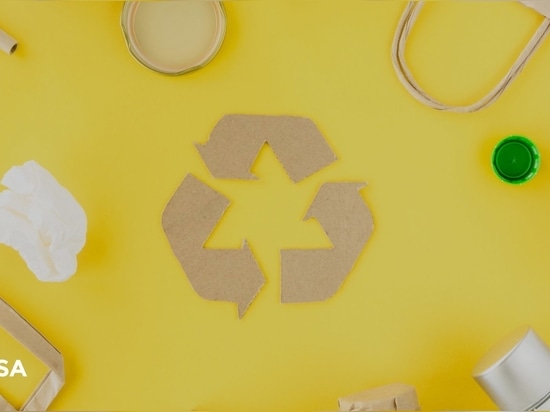
The environmental benefits obtained when we recycle redound to our quality of life. But if we really want to protect our planet, we need to reuse and reduce our waste before we tackle waste management. Let´s see why is it important to recycle.
What is recycling and why it is important?
Recycling involves collecting and processing materials that would otherwise be discarded as waste, transforming them into new products. Recycling benefits society, the economy and nature. Products should only be recycled when they can no longer be reused; giving them a second life is paramount.
This philosophy underlies the thinking of organizations such as the U.S. Environmental Protection Agency (EPA), which promotes the waste management hierarchy. This model classifies various management strategies, from the most to the least environmentally preferable; it prioritizes reduction at source and reuse of waste over recycling.
Key reasons why recycling is important
Why is it important to recycle, reduce and reuse? Let’s look at the main benefits of recycling:
Environmental. By recycling our waste, we save energy; recycling 10 plastic bottles saves enough energy to power a laptop computer for 25 hours. By facilitating the conservation of natural resources, recycling reduces the need to extract wood, water or minerals to make new products. And it reduces greenhouse gas emissions.
Socioeconomic. The EPA released an update to the National Recycling Economic Information (REI) Study in 2020. In one year, recycling and reuse activities in the US accounted for 681,000 jobs, nearly $38 billion in wages and $5.5 billion in tax revenues. This equates to 1.17 jobs per 1,000 tons of materials recycled, $65.23 in wages and $9.42 in tax revenue per ton of materials recycled.
Why reduce and reuse are even more important than recycling
Why is it important to recycle, reuse and reduce? By reusing waste, we reduce it. From there, recycling is the healthiest and most sustainable alternative. Recycling must be approached from recovery – paper, glass, plastic, metals, construction and demolition materials, and organic matter from the municipal solid waste (MSW) stream – taking into account its potential transformation into materials to manufacture new products. The challenge: to reduce the amount of virgin raw materials needed to meet consumer demand.
Why it is important to recycle e-waste
Discarded electrical and electronic equipment contains potentially harmful materials; it pollutes the environment and puts those involved in the recycling of Waste Electrical and Electronic Equipment (WEEE) at greater risk. And many rare minerals needed for modern technology come from countries that do not respect human rights.
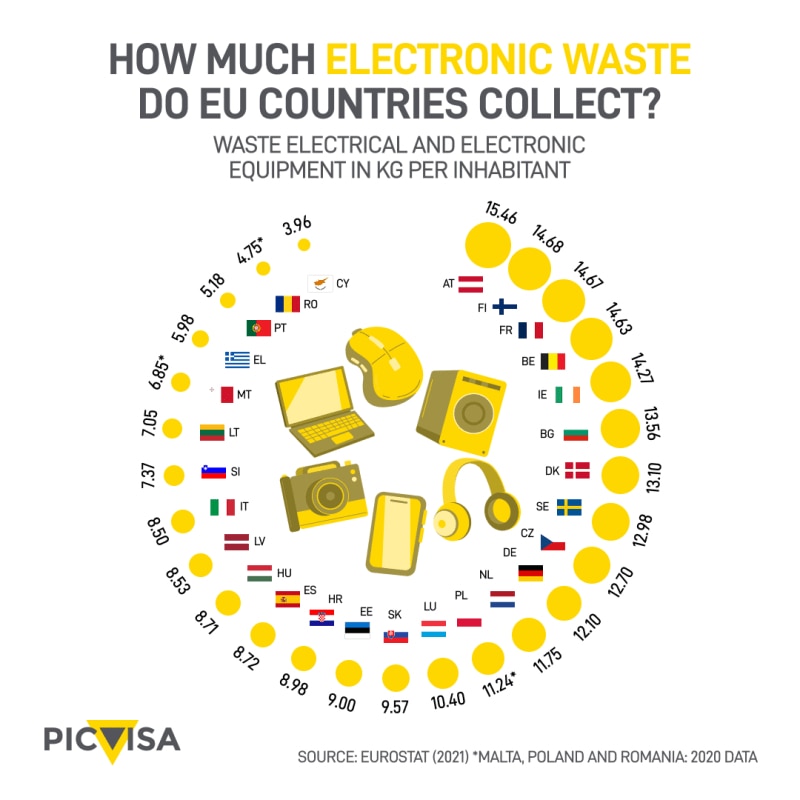
How much electronic waste do EU countries collect EN
It is worth noting that WEEE represents one of the fastest growing waste streams in developed economies. According to EU data, total WEEE collected increased from 3.0 million tons in 2012 to 5.2 million tons in 2023 (+75%), while total waste treated grew from 3.1 to 5.2 million tons (+66%) during the same period. Recovered WEEE increased from 2.6 to 4.8 million tons (+83%), and recycled and prepared for reuse grew from 2.4 to 4.3 million tons (+77%) from 2012 to 2023.
The recycling of Waste Electrical and Electronic Equipment is lagging behind production. And the magnitude of the problem requires an approach in which recognition and optical sorting technologies, such as machine vision and machine learning, are crucial. In Vizcaya (Spain), the company Indumetal Recyclinga pioneer in Europe in WEEE recycling, manages some 30,000 tons of this waste every year to reintroduce it back into the value chain. To do so, it uses PICVISA’s optical sorting technologies, specifically the artificial intelligence-based ECOFLOW flow analyzer.
Why picking up trash also matters
It’s proven: recycling and composting MSW dramatically reduces carbon dioxide emissions. Why is it important to collect garbage? By diverting waste from landfills and incinerators, recycling reduces the harmful effects of pollution and emissions.
Real-world benefits of recycling: Data and examples
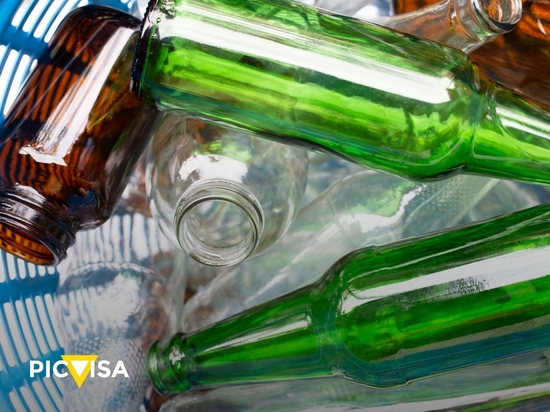
Recycling paper saves water and energy, and avoids cutting down trees, while recycling 1 kilo of glass saves 1.2 kg of raw material. Recycling plastics prevents them from ending up in oceans and landfills, reducing marine pollution. And recycling aluminum, for example cans, returns them to the supermarket in weeks, using 95% less energy.
WEEE recycling rates vary greatly from one EU Member State to another: in Croatia, for example, that rate is above 81% since 2017, while in Malta it barely reaches 21%. Its potential hazardousness is what places the separation and treatment of discarded waste as one of the priorities in the European “green agenda” for the coming years
How you can make a difference: Practical steps
Apply the 3Rs: Reduce (buy in bulk, use reusable bags, avoid single-use plastics), Reuse (bottles, clothes, water for plants) and Recycle correctly (separate organics, plastics, glass, metal in appropriate containers.
Common recycling FAQs
What happens to the materials after recycling? They are taken to sorting plants where they are separated, cleaned and processed to become raw material, which is then used to make new products: packaging, clothing, furniture or even compost. Other questions:
Does recycling really make a difference today?
It is not a magic solution, but it complements reuse and waste reduction. It is a key tool for sustainability, but its success depends on proper separation and process improvement, using technologies such as those marketed by PICVISA.
What are the most important items to recycle
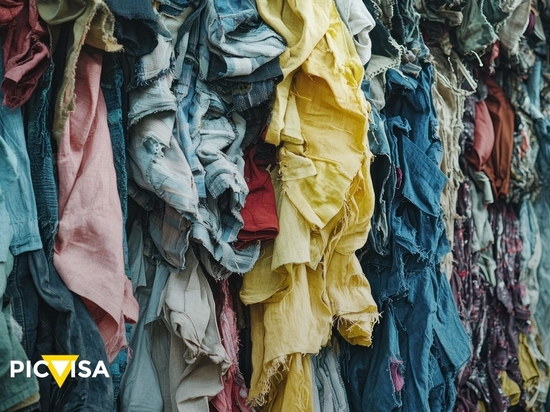
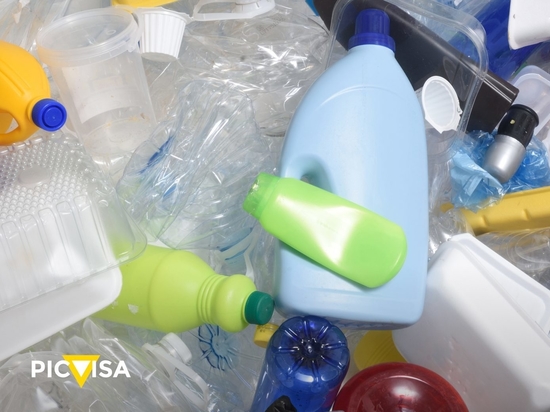
In addition to WEEE (cell phones, computers), it is essential to recycle items made of paper and cardboard (newspapers, boxes), plastics (bottles, containers), glass (jars, bottles), metals (aluminum and steel cans) and textiles (clothing), without forgetting batteries and used oil, due to their volume and environmental impact.
Why should I recycle even if my city does not make it easy?
Because you protect the environment (less air, water and soil pollution, conserve natural resources and habitats); save energy and raw materials; fight climate change and promote the creation of new products and jobs.
Can all plastics be recycled?
Not all of them, but after processing, they can be put to uses other than their original ones, especially as construction materials. The challenge posed by plastics that are difficult to recycle is being overcome thanks to technologies that make it possible to transform them into valuable new resources. But there is still much to be done to close the loop and reduce the environmental impact of plastic. At PICVISA we are working to help reduce this gap.
Why is e-waste recycling so important?
The management of these wastes is critical to minimize their environmental impact and protect human health.
What should I never put in the recycling bin?
To avoid contaminating recyclable streams, we should not deposit flat glass (windows, mirrors), contaminated (greasy) paper and cardboard, batteries, medicines, electronic waste, light bulbs, textiles… These are products to be taken to clean points, pharmacies and special collection points.
Do I need to wash containers before recycling them?
It is not necessary, what is crucial is that they are empty and free of large food or liquid residues. Recycling plants clean them with mechanical processes. However, it is crucial to deposit them in the correct container so that the facilities can treat them properly.
How can I start recycling if I’m a beginner?
Your individual actions add up to a great global impact, without relying exclusively on municipal infrastructure to benefit the planet. Separate your waste at home, and repeat this slogan to yourself: “I must reuse, separate and reduce waste”.
Is it better to recycle or to reduce and reuse?
Rather than recycling, it is better to reuse and reduce. Reducing prevents the generation of waste at the source, and reusing extends the life of objects, avoiding the energy and resources required for recycling, which is a necessary industrial process, but is the last resort in the 3R hierarchy.