#Industry News
Optical and NIR sorting deliver higher-purity cullet and cleaner recycled glass streams
Optical and NIR sorting deliver higher-purity cullet and cleaner recycled glass streams
A glass sorting machine automates the separation of cullet by colour, composition and the presence of contaminants. It is one of the key stages of the glass recycling process for producing more homogeneous cullet streams with higher purity levels, combining visible-light (VIS) and near-infrared (NIR) sensors, high-resolution cameras and machine vision to classify each fragment in real time.
Placement within the plant depends on the treatment process. In lines that recycle container glass collected through bottle banks, where the incoming material is comparatively clean, the machine performs the main optical sorting stage right after crushing and screening. In municipal solid waste lines, where glass is mixed with organic matter, plastics, metals and fines, the sorter is installed later, at the refining or final cleaning stage, once the stream has already been partially separated, allowing more accurate sorting.
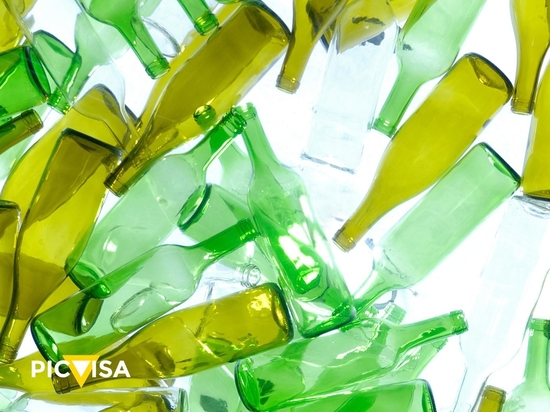
Optical sensors and colour detection. VIS sensors and high-resolution cameras identify the colour of each fragment and separate flint, green and amber glass, while machine vision evaluates shape, texture and transparency; detection takes place within milliseconds, allowing large volumes to be processed in real time.
Contaminant detection. NIR sensors and spectral analysis algorithms detect CSP contaminants (ceramics, stones and porcelain), one of the main challenges in glass recycling because they do not melt in glass furnaces and can cause defects in new containers. The equipment can also identify opaque glass such as ceramic glass and Pyrex, laminated glass from windscreens, lead glass from crystalware, and enamelled or decorative glass, plus, depending on configuration, residual metal fragments, plastic film, paper and organic matter. Magnetic and eddy current separators handle most metals elsewhere in the line.
Ejection and purity. Once a fragment is identified, a matrix of pneumatic micro-valves ejects it from the accelerated conveyor into the correct stream: CSP contaminants to reject, and flint, green or amber glass to their respective colour fractions. This produces purity levels above 99 percent in container glass recycling lines, with more moderate purity typically achieved in municipal solid waste lines.
Choosing a glass sorting machine. Key criteria include detection technology and scanning speed, the CSP removal rate and colour-separation accuracy, processing capacity in tonnes per hour, the particle size range handled, from fines below 6 millimetres to coarse fragments above 20 millimetres, the ejection system's response speed and durability, integration with existing conveyors and screening equipment, and operating and maintenance costs.
ECOGLASS by PICVISA. The ECOGLASS optical sorter automates glass sorting using NIR technology, machine vision and artificial intelligence. The latest models specialise in CSP contaminant removal and colour sorting and feature bullet valves that improve sorting accuracy, making the solution suitable for both dedicated glass recycling plants and municipal solid waste treatment lines. Through AI, ECOGLASS optimises detection and separation to help minimise rejects and increase recovery rates.
When to upgrade. A line that cannot guarantee purity above 95 percent, processes below 6 to 8 tonnes per hour or still relies on continuous manual inspection is a candidate for automation. At TM Alcudia, a plant in Mallorca, PICVISA's glass sorting solution processes up to 25 tonnes of glass per hour and produces high-purity recycled glass fractions, supporting the circular economy in the Balearic Islands.
Related PICVISA resources: the glass recycling process (https://picvisa.com/glass-recycling/), optical sorting technology (https://picvisa.com/optical-sorting/), the ECOGLASS optical sorter (https://picvisa.com/optical-sorting/ecoglass/), the TM Alcudia glass sorting case study (https://picvisa.com/casos-de-exito/tm-alcudia/automated-glass-sorting-transforming-glass-recycling-with-tm-alcudia-in-mallorca/) and NIR plastic sorting technology (https://picvisa.com/nir-plastic-sorting/)."