#Industry News
Near infrared sorting for cleaner polymer fractions and higher-value recycled plastic
Near infrared sorting for cleaner polymer fractions and higher-value recycled plastic
NIR plastic sorters based on near infrared spectroscopy are one of the core technologies in modern recycling plants. Part of PICVISA's optical sorting portfolio, these systems automatically identify and separate materials according to their composition, helping facilities produce cleaner, more homogeneous streams, recover valuable resources and improve overall process efficiency.
How NIR plastic sorting works. The sorter illuminates each container or plastic fragment with near infrared light. Every polymer absorbs and reflects that light differently according to its molecular structure, creating a unique spectral signature. The sensor captures the signature and the software compares it against a reference materials database. Within milliseconds the system identifies the polymer and fires high-speed air jets to direct the item into the correct output fraction.
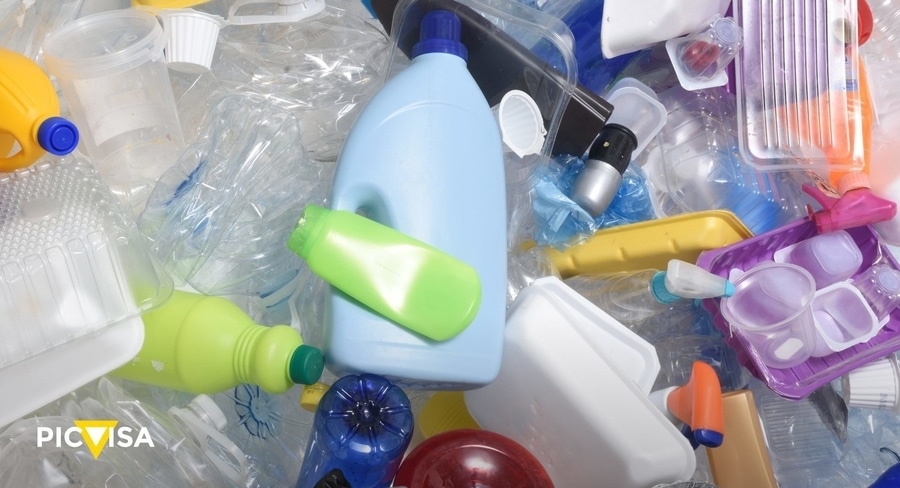
Which plastics can be identified. Most thermoplastic polymers found in packaging waste, provided their spectral signature falls within the approximate range of 900 to 1,700 nanometres: PET, HDPE, PP, PE, PVC and other plastics common in recycling streams. Black plastics, multilayer and coextruded structures, metallised and coated materials remain the main challenge for near infrared sorting, and PICVISA is actively developing solutions aimed at improving black plastic identification. In practice, performance depends as much on equipment configuration as on the material itself: particle size, surface contamination and multilayer content all influence results, which is why every application requires a configuration tailored to the input stream.
Applications across the plant. NIR sorters work at different stages of plastic waste treatment, from whole containers to shredded material. In packaging sorting plants the technology separates PET, HDPE, LDPE, PP, PS and PVC, improving the recovery of homogeneous fractions and reducing cross-contamination between incompatible polymers. The PICVISA ECOPACK optical sorter automates identification and separation of packaging waste in selective collection streams, municipal solid waste and material recovery facilities. For shredded plastics and flakes, where small particle size and contaminants demand very accurate identification, PICVISA offers ECOFLAKE, developed specifically for flake sorting. NIR systems can also be combined with visible-light cameras to add colour-based sorting criteria.
Why purity matters. The purity of recovered fractions is one of the key factors determining their value. Even small amounts of an unwanted polymer can compromise the quality of the recycled material and limit its use in new manufacturing processes. More accurate sorting produces cleaner fractions, better suited to subsequent recycling stages. Automation also brings consistency: unlike manual inspection, a NIR system applies the same identification criteria continuously across the entire stream, holding performance stable even when input composition or volume changes. It reduces material losses, raises recovery rates and, depending on configuration, generates process data that supports line monitoring and traceability.
Choosing a NIR plastic sorter. Verify which polymers the equipment can identify and whether its configuration matches the real composition of the incoming stream. Consider processing capacity in tonnes per hour, the target purity levels for recovered fractions, and the accuracy of both the sensors and the sorting software.
Related PICVISA resources: optical sorting solutions (https://picvisa.com/optical-sorting/), the ECOPACK optical sorter (https://picvisa.com/optical-sorting/ecopack/), ECOFLAKE plastic flake sorting technology (https://picvisa.com/ecoflake/) and plastic recycling automation (https://picvisa.com/technifying-treatment-plants-to-improve-the-classification-of-plastic-containers/)."