#Industry News
How handling robots boost productivity, safety and precision in waste sorting
How handling robots boost productivity, safety and precision in waste sorting
Increased productivity and efficiency, greater safety and precision in industrial operations: these are the key benefits of robotic material handling systems. A handling robot automates line operations, assembly and auxiliary flows, enabling efficient delivery and pick-up of raw materials, finished products and items running on conveyor belts.
Today's waste management is unsustainable without advanced technologies. This is highlighted in the report Global Waste Management Outlook 2024, by the United Nations Environment Programme (UNEP), which also points to the usefulness of data and digitisation for prioritising waste prevention and management. There are no global figures for robots installed in the sector yet, but the trend is clear: AI and robotics are critical tools for the future of the industry, and while the European Union leads in advanced automation, the United States is growing rapidly with its own success stories.
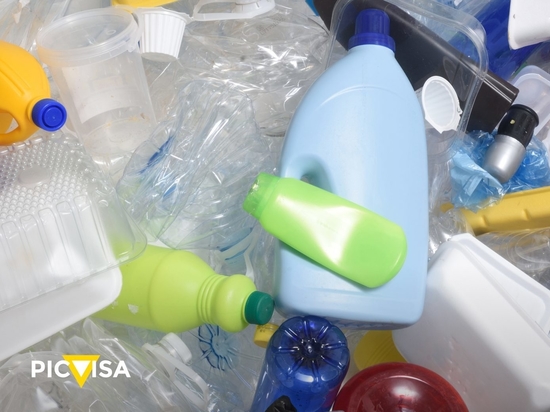
Robotic material handling is the ability of a robot to physically interact with different types of waste. Depending on the material, it can detect, grab, separate, sort, disassemble or shred it. Robotisation is particularly focused on waste sorting, where, complemented by AI, it already far surpasses human efficiency.
Robotic material handling systems bring several important advantages. They increase performance in waste treatment, since combining advanced technologies increases process precision, reduces waste volume and helps valorise materials. They reduce the manual handling of heavy and hazardous materials, eliminating the risk of musculoskeletal injuries and exposure to toxic or contaminated waste. They bring greater consistency to material flows, accelerating the transformation of waste into standardised secondary raw materials that can be reused repeatedly in a closed 'monoflow' of pure plastic, glass, textile or paper. They integrate better with automated sorting systems, since a handling robot uses AI and machine vision to identify, sort and separate waste automatically and accurately, as in PICVISA's ECOPICK. And they increase plant safety and reliability, since an autonomous handling system creates safer industrial spaces, operates around the clock and increases the purity of recycled material.
Compared with manual handling, robotisation brings greater speed, accuracy, safety and continuous operability, transforming a labour-intensive process into a high-tech operation that maximises resource recovery while minimising environmental impact.
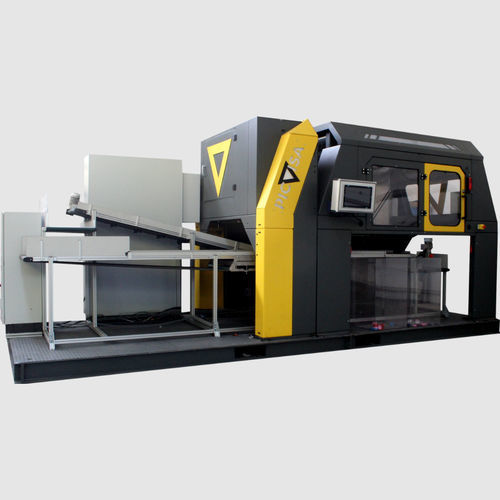
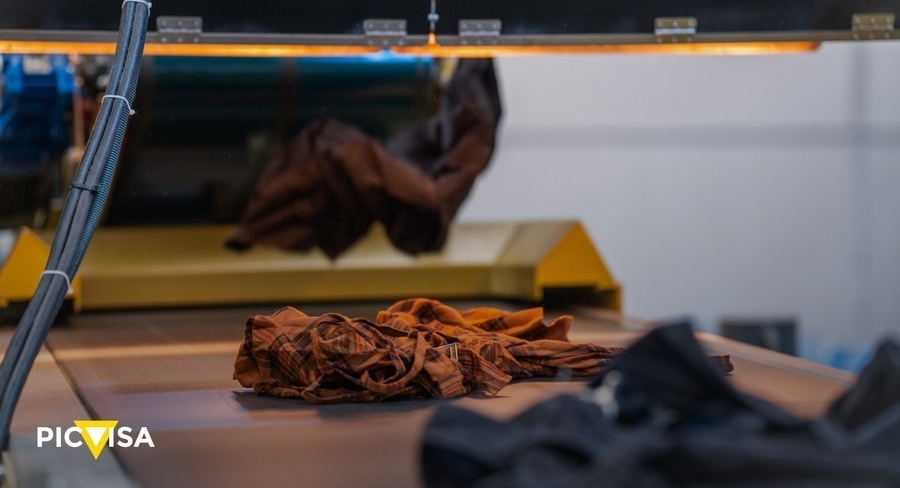
In a material recovery facility, a waste sorting plant or a factory's discarded packaging line, robotic handling systems provide high precision and repeatability, reduce contaminants in recycled fractions and avoid dangerous manual sorting. They introduce materials into optical sorters using artificial vision, sensors and robotic arms to identify, collect and sort plastics, metals and paper. Robotic stackers then organise and palletise sorted materials automatically, grouping and preparing recycled materials on pallets without manual intervention. PICVISA's systems use spectroscopy and machine vision for the automated sorting of plastics, clean cullet and textile fractions, including near-infrared (NIR) and Laser Induced Plasma Spectroscopy (LIBS) technologies that identify metal alloys in real time. After optical sorting, robotic handling equipment moves the sorted output into bags and big bags; in semiconductor recovery, dedicated robots handle silicon wafers in clean-room environments.
Robotic handling is the technical foundation that makes modern recycling installations viable. Combining productivity, recovered material quality and operational sustainability, robotic material handling applications are essential to moving towards a circular economy.
Related PICVISA resources: ECOPICK robotic sorting (https://picvisa.com/ecopick/), hyperspectral vision for textile classification (https://picvisa.com/hyperspectral-vision-for-the-classification-of-textiles-for-recycling/), UNEP Global Waste Management Outlook 2024 (https://www.unep.org/resources/global-waste-management-outlook-2024)."