#Product Trends
Good Bearing vs. Faulty Bearing
Demonstrating Acoustic Emission for Rotating Machinery Monitoring
Bearing failures are among the most common causes of unplanned downtime in rotating machinery. Detecting deterioration at an early stage is therefore an important part of predictive maintenance.
But what does an early bearing defect actually look like from an acoustic emission perspective?
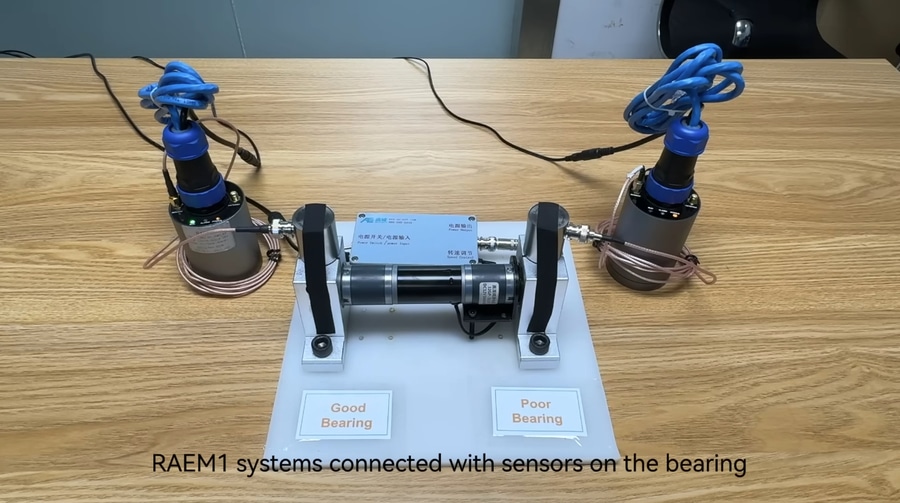
To demonstrate this, we built a simple rotating-bearing test rig that allows us to compare the acoustic emission signals generated by a healthy bearing and a faulty bearing under similar operating conditions.
The result clearly illustrates why Acoustic Emission (AE) is increasingly being considered as a useful complementary technology for rotating machinery condition monitoring.
The Demonstration: Healthy Bearing vs. Faulty Bearing
For our demonstration, a rotating test rig was equipped with interchangeable bearings representing two different conditions:
Condition 1: Healthy bearing
The bearing operates normally, with relatively smooth rolling contact and adequate lubrication.
Condition 2: Faulty bearing
A bearing with an intentionally introduced or existing defect is installed under comparable operating conditions.
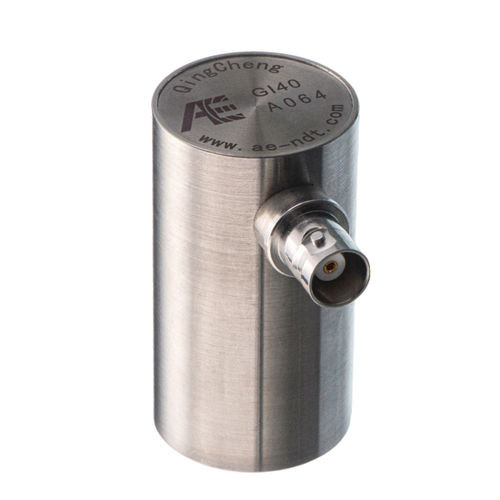
An acoustic emission sensor is mounted close to the bearing position using appropriate coupling. The signals are then amplified and acquired by an AE monitoring system.
The purpose of the demonstration is not simply to show that a defective bearing is “louder.” Instead, it demonstrates that changes in the microscopic mechanical interactions inside the bearing produce measurable differences in AE activity.
What Can Be Observed?
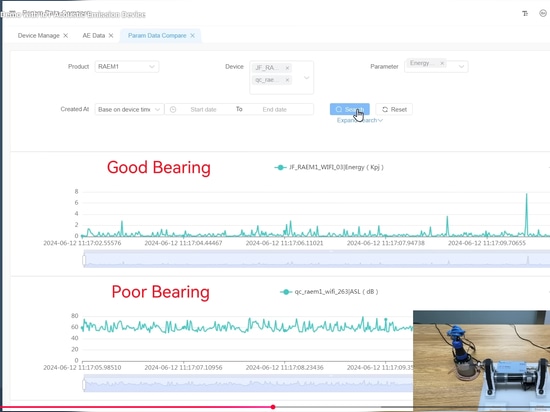
With the healthy bearing running, the detected acoustic emission activity is generally relatively stable and low.
When the faulty bearing is installed, the AE response changes noticeably.
Depending on the defect type and operating condition, this may appear as:
increased AE amplitude;
more frequent transient events;
higher RMS or energy levels;
repeated impact-related bursts;
changes in signal distribution over time;
increased activity associated with friction or damaged rolling surfaces.
The difference between the two conditions can often be observed directly in the acquired waveform or trending parameters.
This makes the demonstration particularly useful for explaining how AE condition monitoring works in a real rotating system.