#Product Trends
Rotating Machinery Condition Monitoring with Acoustic Emission
Detect Bearing and Mechanical Faults at an Earlier Stage
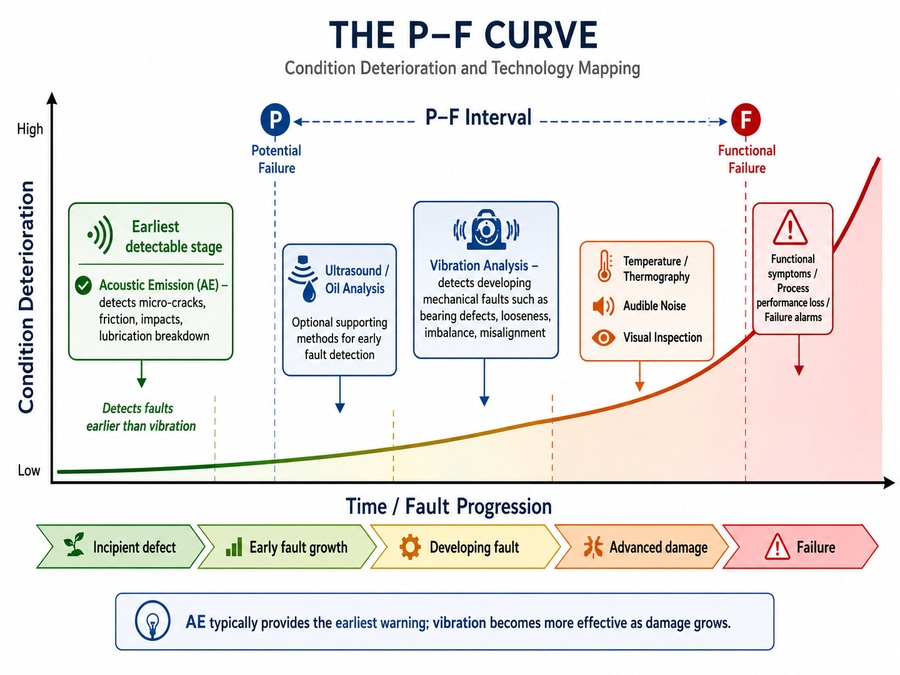
Bearing wear, poor lubrication, surface damage and friction can begin long before a machine shows obvious vibration, temperature rise or performance degradation.
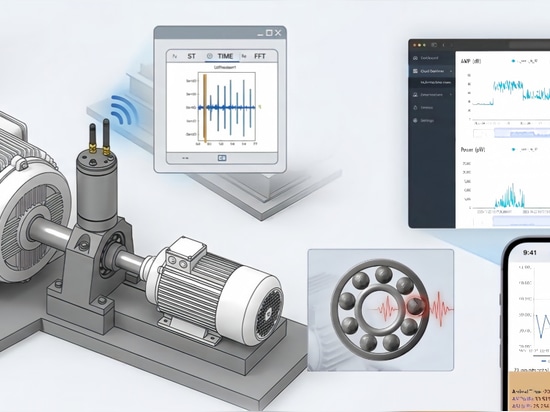
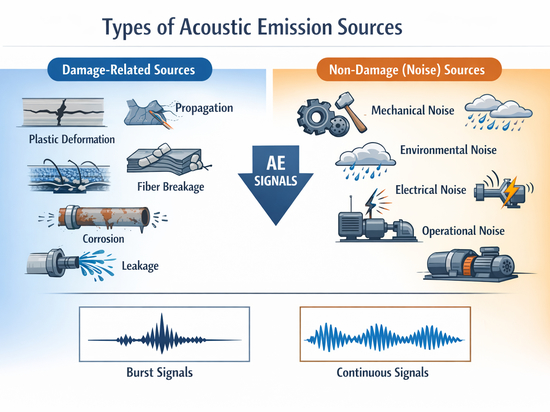
Acoustic Emission (AE) monitoring detects high-frequency elastic waves generated by microscopic friction, impacts, wear and material damage inside operating machinery.
Because these signals can appear during the early stages of degradation, AE provides maintenance teams with an additional early-warning tool for identifying developing mechanical problems — particularly in bearings and low-speed rotating machinery.
AE Does Not Replace Vibration. Acoustic emission and vibration monitoring are complementary technologies. AE is particularly valuable for detecting early friction, lubrication and localized surface damage. Vibration analysis remains highly effective for machine dynamics and developed mechanical faults. For critical machinery, combining both technologies can provide broader coverage across the complete fault-development process.
Low-speed bearings are one of the strongest applications for acoustic emission monitoring. When rotational speed decreases, vibration energy associated with a localized bearing defect can become very weak. However, each contact between a rolling element and a damaged surface may still produce a short-duration high-frequency acoustic emission signal. AE can therefore be effective for monitoring slow-speed bearings.
If you want to know more about the solution, please see our website for full information. https://www.aendt.com/solutions/s7/