#Product Trends
Thermal Camera Specifications: What to Check Before Buying
The right thermal camera is not necessarily the model with the highest specifications on its datasheet. It is the model whose resolution, lens, sensitivity, measurement range, and reporting workflow best match your inspection requirements.
The right thermal camera is not necessarily the model with the highest specifications on its datasheet. It is the model whose resolution, lens, sensitivity, measurement range, and reporting workflow best match your inspection requirements.
Before comparing thermal camera specifications, define the smallest target size, the closest and farthest working distances, the expected temperature span, and whether you need a qualitative image or a radiometric temperature measurement. Those requirements determine which specifications matter most.
For most buyers, the priorities are: native infrared resolution and field of view, focus, thermal sensitivity, temperature range and accuracy, then frame rate, durability, file format, and analysis software. Each specification serves a different purpose, and no single one tells the whole story.
Thermal Camera Specifications at a Glance
Specification What it tells you What it does not prove
Native IR resolution Number of independent detector pixels Whether the lens resolves your target
at the required distance
FOV (Field of view) Width and height of the captured scene Whether a small target fills enough pixels
for measurement
Focus Whether the thermal image is sharp Temperature accuracy by itself
at the working distance
NETD Ability to distinguish low thermal Absolute temperature accuracy
(thermal sensitivity) contrast under stated test conditions
Measurement range Calibrated temperature span Equal accuracy across all conditions and surfaces
Accuracy Expected agreement with Performance with incorrect emissivity
a reference under stated conditions or insufficient target size
Frame rate Image update frequency Spatial detail or radiometric accuracy
Durability and Reliability Resistance to environmental stress Detector resolution or optical performance
and long-term operational stability
Software and Workflow Ease of data processing, reporting, Hardware imaging capability
and integration into inspection workflows
Start With the Target, Distance, and Decision
Specification selection starts with the application. A building inspector looking for broad insulation patterns has different optical and thermal sensitivity requirements from a technician inspecting a small electrical connection across a restricted work area. A fixed process camera also has different power, interface, and data requirements from a handheld inspection instrument.
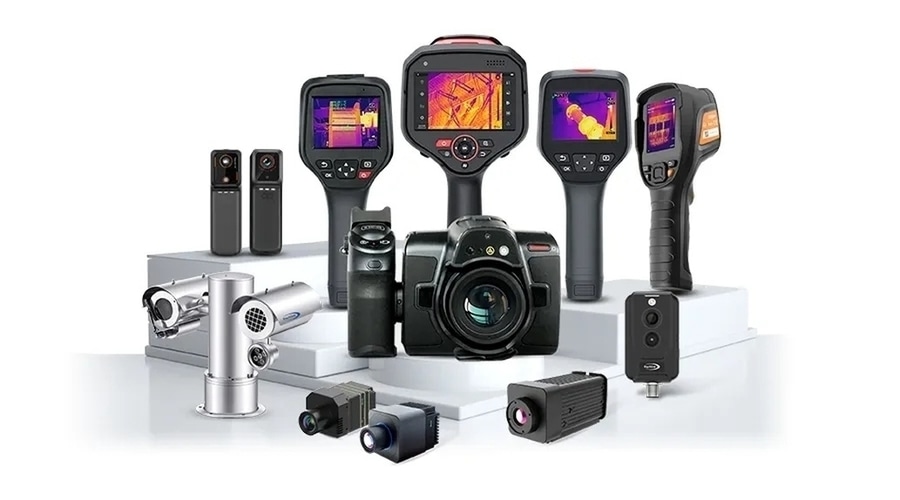
Handheld Thermal Camera
Fixed Thermal Camera
Define whether the task is detection, inspection, or measurement. Detection asks whether a thermal anomaly is present. Inspection asks where it is and how it relates to surrounding components. Radiometric measurement adds requirements for calibration, target fill, focus, emissivity, reflected radiation, distance, and atmospheric conditions.
The intended thermal imaging application should therefore be documented before a lens or detector is selected. Give the supplier the smallest target dimensions, minimum and maximum distances, required scene width, expected temperatures, and what you need the inspection to confirm. That brief is more useful than asking for the “highest-resolution” camera without context.
Evaluate Resolution, Field of View, and Focus Together
Native Infrared Resolution
Native infrared resolution is the number of detector elements that independently sample the scene. A 640 × 512 detector provides more native thermal pixels than a 256 × 192 detector, but that comparison is meaningful only when the lens, distance, and scene are also considered.
Do not confuse native resolution with the displayed image size. Interpolation and image enhancement may improve presentation, edge appearance, or readability, but they do not create the same independent scene samples as additional detector elements. When evaluating thermal imaging systems, ask suppliers to state native detector resolution separately from enhanced output resolution.
Field of View and Pixels on Target
Field of view is set by the detector format and lens. A wide field of view captures a larger area of the scene but distributes the detector pixels over a larger area. A narrow field of view covers a smaller area while placing more pixels on a distant target. The correct choice depends on both the required scene coverage and the size of the smallest target.
For measurement, a target should occupy more than a single detector pixel. Optical blur, detector sampling, focus, and the camera’s measurement algorithms all affect the effective measurement area. Some manufacturers provide a measurement IFOV or spot-size criterion for the exact camera-and-lens combination. These documented values should be used instead of relying solely on theoretical geometric IFOV when determining whether a measurement is valid.
Focus and Working Distance
Focus and working distance are closely linked optical factors in thermal imaging. Fixed-focus designs are convenient when all targets fall within their intended depth of field. Manual or autofocus systems support varying distances, but the image must still be properly focused at the target plane. Soft focus mixes radiation from adjacent areas and reduces both detail and measurement accuracy.
Before purchase, request a field-of-view calculation for both the minimum and maximum working distances. Confirm that the full scene fits while the smallest target still spans the required measurement area. When the inspection is critical, test the proposed camera and lens on a representative target before deployment.
NETD Is Thermal Sensitivity, Not Measurement Accuracy
Noise-equivalent temperature difference, or NETD, describes how small a temperature difference the imaging system can distinguish from noise under stated test conditions. It is usually expressed in millikelvin (mK). A lower NETD indicates higher thermal sensitivity, allowing the system to detect smaller temperature differences and produce clearer thermal contrast when tested under comparable conditions.
However, NETD is not a measurement accuracy specification. Measurement accuracy describes how closely a reported temperature is expected to match a reference value under defined calibration conditions. A camera can show subtle thermal patterns and still produce a poor field measurement if the target is too small, out of focus, highly reflective, affected by atmospheric attenuation, or measured with the wrong emissivity setting.
NETD values also need context. Target temperature, lens aperture, frame rate, signal processing, and the reporting convention can affect the stated result. Compare values only when the test conditions are available and reasonably consistent.
Lower NETD matters most when the inspection depends on low thermal contrast, such as subtle building-envelope patterns or small temperature differences across a process surface. When the target-to-background contrast is already large, optical detail, measurement range, focus, durability, or reporting functions may be more important purchasing criteria.
The correct question is not “Which camera has the lowest NETD?” It is “What level of thermal contrast must this inspection detect, under what conditions, and which other specifications determine whether that contrast is usable?”
Match Temperature Range and Radiometry to the Task
Measurement Range and Accuracy
Measurement range is the temperature span over which a radiometric camera is calibrated to report values. Some instruments divide that span into separate ranges with different operating settings or accuracy statements. Choose a range that covers the expected minimum and maximum temperatures with a sensible margin; do not select a camera solely because it offers the widest measurement range or the highest upper temperature limit.
Check the accuracy statement for every range you expect to use. It may be expressed as an absolute temperature, a percentage of the reading, or whichever value is greater. The specification applies only under defined test conditions, not to every material or operating environment.
Radiometry and Saved Measurement Data
Field measurements also depend on the radiometric model. Relevant measurement correction inputs may include emissivity, reflected apparent temperature, distance, atmospheric transmission, and transmission through an external window. These are not “accuracy settings”. They are inputs used to estimate how much of the radiation reaching the detector came from the target.
Not every thermal camera provides calibrated temperature data. Imaging-only cameras can reveal relative thermal contrast without reporting radiometric values. If the task requires measurement, verify that saved files preserve the required radiometric data and that the software supports the necessary correction inputs and analysis tools.
Ask how calibration is verified, which lens and range the accuracy specification covers, and whether the documentation fits your quality process. Avoid copying a generic accuracy figure into a purchase requirement without its conditions.
Check the Specifications That Affect Field Use
Frame Rate and Environmental Fit
Frame rate matters when the target moves, the camera moves, or the thermal event changes quickly. A higher rate can make dynamic scenes easier to observe. It does not increase native spatial resolution or prove temperature accuracy. For stationary inspection targets, other specifications may have greater practical value.
For handheld thermal cameras, compare battery runtime, ingress and drop protection, operating temperature, control layout, display visibility, storage, and annotation features.
For fixed thermography cameras, review power, network interfaces, alarm outputs, time synchronization, environmental protection, mounting, and service access. Use the ratings for the exact configuration rather than assuming that every product in a category is equivalent.
File Formats, Software, and System Testing
Data format and software deserve the same attention. A screenshot, ordinary video file, and fully radiometric still image do not contain the same measurement information. Confirm what the camera saves and whether the thermal analysis software can apply supported correction parameters, create measurement areas, export data, and generate the reports your process requires.
A useful procurement test uses the complete proposed setup: camera, lens, external window if present, mounting, software, and representative target. A datasheet comparison should narrow the options; a field-relevant evaluation should confirm the decision.
Thermal Camera Buying Checklist
Before approving a camera, confirm:
1. The smallest target is resolved at the maximum working distance.
2. The lens covers the required scene at every planned distance.
3. Native detector resolution is stated separately from enhancement.
4. NETD test conditions and required thermal contrast are understood.
5. Expected temperatures fall within an appropriate calibrated range.
6. Accuracy conditions and radiometric correction inputs fit the task.
7. Focus, frame rate, protection, file format, and software support the workflow.
FAQ
Is a 640 × 512 thermal camera better than a 256 × 192 camera?
It provides a higher native pixel count, but suitability still depends on the lens, field of view, target size, distance, focus, sensitivity, and measurement requirements. A higher detector count cannot compensate for the wrong optics or range.
Does lower NETD make a camera more suitable?
A lower NETD is valuable when the task depends on low thermal contrast. It may provide little practical benefit when contrast is already high and another limitation—such as target size, focus, range, or data workflow—controls the result.
What temperature range should I choose for a thermal camera?
Choose a calibrated range that covers the coldest and hottest surfaces you expect, with enough margin for normal variation. A higher maximum temperature does not make a camera better for every task. Check the accuracy statement and operating conditions for the specific range you will use.
Which camera adjustments can influence temperature measurement?
Focus, emissivity, reflected apparent temperature, target distance, atmospheric inputs, and transmission through an external infrared window can influence a radiometric temperature estimate. Target size and measurement-area placement also matter. Display palette, level, and span change how the image looks, but they do not by themselves correct the measurement model.
Conclusion
Thermal camera specifications should be evaluated based on the requirements of the application. Define the target, distance, temperature span, and inspection objective first. Then compare resolution and optics, sensitivity, radiometric performance, and workflow features as one system.
If you are comparing thermal cameras for temperature measurement for an industrial inspection or fixed monitoring project, Raythink can help review the target dimensions, distance, temperature conditions, and required outputs before recommending a configuration. A technical evaluation provides a stronger starting point than comparing isolated specifications.