#Product Trends
Can Thermal Cameras See Through Fog, Rain, and Smoke?
Thermal cameras often maintain thermal contrast in light fog, light rain, and certain smoke environments, while visible-light images begin to lose clarity. They cannot see through every weather condition or type of smoke. Dense fog and heavy rain red
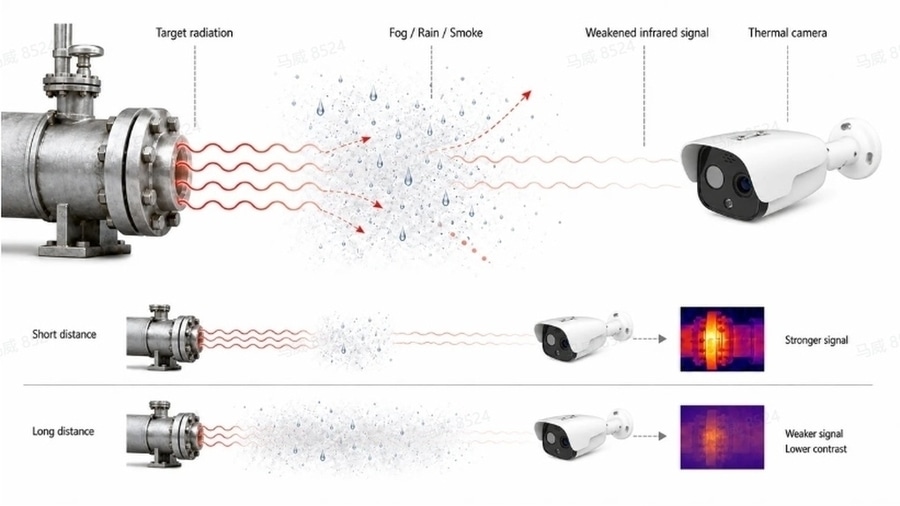
Thermal cameras often maintain thermal contrast in light fog, light rain, and certain smoke environments, while visible-light images begin to lose clarity. They cannot see through every weather condition or type of smoke. Dense fog and heavy rain reduce the infrared signal reaching the camera. Dense smoke can greatly reduce the target signal, while hot smoke can emit infrared radiation that hides the target.
Atmospheric condition Typical detection result Why detection becomes harder
Light fog Thermally contrasted targets often remain detectable at short to moderate range. Suspended water droplets attenuate the target signal.
Dense fog Detection range may decrease substantially, and the advantage over visible imaging may become limited. Higher droplet density and a longer viewing path increase signal attenuation.
Light rain Targets with strong thermal contrast often remain detectable. Rain attenuates target radiation and may cool exposed surfaces, reducing thermal contrast.
Heavy rain Detection range may decrease substantially. Dense rainfall attenuates the target signal, while water on the camera window further reduces image contrast.
Cool, diffuse smoke Warm targets may remain detectable. Suspended particles attenuate the target signal, especially at higher densities and longer viewing distances.
Dense or hot smoke Targets may become difficult or impossible to detect. Soot and steam attenuate the target signal, while hot gases and particles can add infrared radiation that masks it.
The answer also depends on the purpose of the inspection. A camera may still detect the presence of an object after the image has lost enough detail for identification or reliable temperature measurement.
What Does “See Through” Mean in Thermal Imaging?
The phrase “see through” suggests that fog, rain, or smoke becomes transparent. Thermal imaging does not work that way. Infrared radiation from the target must still travel through the atmosphere and the camera optics before reaching the detector. Droplets, particles, and gases along that path can attenuate the target signal, while warm obscurants may add infrared radiation of their own.
In practice, whether a thermal camera can “see through” an obscurant (such as fog, rain, or smoke) depends on the required task. Detection means determining that an object or thermal anomaly is present. Classification or identification requires enough detail to distinguish the target at the level required by the application. Radiometric measurement uses detected radiation to estimate the apparent surface temperature.
These tasks have different performance limits. A warm target may remain detectable after its outline becomes too weak for identification, while reliable temperature measurement may fail even earlier because the atmosphere alters the radiation reaching the detector. Any performance claim should therefore specify both the atmospheric condition and the required task.
Why Thermal Imaging Can Outperform Visible Imaging
Visible cameras mainly record light reflected from a scene. Fog droplets, rain, and smoke particles scatter that light, which reduces contrast and causes a hazy appearance.
Thermal cameras detect infrared radiation within a defined spectral band. Under certain atmospheric conditions, thermal infrared radiation can pass through fog or smoke more effectively, allowing warm targets to remain detectable even when visible images have degraded. This gives thermal imaging an advantage in some conditions, but it does not make the camera immune to the atmosphere.
If the fog or smoke is warm, it can add infrared radiation to the image and reduce the difference between the target and its background.
As radiation travels toward the camera, water, gases, and particles can absorb part of it. Droplets and particles can also scatter radiation away from the camera. If the fog or smoke is warm, it can add infrared radiation to the image and reduce the difference between the target and its background.
The target signal experiences greater attenuation over longer viewing distances. A thin layer of mist over a short distance may cause little loss, while the same mist over a much longer path can attenuate the signal enough to prevent detection.
Camera design also affects whether the weakened target signal produces usable detail. The lens determines how large the target appears, while detector sensitivity, focus, and processing affect how clearly the remaining contrast is displayed. A larger target or greater thermal contrast is generally easier to detect.
Can Thermal Cameras See Through Fog?
Thermal cameras often preserve more usable contrast than visible-light cameras in light or moderate fog. Dense fog can still significantly reduce thermal detection range because suspended water droplets absorb and scatter infrared radiation.
55x zoom, observing targets at 2.2km, in foggy weather at dusk
How Distance and Target Contrast Change the Result
A nearby target viewed through thin mist is not comparable to a distant target behind a dense fog bank. The infrared signal becomes weaker as it travels through more fog, so a target that is clear at short range may disappear at a longer distance.
The target also needs enough contrast with its background. A large, warm object against a cooler background can remain detectable after a small or low-contrast target has disappeared. Higher detector resolution can help only when enough signal reaches the camera. The lens, focus, target size, and distance determine how many useful pixels cover the target.
Atmospheric models can estimate transmission when the fog condition and system inputs are known. The accuracy of the estimate depends on how closely actual conditions match those assumptions. Research on thermal-imager range prediction shows that useful estimates must account for atmospheric transmission, target characteristics, optics, detector performance, and the required detection or identification task.
How Fog Affects MWIR and LWIR Images
MWIR and LWIR do not respond identically to every type of fog. Atmospheric transmission may be higher in one band under a particular fog condition, but neither is best in every situation. Detector sensitivity, lens transmission, the target spectrum, and radiation from the atmosphere also shape the final image.
Fog may soften edges and hide small targets before a larger target disappears completely. Automatic image enhancement can stretch the weak contrast that remains, making the display look clearer. It cannot recover target information that never reached the detector. Judge performance with a defined target and task rather than a display screenshot alone.
Can Thermal Cameras See Through Rain?
Light rain often allows useful thermal imaging at shorter distances, especially when the target is much warmer or cooler than the background. Heavy rain can reduce both image contrast and detection range.
How Rain Affects the Signal and Camera Window
Raindrops absorb and scatter some of the infrared radiation traveling toward the camera. Water on the protective window can reduce transmission and degrade image quality. Rain also cools exposed surfaces, which may reduce the thermal contrast that makes the target visible.
The enclosure protects the camera hardware from water ingress. Its IP rating describes the level of protection verified under standardized tests; it does not guarantee a clear thermal image through rainfall or a wet optical window. Evaluate mounting angle, drainage, window design, and cleaning access separately. If the installation uses a wiper or protective cover, confirm that it is suitable for the infrared window.
Why Heavy Rain Reduces Detection Range
Heavy rain places more water in the optical path, so less target radiation reaches the camera. The loss becomes greater over a longer viewing distance. Wind-driven rain can also wet one side of the camera window more severely than a static ingress test suggests.
Rain changes the scene as well as the optical path. It can cool surfaces and make the target and background approach the same temperature. In that case, the atmosphere may still transmit enough infrared radiation, but the camera no longer receives enough contrast for reliable detection. Sheltered targets or equipment that retains process heat may remain easier to see.
Can Thermal Cameras See Through Smoke?
Thermal cameras can detect warm targets through some smoke, but the result changes with smoke density, temperature, and viewing distance. Cool, diffuse smoke is usually easier to image through than dense smoke near an active heat source.
How Smoke Density and Temperature Affect the Image
Cool, diffuse smoke may block visible light while allowing enough thermal infrared radiation to preserve target contrast. Dense soot, high particle concentrations, or a long path through smoke can attenuate the target signal more strongly.
Visible Light Camera ImageVisible Light Camera Image
Infrared Thermal Camera ImageInfrared Thermal Camera Image
Hot smoke creates a different problem. Hot gases, particles, and flames can add infrared radiation that masks the target. Thermal turbulence can also distort target boundaries and make the image appear unstable. A bright area in a thermal image may therefore be radiation from the smoke or flame rather than the surface behind it.
Why One Smoke Test Cannot Predict Every Scenario
One smoke test cannot represent every scenario because smoke composition, particle concentration, temperature, and viewing distance vary with the source and the way the plume develops.
Smoke from different sources can contain different amounts of water vapor, soot, ash, aerosols, and combustion gases. Its particle distribution also changes as the plume cools and mixes with air. A camera that detects a target through cool, dispersed smoke may not provide the same result through dense, hot smoke.
The relative temperatures of the target, background, and smoke determine how much contrast remains. A warm object behind cool smoke may stand out clearly, while hot smoke can mask it. Flames and hot particles may also dominate the camera’s automatic gain control and hide weaker target details.
How to Test a Thermal Camera for Fog, Rain, or Smoke
A useful test starts with the task, not a general all-weather claim. The distance at which a camera can detect or identify a target depends on the atmosphere, lens, target size, and thermal contrast. For more detail, see how far a thermal camera can see.
Define the target and task. State the target size, viewing distance, field of view, and minimum thermal contrast. Decide whether the camera must detect, identify, or measure the target. Different thermal imaging applications need different test criteria.
Record a clear-condition baseline. Test the complete installed system with the intended camera, lens, focus, mounting position, and target. The baseline shows how much image detail and contrast are available before environmental effects are introduced.
Repeat the test in representative conditions. Keep the target position and decision criteria consistent. Record the viewing distance, fog visibility or rain intensity, type of smoke, and condition of the camera window. Compare whether the operator can still complete the intended task, not merely whether an image remains on the screen.
Inspect the optical path. Condensation, water films, dirt, external windows, and protective housings can reduce image quality independently of the atmosphere. Check drainage, cleaning access, focus, and mounting stability.
Set an operating limit for each task. Detection may remain possible after identification has failed. Long-range temperature measurement also requires a suitable atmospheric correction model; unaccounted transmission loss can reduce thermal imaging accuracy even when the target remains visible.
For fixed-site monitoring, explore Raythink’s fixed thermal security cameras. Select the camera and lens based on target size, viewing distance, field of view, and whether the task is detection or identification.
FAQ
Can a higher-resolution thermal camera see more clearly through fog or smoke?
Only if enough target signal reaches the detector. More pixels can preserve image detail, but they cannot recover radiation absorbed or scattered by dense fog or smoke. The lens, target size, and viewing distance still determine how many useful pixels cover the target.
Can image enhancement recover detail lost in bad weather?
Image enhancement can make weak contrast easier to see, but it cannot recover detail that never reached the detector. Aggressive processing may also emphasize noise or structure in the fog or smoke, so judge the processed image against the intended task.
Can a thermal camera measure temperature accurately through fog or smoke?
Not reliably unless the atmospheric effect is known and included in the measurement setup. Fog and smoke can weaken the target radiation and introduce additional radiation from the atmosphere. A target may remain visible even when its displayed temperature is no longer dependable.
Does an IP rating mean a thermal camera will see clearly in heavy rain?
No. An IP rating describes the enclosure’s tested protection against water and dust ingress. Heavy rain can still weaken the target signal, wet the optical window, and reduce thermal contrast in the scene.
Conclusion
Thermal cameras often provide an advantage over visible-light cameras under certain fog, rain, and smoke conditions. Dense fog, heavy rain, and hot or concentrated smoke can still reduce detection range or hide the target.
Define whether the camera must detect, identify, or measure the target, then test the complete installed system at the required distance under representative conditions. This provides a realistic operating limit without turning a conditional advantage into an absolute “see through” claim.