#Product Trends
Fixed Focus vs Manual Focus Thermal Cameras: Which Is Right for Your Inspection?
Choose fixed focus when you inspect similar targets from predictable distances and want to capture images without adjusting focus each time. Choose manual focus when the distance changes frequently or you need to focus precisely on a close or small c
Choose fixed focus when you inspect similar targets from predictable distances and want to capture images without adjusting focus each time. Choose manual focus when the distance changes frequently or you need to focus precisely on a close or small component.
Neither system is inherently better. The best choice is the camera and lens combination that can clearly capture your smallest target at both the closest and farthest inspection distances.
Fixed focus vs manual focus at a glance
Your inspection conditions Better starting point What to test
Similar targets at predictable distances Fixed focus Photograph the smallest target at the nearest and farthest positions
Targets at several distances or depths Manual focus Confirm that the operator can refocus before every capture
Close or very small components Either may work Check minimum imaging distance, lens, field of view, IFOV, and detector resolution
Many images on a routine route Fixed focus Follow the normal workflow and compare capture time and image quality.
Mixed-distance troubleshooting Manual focus Test near and far targets under normal access conditions
If both systems produce usable images throughout the real inspection, either can be a valid choice. Workflow, controls, reporting features, and the rest of the camera specification can then decide the result.
How the two focus systems change the inspection
A fixed-focus thermal camera does not require the operator to refocus for every image. This removes one step from the capture process and can suit routine rounds where target sizes and working distances remain similar.
The tradeoff is that the camera’s designed focus range must suit the inspection. Before choosing one, test the nearest target, the farthest target, and the smallest component you need to examine. Review the saved thermal images, not only the live display.
A manual-focus thermal camera lets the operator adjust focus for the target. That control is useful when the target plane changes, when equipment sits at different depths, or when the inspector moves between a broad assembly and small components.
Manual focus also adds an extra step for the operator. The team needs enough time to adjust the focus and a simple way to confirm that the image is in focus before saving it.
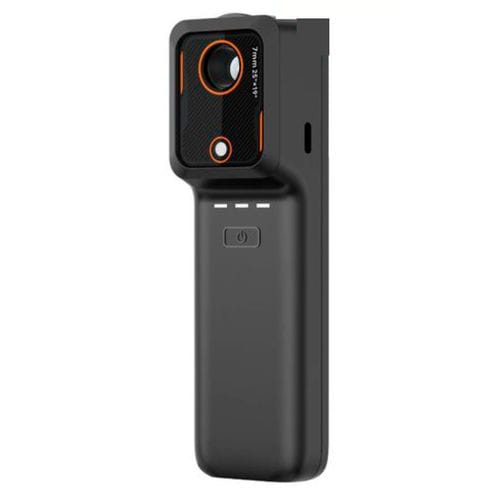
Raythink IX2 AIR Pro Wireless Thermal Camera
Focus mode is separate from focal length and field of view. Check all three for the exact camera and lens. Autofocus, assisted focus, and motorized focus are additional systems and should be evaluated separately.
Why a sharp image is not the only requirement
Focus determines whether target boundaries appear clear, but a sharp-looking display does not prove that a small target can be measured reliably.
Consider a small hot connection surrounded by cooler material. If the hot area covers too few detector elements, its signal can be averaged with the cooler background. The displayed peak may therefore be lower than the hottest part of the real target.
This is why target size, working distance, lens, field of view, IFOV, and detector resolution must be considered together:
Field of view (FOV) describes how much of the scene the camera sees.
Instantaneous field of view (IFOV) describes the angle represented by one detector element. At a given distance, it helps estimate how much area that element covers on the target.
Detector resolution is the number of thermal detector elements available to form the image.
Minimum imaging distance is the closest distance at which the specified camera-and-lens configuration is designed to produce a usable image.
For practical selection, save images of your smallest target at the planned distances. Confirm that you can distinguish its boundaries and place the measurement area without including too much surrounding background. A broader industrial thermal-camera selection guide explains the other specifications that should be reviewed in addition to focus.
Use four inputs to make the choice
Write down four facts before comparing products. They create a useful configuration brief for your team or supplier.
1. Smallest critical target
Identify the smallest component or feature that the inspection must distinguish. Do not base the decision on the largest object in the scene.
Test that target with the planned lens and working distance. If both focus types produce a usable image, the capture workflow may decide the choice. If the operator must adjust focus deliberately to show the feature clearly, manual focus becomes the stronger candidate.
2. Nearest, typical, and farthest distance
Record the actual inspection range rather than testing at one convenient demonstration distance. The closest target is especially important because minimum imaging distance varies by camera and lens.
Predictable distances can favor fixed focus. A wide range of target planes can favor manual focus when the operator has time and access to refocus.
3. Number of captures and frequency of distance changes
Count how many images a normal route requires and how often the target distance changes. Then trial the camera using the real sequence.
Removing the manual focus step may help on a high-volume route with stable geometry. Manual focus may be worth the extra step during mixed-distance troubleshooting.
4. Reporting requirement
Decide whether images are used for quick anomaly screening, comparison over time, or formal radiometric reports. More demanding records need a consistent capture process and a clear rule for accepting or retaking an image.
Whichever focus mode you choose, review the saved radiometric file in the intended reporting software. Do not judge the result only from the camera display.
How the choice changes in real inspections
Routine electrical rounds
Fixed focus can work well when inspectors view similar cabinets from consistent distances and positions. Test the smallest connection at the nearest and farthest cabinets before standardizing the route. If access distance or component depth changes frequently, manual focus may provide better control.
For the wider purchasing requirements around resolution, IFOV, temperature range, reporting, durability, and working distance, use the electrical-inspection thermal-camera checklist.
Mixed-distance mechanical troubleshooting
Manual focus is often the better starting point when the operator moves between an entire machine and smaller bearings, couplings, or electrical components. Test whether focus can be adjusted and confirmed under the real access conditions, including any personal protective equipment.
Building and HVAC surveys
Either system may fit. Fixed focus can suit a standardized route across similar equipment, while manual focus can help when the inspector alternates between broad surfaces and smaller details. Define the smallest feature that matters and test it at the actual working distances.
PCB and precision inspection
Short working distances and small components make the exact lens and minimum imaging distance especially important. Manual focus can be a strong candidate, but a fixed-focus configuration may also work when its near limit and target coverage are suitable.
Use the PCB thermal-camera selection guide to develop more detailed requirements for component size, lens, distance, and image coverage.
What to verify before buying
Treat the words fixed focus and manual focus as the start of the comparison. For each shortlisted camera and lens:
Confirm the focus mode and how the operator uses its controls.
Record the minimum imaging distance and any stated focus range.
Test the smallest target at the nearest, typical, and farthest distances.
Check that target boundaries and the intended measurement area remain clear in saved radiometric images.
Match the field of view, IFOV, and detector resolution to the target and distance.
Check the temperature range and the conditions attached to the accuracy specification.
Repeat the normal capture sequence with the people who will perform the inspection.
Define when an image is accepted and when it must be retaken.
Fixed-focus cameras do not all share the same minimum imaging distance. For example, Raythink|Raytron Industrial lists a minimum imaging distance of 0.3 m for the CX20 Pro and 11 cm for the EX10. If you inspect targets at close range, check this specification for the exact camera rather than relying on the “fixed focus” label alone.
If a product page does not list the minimum imaging distance, ask the manufacturer for the value for the current lens or datasheet, and test the proposed configuration before procurement.
Choose the system that performs well in your real inspection
Fixed focus works well when inspection distances are predictable and repeated captures are required, provided the important targets remain clearly visible throughout the inspection range. Manual focus is better suited to applications where target distance varies and the operator needs direct control over focus.
The final choice should come from a short trial using the smallest target, actual working distances, normal operator, and intended reporting process.
Share those details with Raythink|Raytron Industrial: the smallest target, nearest and farthest distance, number of captures, frequency of distance changes, and reporting requirement. The team can use them to narrow down the focus and lens configurations and identify the specifications to verify next.