#Product Trends
Sampling from mixers with wall-mounted agitators
Whether pharmaceutical products, food/feed, or minerals, reliable quality assurance today requires companies to con-stantly monitor to meet prevailing quality standards and guarantee seamless traceability.
Processing low-quality raw materials can also have financial implications. Additionally, there are costs and reputation losses due to material recalls. For this reason, the verifica-tion of raw materials at the beginning of the processing pro-cess is of paramount importance. Samplers are used for reliable quality assurance in the following areas:
• Upon goods receipt to check the delivered quality,
• In production for precise process control, and
• During filling and loading for output control.
Selection of the Right Sampler
In general, the specific use case must be thoroughly exam-ined before using a sampler. The following factors influence the choice of the sampler:
Material Parameters: Important for the sampler's choice is whether the process material is solid, liquid, or gaseous. Additional parameters such as viscosity or chemical proper-ties must also be considered.
Process Parameters: In which area is the sampler used? Each environment imposes its own requirements on the sampler's material and the seals used.
Flow Speed: How fast does the process material flow? The sampler must be designed for the forces exerted by the ma-terial.
Pressure: Higher pressures in the system pose greater chal-lenges to the sampler than systems operating at ambient pressure. Negative pressures should also be taken into ac-count.
Temperature: The materials used in the sampler must be able to withstand the process and material temperatures.
ATEX: If the sampler is used in an explosion-prone envi-ronment, it must be designed for this purpose. Installation Location: The planned installation location has a significant influence on the sampler's choice. Here, the primary distinc-tion is between stationary (e.g., in tanks, silos) or flowing (e.g., in pipelines) materials. For instance, a cup sampler can only be used in applications with falling material. In con-trast, auger samplers can also be used in containers filled with material.
Collision Consideration: If movable parts are located within the process space, such as in mixers, care must be taken to avoid collisions with the sampler, as these often lead to damage and plant failure.
The next section, therefore, focuses on the peculiarities of sampling in mixers.
Challenges in Sampling from Mixers
Mixers come in various designs and applications. However, when the agitator is flush-mounted, there is a risk of collid-ing with the sampler during operation. There are various ways to prevent a collision:
1. Install the sampler only when the agitator is not in-stalled, e.g., with fold-out agitating mechanisms, or when it's stationary. As a result, no samples can be tak-en during the mixing process.
2. Design a recess in the agitator for the sampler. This al-lows the sampler to remain continuously in the process without colliding. On the other hand, this can lead to dead spaces or insufficient mixing of the material.
3. Design the sampler so that it is flush with the container wall and can still take material. For this purpose, REM-BE® Kersting GmbH has developed a new pneumatic sampler, which will be discussed in the next section.
Mobile Auger Sampler
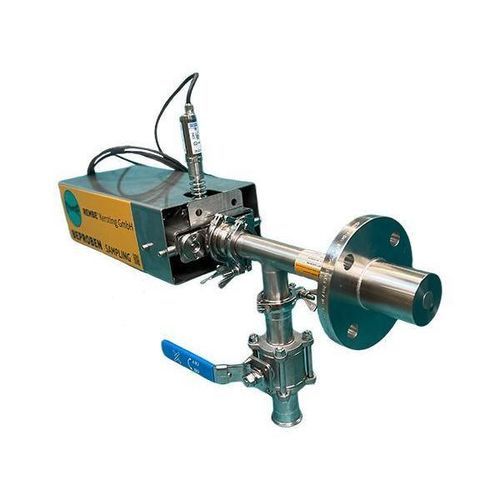
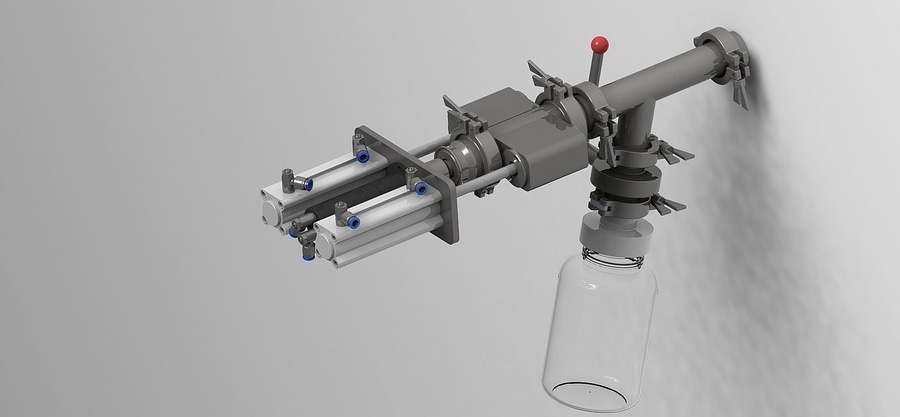
The following illustration shows the structure of the new pneumatic "SAMscrewtasty", specially developed for mix-ers with flush-mounted agitators. The sampler is equipped with an auger that can also move linearly. The sampler can be separated from the environment with the red hand lever.
The sampling is done in 6 steps:
1. The sampler is in its basic position. The auger has moved all the way forward, pressing against a sealing surface in the welding flange.
2. The auger moves back pneumatically, opening a sample chamber.
3. The agitator introduces process material into the sam-ple chamber.
4. The auger rotates forward, closing the sample chamber.
5. The sample is carried to the sample outlet by rotating the auger backward.
6. The sampler is back in its basic position, ready for an-other sampling. This design ensures that no material enters the auger in its basic position. Additionally, the process is sealed from the environment, making the system suitable for hygienic applications.
This design ensures that no material enters the auger in its basic position. Additionally, the process is sealed from the environment, making the system suitable for hygienic appli-cations.
Learn more in our Blog!