#Product Trends
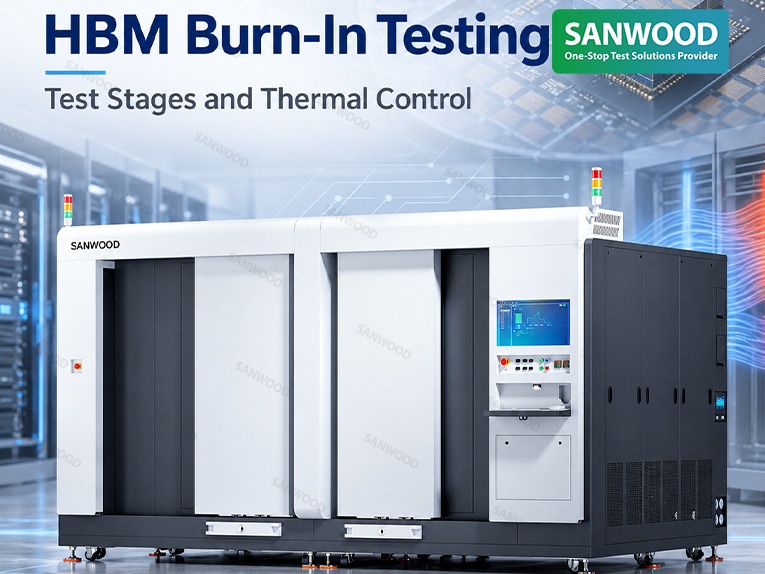
HBM Burn-In Testing: Test Stages and Thermal Control
HBM burn-in testing requirements vary by test stage, electrical access and thermal control. Review key considerations when evaluating SANWOOD Memory Burn-in Test Systems.
Memory Burn-in Test Systems play a role in semiconductor reliability testing, but HBM burn-in testing requires more than selecting a temperature range. High Bandwidth Memory (HBM) uses vertically stacked DRAM dies, creating different electrical and thermal requirements depending on the assembly being tested.
For semiconductor manufacturers and reliability engineers, understanding the relationship between the test stage, device configuration and temperature control is essential when evaluating a suitable burn-in testing solution.
How HBM Test Stages Affect Equipment Requirements
HBM testing may take place at different stages of semiconductor manufacturing, including before stacking, after stacking or following integration into a processor package.
Each stage involves different test conditions:
• Before stacking: Individual memory dies may be screened to identify early-life failures before further assembly.
• After stacking: Testing can evaluate the assembled memory stack, including its accessible electrical connections and thermal behavior.
• After package integration: Testing involves a larger assembly containing HBM, with additional heat sources and potentially different diagnostic capabilities.
These are possible test configurations rather than mandatory sequential steps. Results obtained at one stage do not automatically establish reliability at another.
The device under test (DUT) determines the required electrical contacts, thermal interfaces and suitable testing platform.
Why Temperature Control Matters in HBM Burn-In
Temperature control is an important consideration in HBM burn-in testing, particularly when devices operate under electrical stress.
However, chamber air temperature, device-surface temperature and semiconductor junction temperature are not interchangeable.
For powered HBM assemblies, actual device temperatures depend on operating conditions, heat generation and the available cooling path. Even when chamber air temperature remains consistent, different devices or operating states may experience different thermal conditions.
An HBM burn-in testing configuration should therefore define the temperature reference, measurement location, operating load and verification requirements.
Evaluating SANWOOD Memory Burn-in Test Systems
SANWOOD provides Memory Burn-in Test Systems for semiconductor testing applications. Published configurations include temperature monitoring arrangements with repositionable probes and selectable air-temperature feedback locations.
When evaluating a SANWOOD system for an HBM-related project, important considerations include:
• DUT dimensions, assembly format and test quantity
• Compatibility with burn-in boards (BIBs), carriers or other contact fixtures
• Required temperature range, monitoring locations and thermal load
• Electrical-test interfaces and integration with existing equipment
Not every HBM configuration is suitable for conventional board-based burn-in testing. Confirming the DUT's contact arrangement and thermal requirements is therefore an important part of equipment selection.
SANWOOD can review the proposed test configuration and environmental control requirements to help determine a suitable system arrangement for the application.
For more information about HBM burn-in testing, read the full article on SANWOOD's website, or explore our Memory Burn-in Test Systems to learn more about available equipment.