

#Industry News
SiC Reliability Testing: HAST Chambers and Temperature Forcing Systems
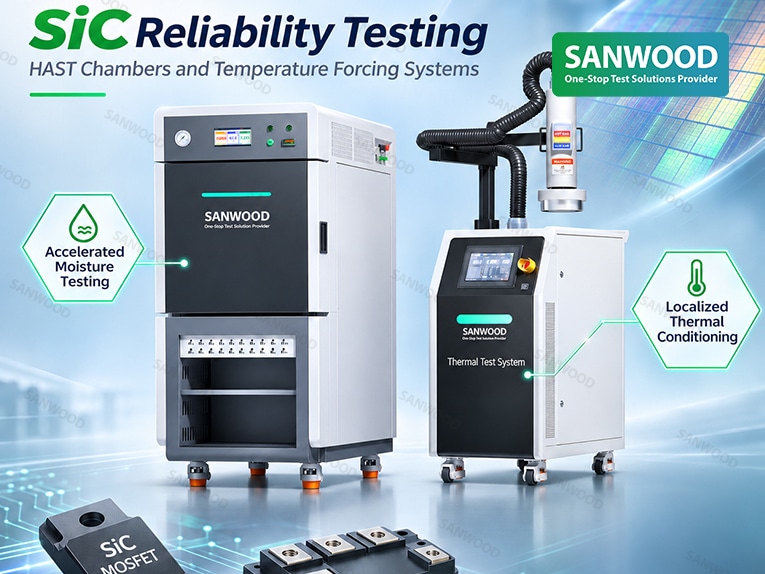
Explore SANWOOD HAST chambers and temperature forcing systems for SiC package moisture evaluation and electrical measurements at controlled temperatures.
In semiconductor reliability testing, silicon carbide (SiC) MOSFETs and power modules require careful evaluation of package moisture resistance and electrical behavior at different temperatures. These tasks involve different equipment and measurement conditions.
SANWOOD HAST Test Chambers support accelerated moisture evaluation, while SANWOOD Temperature Forcing Systems provide localized thermal conditioning for electrical measurements. Understanding their roles helps laboratories select equipment around the package, fixture and test objective.
HAST Test Chambers for Package Moisture Evaluation
Highly accelerated stress testing (HAST) exposes suitable non-hermetic semiconductor packages to elevated temperature and humidity under pressure. It supports investigation of moisture-related corrosion, insulation degradation and electrical changes.
Package construction matters. A molded SiC MOSFET and a gel-filled power module should not automatically receive the same exposure. Test conditions must follow the applicable procedure and account for material limits and relevant failure mechanisms.
For biased HAST, the equipment review should also cover the bias source, electrical feedthroughs, fixture insulation and monitoring requirements. A chamber’s environmental specifications alone do not establish high-voltage suitability.
Temperature Forcing Systems for Electrical Measurements
A SANWOOD Temperature Forcing System directs temperature-controlled air toward a device or selected test area. External instruments measure parameters such as on-state resistance, leakage current and threshold voltage.
The temperature reference needs to be clear. Delivered-air temperature, package-surface temperature and junction temperature describe different conditions. Measurements should begin when the specified sample location meets the required temperature tolerance and stabilization criterion.
For assembled power modules, busbars, mounting hardware and active cooling can affect the thermal response. Providing SANWOOD with assembly dimensions, expected heat dissipation, sensor locations and cooling status helps assess whether localized airflow suits the test.
Make Before-and-After Results Comparable
A change in an electrical reading may reflect measurement conditions as well as device degradation. Keep test voltage, current, temperature reference and readout timing consistent. SiC threshold-voltage measurements also require attention to gate-bias history, while on-state resistance measurements must account for self-heating.
Where the approved plan permits, temperature forcing can support electrical measurements before and after a separate HAST exposure. Record sample identity, recovery conditions and elapsed time before measurement. Additional heating or drying can alter retained moisture, so post-HAST temperature sweeps must remain compatible with the prescribed procedure.
These controls help laboratories interpret results while keeping each system’s role clear. HAST and temperature forcing support selected tasks within a broader reliability program; complete qualification requires the other specified tests.
Learn More
For a more detailed discussion, read the full article on the SANWOOD website: https://www.sanwood.us/news/220.html.
Explore the equipment:
https://www.sanwood.us/news/220.html
https://www.sanwood.us/products/158.html
To discuss your samples and testing requirements, contact [email protected].




 鄂公网安备42018502009509号