
#Product Trends
ESS Test Chamber Sizing: How Many PCBAs Can You Screen per Shift?
Size an ESS test chamber for PCBA production screening. Compare tray layouts, loaded temperature profiles, and boards screened per shift.
A denser tray layout can fit more printed circuit board assemblies (PCBAs) into an ESS test chamber and still put fewer boards through the chamber by the end of the shift. For production teams using temperature cycling in semiconductor reliability programs, that trade-off affects equipment selection. SANWOOD ESS test chamber sizing starts with the approved temperature profile, the proposed tray layout, and the number of boards that need to complete environmental stress screening (ESS) per shift.
Temperature cycling can help reveal intermittent workmanship defects in assemblies such as memory and storage modules, automotive control units, and communications hardware. A controller board populated with qualified memory devices may still have a marginal solder connection that passes a room-temperature check and becomes intermittent as the board heats or cools. If the screening procedure calls for detecting faults during those transitions, the chamber provides the thermal exposure while separate functional test equipment operates and monitors the boards.
Compare tray layouts by completed batches
Suppose a chamber is available for 420 minutes per shift and two tray layouts meet the same temperature profile and dwell criteria. In this hypothetical scheduling example, the wider-spaced layout holds 40 boards and occupies the chamber for 95 minutes per batch. Four complete batches put 160 boards through the chamber. The denser layout holds 48 boards, but each batch takes 115 minutes. Only three complete batches fit in the shift, for a total of 144 boards.
For this comparison, count the full time each batch occupies the chamber, from loading and connecting the boards through exposure, in-chamber checks, and unloading. When batches must finish within the shift, use the number of whole batches that fit in the available time. If the production target is accepted boards per shift, also check whether a separate functional test station can keep pace and allow for screening yield and any required retests.
Check the temperature profile with the planned load
Chamber volume describes the interior space. Usable batch capacity depends on how the boards, trays, fixtures, and cables fit while leaving room for airflow and handling. When comparing nominal ramp rates, check what temperature was measured, over which interval, and under what loading conditions. Review heating and cooling separately.
Chamber air may reach its target while a board in the middle of a loaded tray is still cooling. The screening procedure determines which measurement governs the exposure and when the dwell begins. A representative temperature record should identify the tray layout, number of boards, sensor locations, and whether the boards were powered. Those details help the production team judge whether the record represents the setup it plans to run.
What to share with SANWOOD
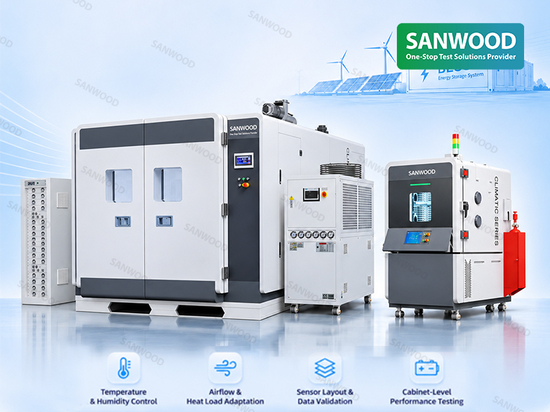
SANWOOD’s rapid-rate temperature change chambers support programmable heating, cooling, and temperature holds. For a configuration review, share the approved profile, target boards per shift, and a drawing showing tray dimensions, spacing, fixtures, and cable routing. Include the approximate total mass and main materials of the load. For powered ESS testing, specify the board operating mode, expected heat load if known, and the external equipment used for functional checks. These inputs give SANWOOD a basis for reviewing usable chamber space, connection requirements, and the loaded conditions that need verification.
For related reading, see SANWOOD’s guide to investigating ESS Test Chamber Sizing for PCBA Production Screening: https://www.sanwood.us/news/216.html.
For product details, explore SANWOOD Chambers: https://www.sanwood.us/products/65.html.