

#Industry News
AEC-Q100 Testing: HAST Chambers for Automotive IC Reliability
Understand how HAST fits into AEC-Q100 testing for automotive ICs, from bias and preconditioning to SANWOOD HAST chamber configuration and lab planning.
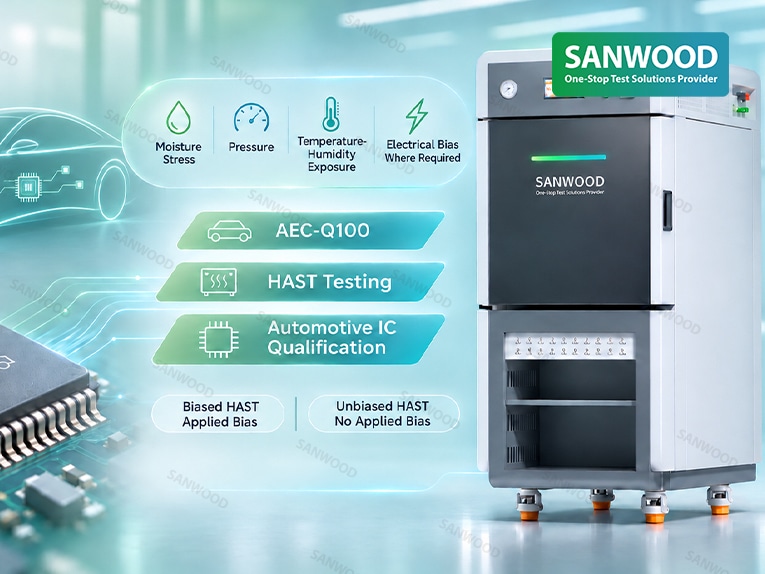
AEC-Q100 testing covers multiple reliability assessments for automotive integrated circuits. For nonhermetic IC packages, HAST testing helps evaluate moisture-related risks under accelerated temperature-humidity conditions. SANWOOD provides HAST chambers to support this environmental exposure stage.
How HAST Fits into AEC-Q100
Moisture can enter nonhermetic packaging through materials and interfaces. Elevated temperature and humidity accelerate this process, helping qualification teams investigate corrosion, insulation degradation and changes in electrical performance.
AEC-Q100 Rev. J distinguishes two relevant moisture-test routes:
A2: Temperature-humidity bias testing or biased HAST. The biased HAST method references JESD22-A110 and applies specified electrical potentials during exposure.
A3: Includes unbiased HAST under JESD22-A118 among its alternatives. Unbiased HAST uses no applied electrical bias.
Both methods involve humidity exposure and require electrical evaluation of the specimens. Completing a HAST cycle alone does not establish that a device has passed the complete AEC-Q100 qualification program.
What to Define Before Selecting a HAST Chamber
Start with the adopted qualification method and exposure recipe. For example, the Rev. J matrix lists HAST conditions of 130°C/85% RH for 96 hours or 110°C/85% RH for 264 hours. These stress conditions are separate from the IC’s operating temperature grade.
A laboratory should also define:
Sample preparation: Include applicable preconditioning and electrical checks in the test schedule.
Fixture dimensions: Review the space occupied by boards, sockets, supports and connections.
Bias requirements: Specify the electrical arrangement, relevant device heat load and monitoring needs.
Batch schedule: Account for preparation, exposure, recovery and electrical evaluation.
Biased HAST requires suitable electrical interfaces and bias equipment. Environmental capability alone does not establish that these items are included with the chamber.
How SANWOOD Supports HAST Testing
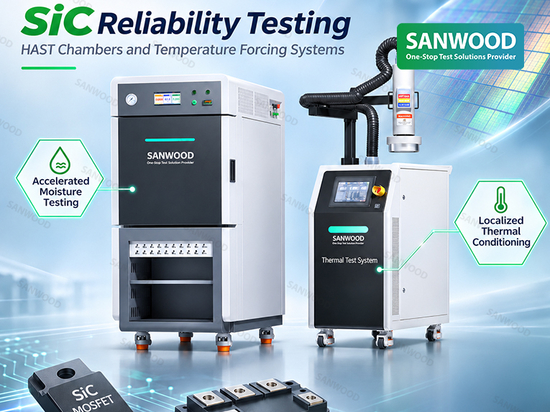
SANWOOD HAST chambers are available in single-chamber and vertically stacked dual-chamber configurations. Independent upper and lower chamber control supports separate exposure schedules within their respective operating ranges.
To discuss a suitable configuration, provide SANWOOD with the adopted test method, exposure conditions, package type, batch quantity and populated-fixture dimensions. For biased HAST, also identify the required electrical interfaces and existing laboratory equipment.
The chamber provides the pressurized temperature-humidity environment. The device supplier or laboratory remains responsible for electrical evaluation and qualification decisions.
For a more detailed explanation, visit sanwood.us.
Explore the product: https://www.sanwood.us/products/158.html
Contact us: [email protected]

 鄂公网安备42018502009509号