
#Product Trends
SpatiX X5 Tested in Challenging GNSS Environments in Colombia
Testing the SpatiX X5 under tree cover and in challenging urban environments in Colombia
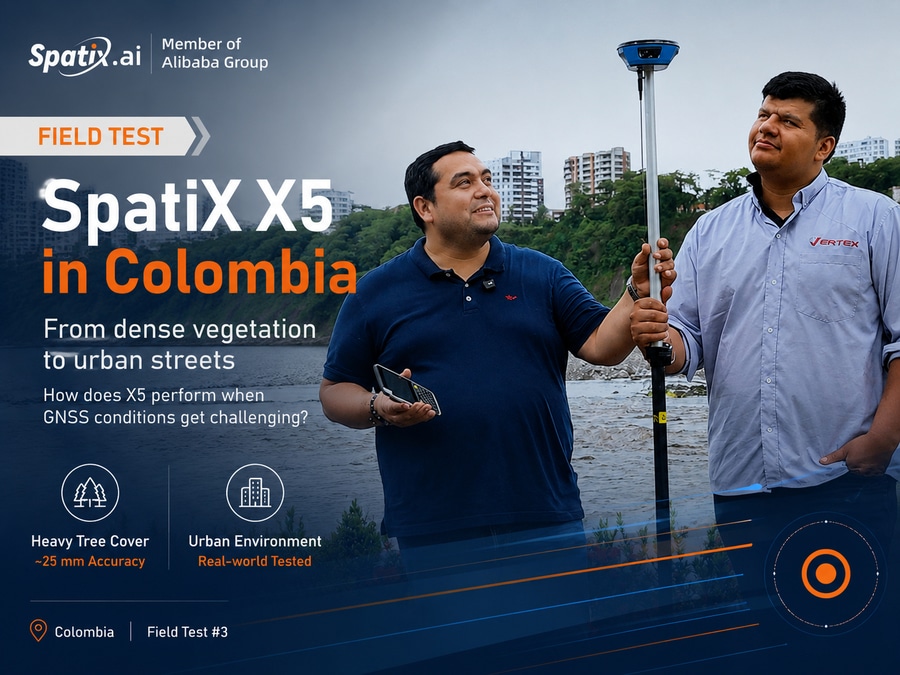
GNSS positioning can become more challenging when survey points are located beneath dense vegetation or in urban environments surrounded by buildings and trees. To evaluate the real-world performance of the SpatiX X5, our local partner Vertex Ingeniería conducted the third X5 field test in Colombia, focusing on challenging GNSS conditions.
During the first part of the test, the X5 was used under heavy tree cover, where foliage can obstruct satellite signals and increase the impact of multipath and signal attenuation. The field test achieved approximately 25 mm positioning accuracy, demonstrating the X5’s ability to maintain reliable positioning performance in demanding environments.
The test then moved into an urban environment, where trees, buildings and other surrounding structures created additional potential signal obstructions. This provided a practical scenario for evaluating how the X5 performs when GNSS visibility becomes less favorable in everyday surveying conditions.
From vegetation to urban environments
Rather than testing the receiver only under ideal open-sky conditions, Vertex Ingeniería put the SpatiX X5 through two different environments within the same field test:
Dense vegetation: challenging satellite visibility beneath heavy tree cover
Urban surroundings: trees, buildings and other structures affecting GNSS signal reception
Real-world operation: practical positioning tasks in environments commonly encountered by surveyors and field professionals
These tests highlight an important aspect of GNSS equipment: performance needs to be evaluated not only under open-sky conditions, but also in the environments where positioning challenges actually occur.
Real-world GNSS performance matters
Field testing provides valuable insight into how GNSS receivers perform outside controlled conditions. By testing the SpatiX X5 across different environments in Colombia, Vertex Ingeniería demonstrated how the receiver can be applied to challenging surveying scenarios where maintaining stable and accurate positioning is essential.
From dense vegetation to urban streets, the third X5 field test focused on one practical question:
How does a high-precision GNSS receiver perform when GNSS conditions get challenging?
The field test in Colombia provides another real-world example of the SpatiX X5 being evaluated under demanding positioning conditions.
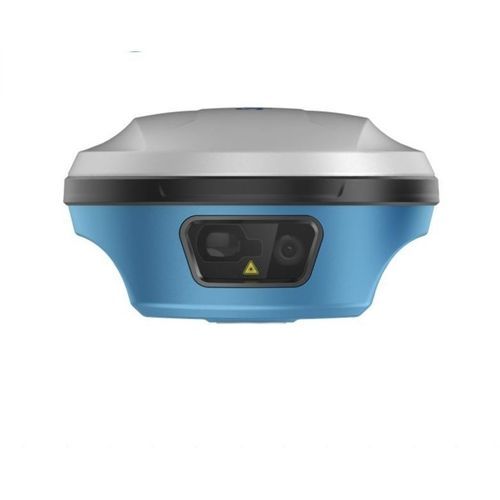
SpatiX X5 — designed for high-precision GNSS positioning in real-world environments.