#White Papers
How to size an industrial pasta line: capacity, building and utilities
Three numbers shape a pasta project long before a supplier is chosen: hourly capacity, the building you already have, and the utilities you can feed to it.
Most pasta investments begin with one question: how many tonnes per day? It is the right question, but it is rarely the constraint that decides the project. Across 42 lines installed in 18 countries since 2007, we have seen far more layouts reshaped by the building and the utilities than by the extruder itself.
CAPACITY COMES IN STEPS, NOT IN A CONTINUUM
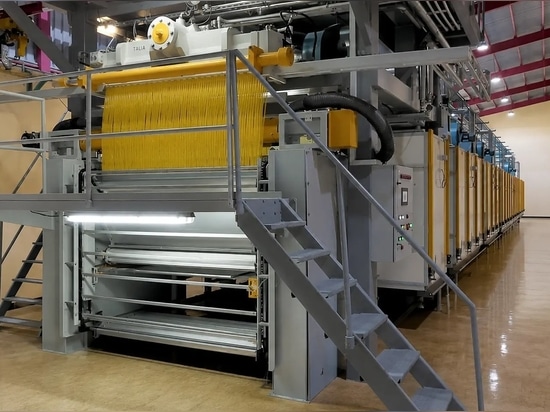
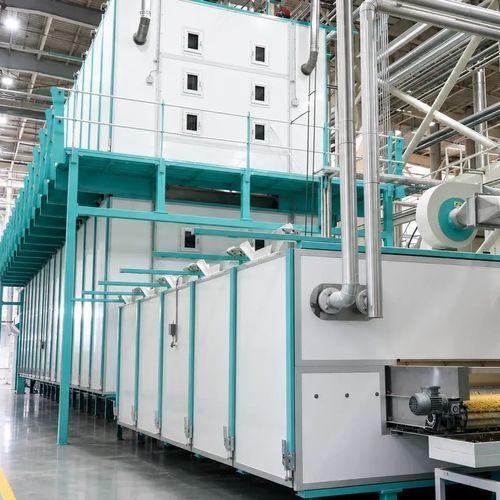
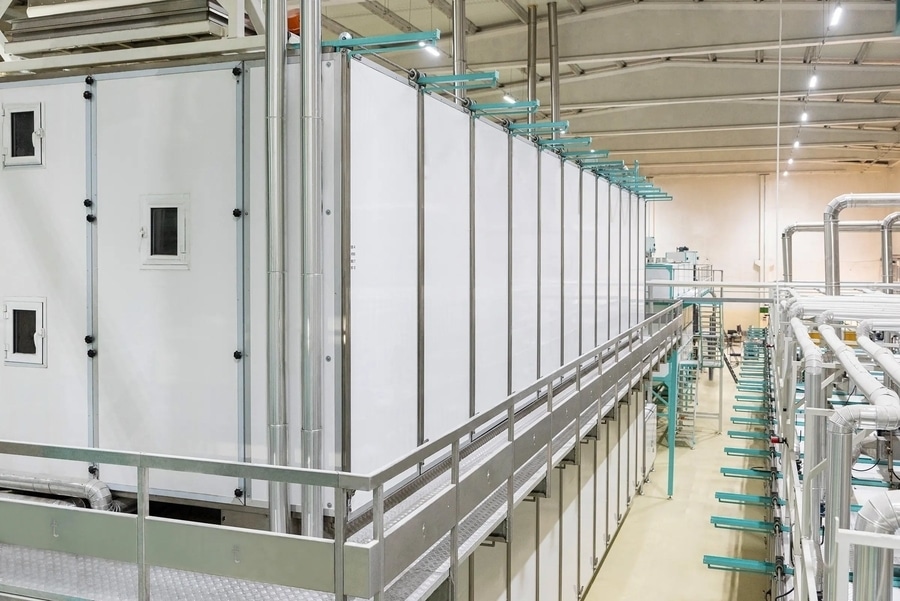
Industrial pasta lines are built around standard capacity steps. Short-cut lines typically run from 500 to 6,000 kg/h; long-cut (spaghetti) lines from 500 to 4,000 kg/h. Between two adjacent steps what really changes is the drying section - the number of decks and the length of the tunnel - because drying, not extrusion, sets the pace of the line. A press can be pushed; a drying curve cannot.
This is why the honest way to compare two offers is to compare drying capacity and the climate control behind it, not the headline kg/h figure.
THE BUILDING DECIDES MORE THAN PEOPLE EXPECT
A 500 kg/h line needs roughly 50 m of length, 14 m of width including auxiliary equipment and 8 m of clear height - about 700 m2, excluding raw material and finished goods storage. Move up to 1,000 kg/h and the same line becomes about 70 m long and needs 9 m of height: about 980 m2.
Note what changes and what does not. The width stays the same. The length grows, and so does the height. In practice, a hall that is short can be worked around; a hall with low clear height cannot. Clear height is the first number a buyer should measure, and the first number a supplier should ask for.
UTILITIES: ELECTRICITY, COMPRESSED AIR, STEAM
At around 1 t/h the installed electrical load is in the order of 150 kW. Compressed air is required at 6-10 bar.
Steam deserves its own paragraph. A drying line needs steam, and in many projects the steam system is quoted separately - something the buyer often discovers after the contract is signed. It is worth asking every supplier one direct question: is the steam system inside your scope or outside it? In our own scope it is supplied together with the line.
WHERE PRODUCT IS LOST - AND WHERE IT IS NOT
On a short-cut line there is no process waste; trimmings simply do not occur.
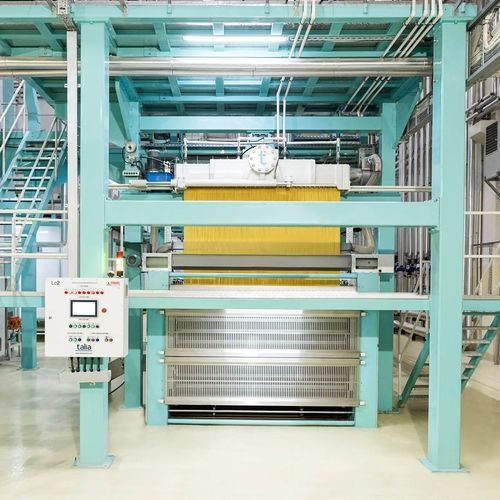
On a long-cut line there are two points. When strands are spread over the sticks, the skirt lengths that form at the ends go straight back to the main mixer and return to production. After drying, the final cut leaves 2-3 cm of product on the stick hangers, depending on the pack length the plant has chosen; that remainder can be routed back to raw material feeding through an optional recovery system.
Few suppliers describe these two points openly, and a buyer comparing offers should ask about them specifically.
THE CALENDAR IS LONGER THAN THE DELIVERY
Manufacturing, from order to ready-for-shipment, takes 4-8 months depending on capacity. On-site installation and commissioning takes a further 3-4 months. From signature to first commercial production, a realistic plan is 7-12 months - and the civil works, power connection and steam infrastructure have to be ready before the line arrives, not after.
FIVE QUESTIONS WORTH ASKING BEFORE THE DRAWINGS
1. What clear height does the line need, not only what floor area?
2. Is the steam system inside the scope of supply?
3. What happens to the trimmed ends on a long-cut line?
4. What is the installed electrical load, and what is the running load?
5. Can we visit a plant of the same capacity that is in production today?
The last question is the one that separates a catalogue from a reference.
Talia Makina designs, manufactures, installs and commissions industrial pasta production lines at its own facility in Gaziantep, Turkiye - short-cut lines from 500 to 6,000 kg/h and long-cut lines from 500 to 4,000 kg/h, supplied turnkey from raw material feeding to packaging. 42 lines are installed in 18 countries, and reference plants can be visited by appointment.