#White Papers
Pasta production line at 1 ton per hour: what a 1,000 kg/h macaroni or spaghetti line produces, includes and costs in 2026
One ton per hour is the step most producers take once a first line has proved itself. Here is what 1,000 kg/h means in tonnes per year, what the line consists of, who buys it and why, and the 2026 investment band.
WHAT 1 TON PER HOUR MEANS IN PRACTICE
A pasta production line is built to run continuously. The product spends hours in drying, so stopping at the end of a shift would spoil everything still inside the dryer; on a spaghetti line, where the strands travel hanging on sticks, the rule is stricter still. That is why output is planned per production day, not per shift. A shift is the operator's working time, not the line's.
At 1,000 kg/h (1 ton per hour) the arithmetic is simple: 24 tonnes of dry pasta per production day, and about 600 tonnes per month with maintenance and cleaning allowed for. A typical annual planning figure is 7,200 tonnes on 300 production days, rising to 7,920 tonnes in high-utilisation operation. In retail terms, 7,200 tonnes is 14.4 million 500 g packs a year. These are theoretical line figures; on a long-cut line the practical limit is usually the stick circuit and the packaging section rather than the press, which is why they are sized together with the line.
MACARONI OR SPAGHETTI: TWO DIFFERENT LINES AT THE SAME CAPACITY
Short-cut pasta (macaroni: penne, fusilli, elbow and more than 30 shapes by changing circular dies) and long-cut pasta (spaghetti, linguine) are made on separate lines. After the press, short-cut product is cut and conveyed on belts through the dryer; long-cut product is hung on sticks, dried in a tunnel and cut to 23-26 cm for the final package. A producer who wants both product groups installs two lines, often together.
WHAT EQUIPMENT A 1 TON PER HOUR LINE CONSISTS OF
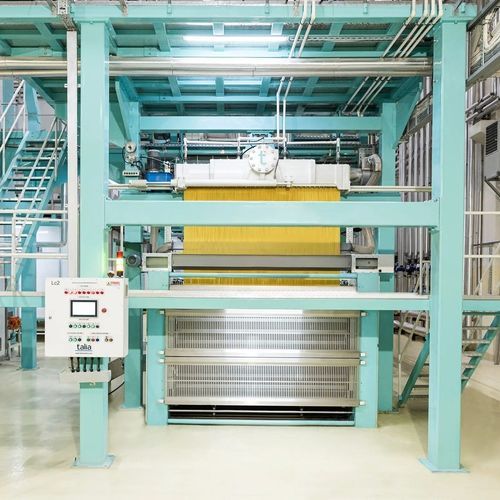
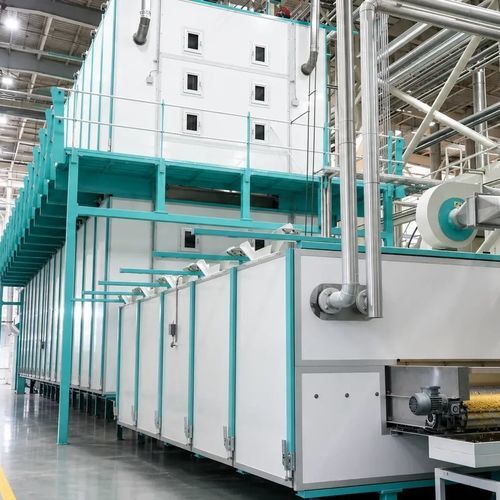
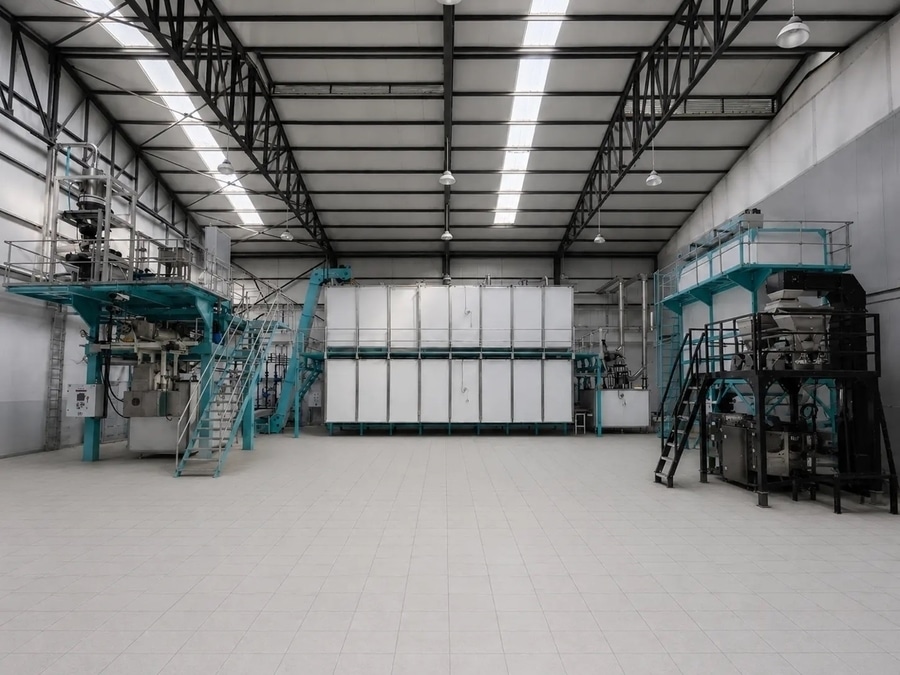
A short-cut line starts at the storage unit above the press, which takes raw material from the plant's own store and keeps the feed uninterrupted. Dosing and mixing, the vacuum extrusion press and the cutting system follow. The cut product passes through a shaker pre-dryer, is lifted by elevator into the multi-tier dryer, then cooled and lifted again into the product silos, where it rests before packaging.
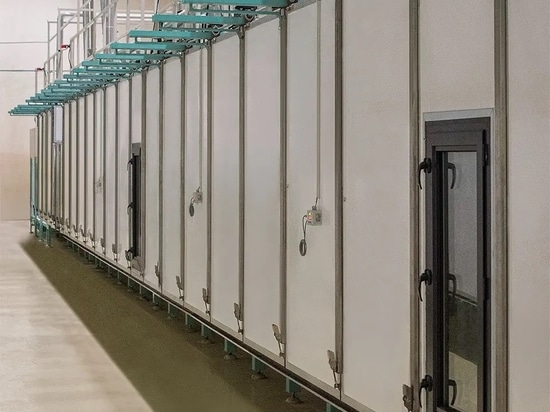
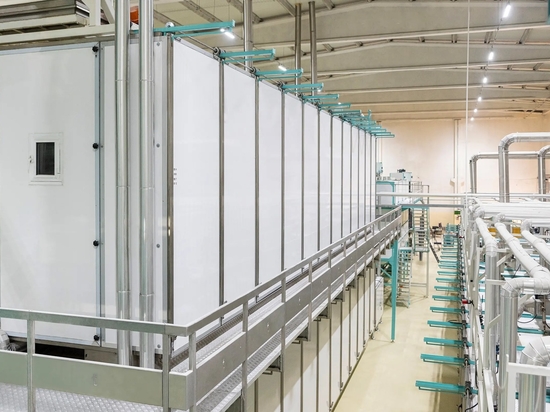
A long-cut line shares the first stages and then differs: the product is spread onto sticks and pre-cut, pre-dried, taken through a multi-stage main drying tunnel with zonal climate control, stabilised and cooled, held in a stick storage area and finally cut to package length.
In both cases production is fully automatic under Siemens PLC control, product-contact surfaces are AISI 304 stainless steel, and recipes can be semolina- or flour-based.
PRICE OF A 1 TON PER HOUR PASTA LINE IN 2026
For a complete 1,000 kg/h industrial line, short-cut or long-cut, the investment band is USD 900,000 - 1,400,000, EXW Gaziantep, packaging machinery excluded. Where a project falls inside the band depends on the line type (at the same capacity the long-cut line is the more complex machine), the drying configuration and the delivery scope. A turnkey scope, which adds the silos feeding the line, the utility units, installation supervision, commissioning and training, typically adds 15 - 25 per cent. For reference, the band for a 500 kg/h line is USD 550,000 - 800,000.
For a medium-capacity plant, 500 to 1,000 kg/h is the range most new producers start in. What makes a line affordable over ten years is cost per kilogram (energy in drying, waste, downtime), not the lowest quotation.
WHO CHOOSES 1,000 KG/H: PATTERNS FROM EIGHT PROJECTS
Since 2013 we have delivered eight projects at this capacity in six countries: Ukraine, Bangladesh, Afghanistan, Turkiye, Madagascar and Kazakhstan. Seven are in operation and one is under installation. They fall into four patterns.
Moving from semi-automatic to fully automatic. In Ukraine (2013) a producer replaced two European semi-automatic lines with one fully automatic line. It is still in production.
Adding spaghetti to an existing range. In Afghanistan a producer started with a 500 kg/h short-cut line in 2015 and returned for a 1,000 kg/h spaghetti line in 2019.
Entering pasta with two lines at once. In Turkiye (2020) a new producer commissioned a short-cut line and a spaghetti line together, began exporting to 23 countries and ordered a 2,000 kg/h spaghetti line in 2023.
Building on what is already there. In Madagascar (2020) the line works alongside existing European-origin lines. In Bangladesh (2016) a complete drying system was built to integrate with the customer's existing press. In Kazakhstan (2025) a grain-sector investor with its own flour mills installed a 1,000 kg/h spaghetti line together with a 3,000 kg/h short-cut line.
That last case is worth a note for flour millers: a mill already has the raw material and the logistics, and a pasta line turns part of its own flour or semolina into a finished product.
WHAT A SUPPLIER NEEDS TO QUOTE 1 TON PER HOUR PROPERLY
Four inputs make quotations comparable: the product group (macaroni, spaghetti or both), the raw material (semolina or flour), the annual tonnage target and the building available. Then check what the capacity is guaranteed on: the reference product format, the tolerance (plus or minus 5 per cent), the final moisture (12.5 per cent maximum) and 24 hours of continuous stable production.
Talia Makina has built industrial short-cut and long-cut pasta production lines in Gaziantep, Turkiye since 2007, with 42 lines installed in 18 countries. The full list of 1,000 kg/h projects, with year and status for each, is on our website.