
#Product Trends
Solenoid Vs. Electromagnetic Coil: Design, Differences and Applications
Learn the differences between a solenoid and an electromagnetic coil, including design, structure, force, power, applications, and selection guide.
Electromagnetic technology plays a significant role in modern automation industry, electronics, medicine, automotive industry and intelligent devices. Electromagnetic coils and solenoids are two kinds of common electromagnetic components. Their designs, performances and applications differ significantly despite the similar base of operation.
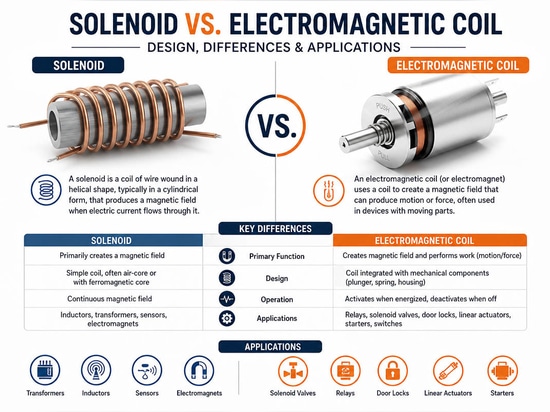
A coil is a component consisting of the wire winding producing the magnetic field when energized . The electromagnetic coil is a coil. It could be used in such applications as electromagnetic induction, magnetic control, heating, sensing, and wireless power transmission. However, the magnetic force of a simple coil is low.
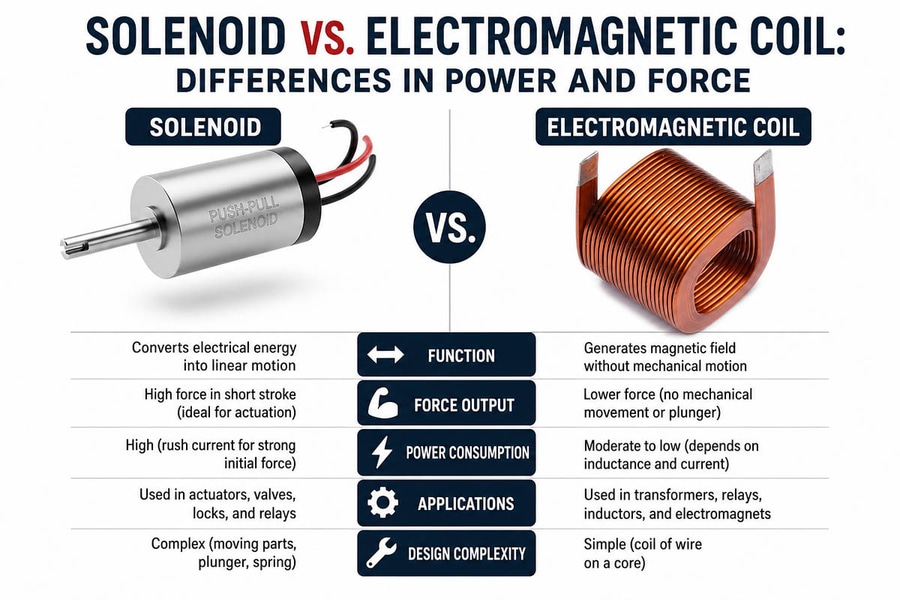
A solenoid is an electronic part working better than a simple electromagnetic coil in terms of the magnetic suction force. It is the assembly of the electromagnetic coil and the magnetic core, housing, yoke, and mechanical components transforming electromagnetic energy into the linear or rotary motion. The solenoid could be powered to provide a mechanical controlled push or pull force.
That is to say:
An electromagnetic coil creates a magnetic field.
A solenoid is an electromagnetic coil creating a mechanical motion and force.
This article provides the comparative analysis of the design structure, dimensions, power consumption, test performance, advantages and industrial applications of DC solenoids and electromagnetic coils.
1. Differences between Electromagnetic Coil and Solenoid Designs
1.1 Electromagnetic Coil Design
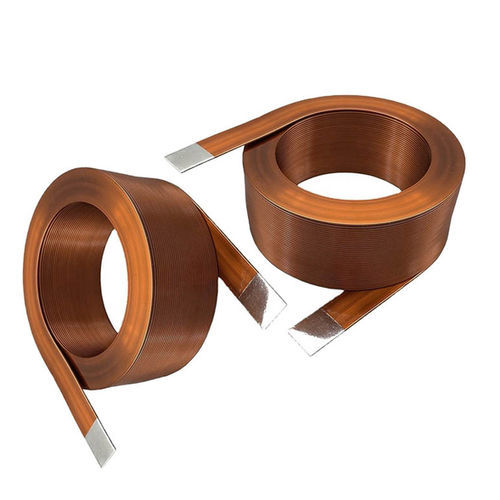
Typically, the electromagnetic coil is produced by winding the enameled copper wire around a bobbin or a core in a specific number of turns and depending on the resistance requirements.
When the electrical current passes through the coil, the magnetic field is created around the winding. Its intensity depends on the following factors:
Number of turns in coil
Current level
Size of wire
Coil resistance
Core material
Simple electromagnetic coil has a rather simple design consisting of:
Copper enameled wire
Insulating layer
Supporting frame or bobbin
Optional magnetic core
The electromagnetic coil is applied mainly to create a magnetic field, not to provide mechanical movement.
For example, the coil is used in the induction or sensing device to generate the magnetic field used for detection or energy transfer. But there is no magnetic circuit here, so the resulting force is not powerful.
1.2 Solenoid Design
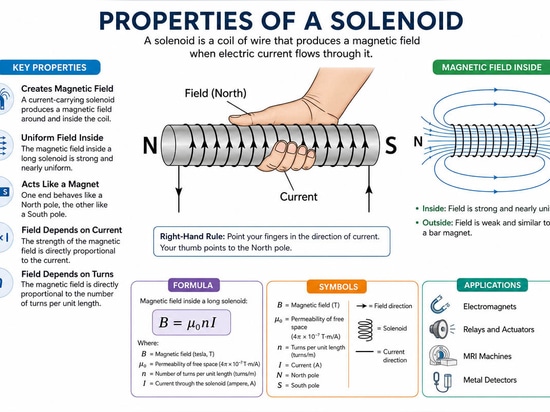
The solenoid is an electromagnetic coil with magnetic and mechanical components improving its performance.
A typical DC solenoid consists of:
Electromagnetic coils
Iron core/plunger.
Magnetic yoke 2. Magnetic yoke 3.
Carbon steel housing
Return spring guidepipe
Shaft, mechanical joint, etc.
The magnetic housing and iron core are added to create the magnetic circuit resulting in the increased magnetic flux density and higher electromagnetic force generation.
The path of the plunger movement can be controlled by the design of the solenoid allowing engineers to optimize the following factors:
Stroke travel
Pulling force
Pushing force
Response time
Duty cycle .
How often it is used
A solenoid is the whole actuator. It is designed to convert electrical energy into the mechanical motion. In comparison to the simple electromagnetic coil.
2. Differences in the dimensions of solenoid and electromagnetic coil
2.1 Electromagnetic Coil Dimensions
Electromagnetic coils are designed for small-scale electronic applications.
Typical applications are:
Control panels
Sensors
Mobile devices
Computer engineering
Precision equipment
4. Wireless charging systems
Induction equipment
Electromagnetic coils could be very small, sometimes only a few millimeters in size.
For example:
A coil inside the control panel has to create a weak magnetic field for actuation the sensing function or electronic switch.
The design is focused on: as the application requires only a weak magnetic field.
Miniaturization
Low power consumption
Great precision
Stable electrical characteristics
However, the output mechanical force is not powerful.
2.2 Solenoid Size
Other mechanical components necessary for the solenoids like:
Magnetic housing
Iron core
Plunge
Spring system:
It is why even mini DC solenoids usually require enough room inside for the movement.
A typical mini DC solenoid may contain:
Diameter: 8-20 mm
Stroke: 1-10 mm
Force: several grams to several kilograms
The whole design has to take into account the following factors:
Required force
Length of stroke
Operating frequency
Duty cycle:
Heat generation
Mechanical life
If the solenoid is small, the efficiency of the magnetic circuit is reduced, and the benefit from the solenoid is lost.
3. Differences in Power and Force
3.1 Features of power of electromagnetic coil
The purpose of an electromagnetic coil is to create a stable magnetic field.
General characteristics are:
Voltages
Resistance
Current
Number of windings
Very low power consumption could be used with the small electromagnetic coil.
But the electromagnetic force is limited as it does not have the complete magnetic circuit.
It is used for:
Controlled signal
Induction application
Magnetic sensor
Small electronic devices
3.2 Solenoid Power Characteristics
The power design of the solenoid depends on the following factors:
Number of windings
Contemporary
Stroke
Required force
Duty cycle
Operating frequency
The engineers select the appropriate solenoid size depending on the mechanical output required.
For example:
The industrial solenoid with high force has to contain:
More copper wire
Enhanced magnetic core
Better heat dissipation
Solid housing structure
The mini solenoid with low power may require only small stroke and low holding force.
The advantage of the solenoid is that the engineers could precisely determine the correlation of the following features:
Voltage + Current + Magnetic Circuit = Force + Stroke
It is why the solenoids are suitable for the precise automation systems.
4. Datasheet comparison testing
You can clearly see from the testing the difference in performance between an electromagnetic coil and a solenoid.
Item DC Solenoid Electromagnetic Coil
Dimensions10 x 8 mm 15 x 10 x 8 mm
Stroke 0 mm 1 mm
Output Force Approx. 35 gram push-pull force Approx. 15 gram magnetic force
Mechanical Movement Yes No
Application Control of actuators Creation of magnetic fields
A solenoid could create more mechanical force as the iron core and magnetic housing concentrate the magnetic field.
The electromagnetic coil creates mainly magnetic energy but not the controlled mechanical motion.
5. Differences in heat dissipation and service life
Heat dissipation is one of the factors that should be considered while choosing between the electromagnetic coil and a solenoid.
Electromagnetic Coil Heating Performance
The design of the electromagnetic coil is rather simple, but the heat dissipation could be limited.
In the long-time operation:
Temperature rise
Increased resistance to electric current
Deterioration of magnetic performance
Unstable service life.
The coil is not usually mechanically protected. Any external vibration or impact could damage the winding.
So the electromagnetic coils are mainly suitable for:
Precision electronic instruments
Low-power applications
Short-range magnetic control
Performance of the Solenoid Heat
The solenoid includes:
Metal housing
Magnetic circuit
Mechanical supporting structure
The magnetic housing improves:
Protection of mechanical parts
Effectiveness of the magnetic circuit
Heat dissipation abilities
The magnetic sleeve and yoke focus the magnetic flux to increase the suction force.
6. Properties of Solenoid
6.1 Controllability of Magnetism
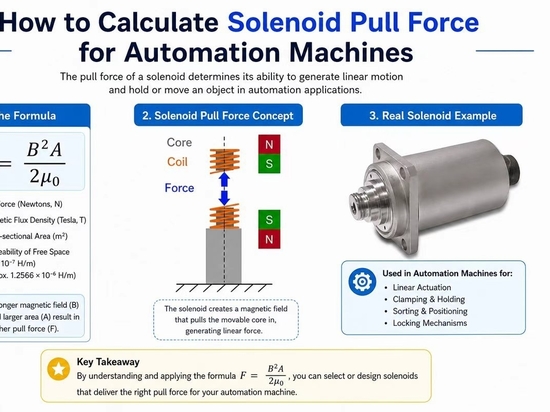
One of the great benefits of a solenoid is the ability to control the electromagnetic force.
When the electricity flows:
The electromagnetic force is generated.
The plunger is activated
When the electricity stops flowing:
electromagnetic force is ended.
The plunger goes back into the spring
This is one of the good examples of a humanized text.
The electromagnetic crane is able to lift steel materials when it receives the electricity. And when the electricity flow is cut off, it is able to drop them.
6.2 Tuning the Magnetical Force
The force of a solenoid can be tuned by changing:
Current
Number of coils
Magnetic materials
Air gap
Generally, a bigger magnetical force is produced when the current is bigger and the number of coils is higher.
6.3 Reversibility of Magnetical Pole Direction
If we change the direction of the current, the direction of the magnetical pole will be changed.
Thus, the solenoids can be created for:
Push
Pull
Rotation
Latch
6.4 Higher Mechanical Force
A solenoid has higher force than a simple electromagnet because of:
Iron core
Magnetical yokes
Steel body
These things drive solenoids:
Valves (
Locks
Toggle
Industrial equipment
6.5 Exact stroke and force control
The movement of the plunger in the solenoid is limited mechanically.
This gives engineers an opportunity to control:
Stroke length
Force output
Latency
This is important for automated machinery.
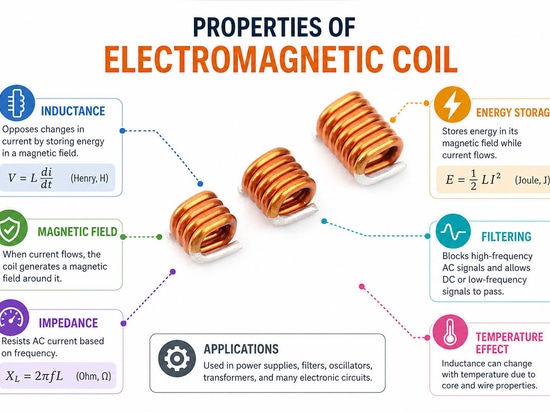
7. Properties of Electromagnetic Coil
7.1 Construction
The construction of the electromagnetic coil is rather simple.
Winding of Copper wire
Insulation layer.
Bobbin building
Advantages include:
Low cost of manufacturing
Flexibility
Ease of customization
7.2 Creation of Magnetical Field
When energized, an electromagnetic coil creates a magnetical field. Typical applications include:
Electromagnetic induction
Wireless charging
Magnetic sensors
Electromagnetic field heating
7.3 Precision
Many precision items use electromagnetic coils, like:
Parts of hearing aid devices
Inductors Computer
Electronic sensors
Micro-control units
These products include the following characteristics:
Very precise
Good electromagnetic performance
Small size
7.4 Poor Heat Dissipation
Often electromagnetic coils are built compactly, and this leads to poor heat dissipation.
The long-time work with high power can lead to:
Rising temperature
Deterioration of Coils
Decreasing effectiveness
7.5. Lower Power Output
The standard electromagnetic coil has much lower mechanical force than a solenoid.
It is suitable for applications requiring:
Magnetic field generation
Traffic control
Small switch functions
8. Choosing the Proper Electromagnetic Coil or Solenoid For Your Specifications
One of the crucial steps in ensuring reliability, service life and low cost is choosing the right electromagnetic coil or solenoid for your particular specifications. While the principles of operation for both of the components are identical, their applications vary greatly: the coil creates a magnetic field, whereas the solenoid produces linear motion.
First of all, you have to define your application requirement. The electromagnetic coil will be preferable if your task includes magnetic attraction, like in relays, sensors, locks and holding devices. On the other hand, you will need a solenoid if you want to create a linear motion, such as pulling, pushing, locking and switching.
The second step is determining the necessary force and stroke. The performance of a solenoid depends on a variety of parameters, including the number of turns, current, air gap, size of the plunger and the magnetic circuit design. As a rule, the larger the force, the larger is the coil, copper winding and magnetic structure. You have to make sure that the solenoid will be able to provide enough force along the whole stroke required.
Thirdly, the power supply and duty cycle have to be considered. First, please clarify whether your system operates with DC or AC voltage, for instance, 12VDC, 24VDC or 110VAC. To be used in continuous motion applications, the solenoid should have 100% duty cycle to prevent overheating. A more powerful solenoid might be suitable in case of intermittent operation with cooling periods.
Furthermore, environmental conditions should not be overlooked. The application with moisture, dust, vibrations or high temperatures might require special materials, coating or design. The housing made of stainless steel, protective coating and high temperature insulation will contribute to increased durability of the product.
In addition, pay attention to the size, lifespan, possibility to customize the solenoid as well as capabilities of the supplier. A reputable company is supposed to offer the customers technical support, performance testing and customized solutions. Prior to selecting the proper solenoid, make sure to investigate the following parameters: force, stroke, voltage, power consumption, response time, cycle life and operating temperature.
Therefore, selection of the appropriate electromagnetic coil or solenoid is a complicated process based on mechanical and electrical performance, environmental conditions and price. Properly selected solenoid or coil will ensure reliability of the system and decreased maintenance costs.
9. Future Trends of Electromagnetic Coils and Solenoids
With the fast development of automation, intelligent manufacturing, robotics, electric vehicles and smart devices, solenoids and electromagnetic coils are developing to be more efficient, smaller, more reliable and smarter in control.
9.1 Compact and High Density Architecture
One of the major trends among the electromagnetic components is the miniaturization.
The modern equipment requires smaller and lighter parts which still work well. Manufacturers develop:
High force density Miniature DC solenoids
Micro electromagnetic coils for precision instrumentation
Improved efficiency of compact magnetics circuits
For example, medical equipment, wearable electronics and miniature robotic systems require having very small electromagnetic components with precise control.
Future design of solenoids will focus on:
More force in smaller sizes
Less power consumption
Decreased response time
9.2 Energieeffizienz und niedriger Stromverbrauch
Energy saving is one of the major requirements for modern electrical systems.
The conventional solenoids are always powered when working especially for holding applications. The future designs will increasingly use:
Latching solenoid technology
Bi-stable magnetics states
Low power coils design
Smart current control
The latching solenoid is able to hold its position without continuous power supply and thus save much energy.
This trend is particularly relevant for:
Battery-operated equipment .
Smart lock
Mobile medical instruments
IoT systems
9.3 Smart Solenoid Control Electronics
Another developing trend is the integration of electronics and electromagnetic components.
Future solenoids will contain the following:
Microcontrollers.
Sensors
Digital drivers
Feedback control systems .
The smart solenoids will be able to switch automatically:
Actual position
Holding power
Maximal operating speed
Temperature protection
Thus, the improved characteristics will include:
Correctness
Reliability
Energy efficiency
Life span
9.4 Advanced Materials and Optimization of Magnetics Circuit
Materials technologies will help to improve the electromagnetic performance even more.
Planned future developments include:
High Performance Magnetics Steels
Better copper wire materials
Advanced insulation materials
Magnetics cores with low losses
New magnetics materials will provide high magnetic flux density but generate less heat.
For the solenoid manufacturers, the optimization of the magnetics circuit will be one of the key methods of increasing force output without increasing the size of the product.
9.5 Increasing the Applications in Automation and Robotics
Industry 4.0 and factory automation are creating the demand for electromagnetic actuators.
Solenoids will be used increasingly in:
Industrial robots
Automated assembly machines
Intelligent manufacturing systems
AGV / AMR vehicles .
Packaging equipment
The compact actuators for robotic systems should be:
Quick response
Precise movement
Long life span
In these industries, there will be an increasing use of customized solenoids.
9.6 Electric vehicle and renewable energy equipment growth
The electromagnetic components can be used in electric vehicles and renewable energy systems.
Applications are:
Battery management system
Power charging apparatus
Security locks
Thermal management valves
Power control systems
The electromagnetic coils and solenoids will continue their evolution meeting the automotive requirements such as:
High temperature resistance
Vibration-proof
Long life
High dependability
FAQ 1: What is the difference between a solenoid and an electromagnetic coil?
The main difference is what they do.
When energized, an electromagnetic coil mainly generates a magnetic field. A solenoid is an electromagnetic coil combined with a magnetic core, housing and mechanical structure to produce controlled push or pull motion.
Only:
Electromagnetic coil = produces magnetic energy
Solenoid = converts electrical energy to mechanical movement
FAQ 2: Can a solenoid be replaced by an electromagnetic coil?
In most applications a solenoid cannot be directly substituted by an electromagnetic coil.
An electro-magnetic coil can generate a magnetic field . But it generally can not provide enough mechanical force or controlled stroke .
If the application needs:
Linear translation
Force to push
Pulling Force
Mechanical switching a solenoid is usually the better option.
FAQ 3: Why does a solenoid require more force than an electromagnetic coil?
A solenoid can exert a higher force due to having:
Iron heart
Magnetic yokes
Steel houses
These elements create a stronger magnetic circuit and focus the magnetic flux.
A simple electromagnetic coil does not have the same magnetic structure, so the output force is much lower.
FAQ4: Solenoid or Electromagnetic coil, which one will last longer?
The life time depends on the working conditions
The electromagnetic coil can have a long electrical life span in low power applications.
However, a well designed solenoid generally has a better mechanical reliability because it has:
Protective housing
Plunger motion control
Controlled stroke;
With proper design, industrial solenoids can often operate for hundreds of thousands of cycles.
FAQ 5: Does solenoid consume power all the time?
Depends on the type of solenoid.
Standard DC solenoids use power when energized, as the coil needs current to hold force.
But latching solenoids require only a short power pulse to change position and can hold the position without continued power.
FAQ 6: Why do solenoids get hot when they are working?
The heat is primarily due to the electrical resistance in the copper coil.
When the coil is activated.
Electric energy is converted into heat
Coil temperature is on the rise
The heat generation depends on:
Voltage
Present
Cycle time
Resistance of coil
Cooling situation
Coil design and duty-cycle selection are important for reliability.
FAQ 7: What do you need to consider when choosing a solenoid?
Engineers should consider the following:
Force required
Stroke length
Operating voltage:
Duty cycle
Speed of reply
Mounting space
Temperature of operation
Required lifetime
Appropriate solenoid specification will provide for stable operation and avoid overheating.
FAQ 8: What are typical uses of electromagnetic coils?
Electromagnetic coils are extensively used in:
Sensors
Inductors
Wireless charging systems
Electromagnetic heating devices
Relays
electrically operated devices
Useful for generating a magnetic field without mechanical motion.
FAQ 9: Where are DC solenoids typically used?
DC solenoids are commonly used to:
Industrial Automations
Medical apparatus
Automotive systems
Smart door locks
Vending machines
Robotics –
System control valves
Office machinery
They are chosen when accurate electromagnetic motion is required.
FAQ 10: What is the future of solenoid technology?
Future solenoid technology will be focused on:
Greater force, smaller size
Less energy is used
Smart control
Enhanced durability
Improved heat handling
Individualized solutions for automation systems
As industries move toward smarter and more efficient equipment, solenoids will continue to be an important electromagnetic actuator solution.
Abstract
Electromagnetic coils and solenoids operate based on the same electromagnetic principle, but serve different purposes.
So a coil of wire is primarily a magnetic field generator. A solenoid is an electromagnetic actuator, and is designed to generate controlled mechanical force and motion.
"Adding magnetic cores, yokes and houses, solenoids can be made to produce stronger force, accurately control stroke and be more reliable for industrial applications."
A custom DC solenoid is generally the best choice for automation equipment, valves, locks, medical devices, robotics, and industrial machinery. An electromagnetic coil is a simpler and cheaper option for electronic sensing, induction, and small devices.
Understanding the differences between solenoid and electromagnetic coil helps engineers select the appropriate electromagnetic component for their specific requirements.
About Weilong Technology
Founded in 2007, Weilong Technology has over 20 years of experience in solenoid and electromagnetic coil manufacturing. We specialize in the design, development, and production of customized electromagnetic solutions for customers worldwide.
Our manufacturing capabilities include a professional testing laboratory, metal stamping workshop, CNC machining, tooling development, precision coil winding, and assembly production lines. Supported by advanced equipment, experienced engineers, and strict quality control systems, we deliver reliable prototypes and high-quality production solutions for various industrial applications.
For more information, please visit: www.smartsolenoid.com