
#Product Trends
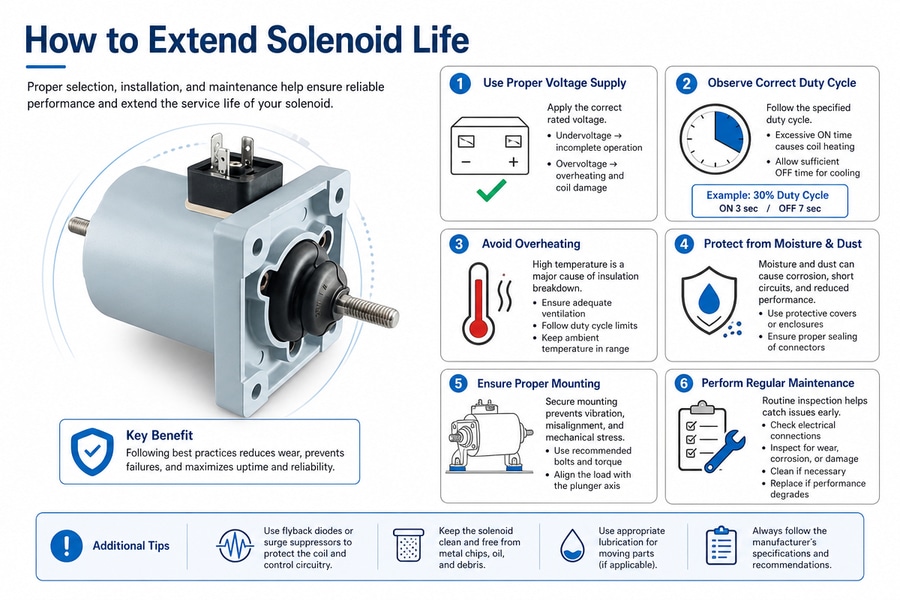
How to Prevent Solenoid Burnout and Extend Lifespan
Learn how to prevent solenoid burnout caused by overheating, overvoltage, excessive duty cycles, and mechanical issues. Discover practical tips to extend solenoid lifespan.
How to Prevent Solenoid Burnout and Extend Lifespan: Complete Guide
Introduction To Solenoid Burnout
Solenoids can be used in different industries from industrial automation to smart locks, medical devices, automotive, vending machines, valves, and security devices due to its ability to provide motion control by using electromagnetic forces. Nevertheless, one of the major issues engineers face during the work with solenoids is solenoid burnout.
Solenoid burnout may cause equipment downtime, increase the costs of maintenance, and delay the process of production. The main reason for solenoid burnout is not connected with manufacturing defect, but it is connected with voltage incompatibility, overheating, inappropriate duty cycle, mechanical overloading, and other operating conditions.
Correct prevention methods which could help to avoid the possibility of solenoid burnout will positively influence on its performance and lifespan.
Chapter 1: How to Prevent Solenoid Burnout?
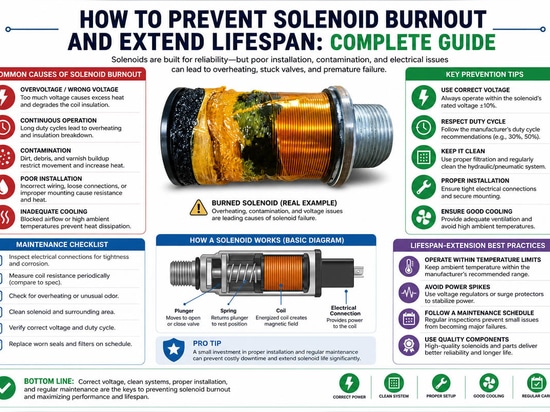
Solenoid burnout occurs as a result of damaging of the internal solenoid windings due to overheating or voltage stress. Copper windings are coated with insulation material. If the temperature exceeds the limit of the insulation, then the insulation breaks and causes a short circuit in solenoid windings.
If the insulation of the solenoid coil fails, then:
Weak magnetic force
Increased current requirements
Intermittent operation (
Complete stop of movement
Permanent damage of solenoid winding
In industrial operations, the malfunction of the solenoid may stop the whole system; therefore, reliability plays an important role in design.
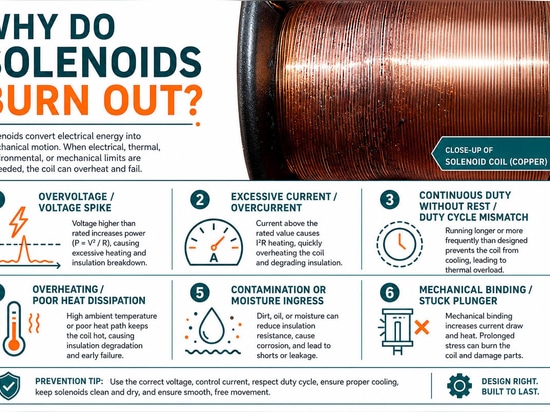
Chapter 2: Why Do Solenoids BurnOut
1. Supply Incorrect Voltage
Supplying of the solenoid with the voltage higher than specified voltage is one of the main reasons of solenoid burnout.
For example:
12V DC solenoid with 24V voltage
24V solenoid with unstable voltage
Wrong operating frequency of AC solenoid
Large amount of coil current occurs as a result of supplying a solenoid with high voltage:
Higher voltage equals higher current = more heat generation = damage of the solenoid winding
Even short term work with overvoltage may lead to solenoid burning.
Prevention Tips
Always check the rated voltage before installation
Use of stable voltage supply
Add voltage protection elements where needed
Do not use unstable battery voltage
2. Overheating and Over Duty Cycle
Each solenoid has rated duty cycle that indicates the length of time that the solenoid can be energized.
Typical duty cycle ratings are:
Intermittent duty (short-time operation)
25% duty cycle.
50% duty cycle
100% duty cycle
If the solenoid that is designed for short-time operation is energized continuously, the heat will accumulate in the coil.
For example:
If you energize a solenoid for several hours, the 10-second rated solenoid will burn out.
Prevention Tips
Select a solenoid that is suitable for your cycle of operation
Find the activation time and the rest time
For long-term holding use a holding or latching solenoid
Use PWM control to reduce heat
3. Inadequate Heat Dissipation
Heat is the primary threat to solenoid reliability.
During work, some of the electrical energy is converted into magnetic force and some is transformed into heat. If the heat accumulates in the coil, the temperature inside increases.
Factors that influence heat dissipation are:
Limited space for installation
High temperature
Plastic housing without ventilation
24/7 operation
Bad mounting design
Prevention Tips :(
Ensure proper ventilation around the solenoid
Do not place near heat sources
Use heat-resistant materials
If you need more force, use a larger solenoid
Larger solenoid is more thermally effective, since there is more space for the coil and better heat dissipation.
4. Incorrect Size of Solenoid
A frequent error during design is selection of the solenoid only based on voltage and current.
Considerations for Engineers:
Required force
Stroke length
Operation frequency
Loading state
Space for installation
Duty cycle:
Environmental factors
If the small solenoid has to shift the heavy load, the solenoid coil will remain energized without finishing the stroke and generate a lot of heat.
Prevention Tips:
Before selecting a solenoid, consider:
Push force requirement
Pulling force requirement
Stroke length
Max operating temperature
Lifetime
Properly selected solenoid will be more effective and have longer lifespan.
5. Mechanical Issues and Plunger Blocking
Solenoid operates using the plunger moving in the solenoid housing.
Mechanical issues may cause additional coil stress such as:
Soil contamination
Misalignment
Excessive friction
Incorrect installation
Broken return spring
If the plunger is unable to move properly, the solenoid will stay in high current state and generate too much heat.
Prevention Tips:
Keep the plunger area clean
Make sure that you line up the plunger correctly during installation
Do not side load the plunger
Check mechanical movement during maintenance.
Proper mechanical design is necessary for precision operations such as smart locks and industrial automation systems.
6. Incorrect spring selection
Many push-pull solenoids have a return spring. Spring force directly influences on solenoid performance.
Spring that is too strong needs more magnetic force and causes:
High power consumption
High coil temperature
Shorter lifespan
If the spring is too weak, the return movement will not be reliable.
Prevention Tips
Select proper spring force
Test the whole assembly in the mechanical unit.
Check solenoid in real operating conditions
7. Electrical Issues and Lack of Safeguard
Switching on and off the solenoids creates voltage spikes, especially when switching DC solenoids.
When the power is disconnected, the magnetic field collapses and creates reverse voltage spikes which can damage:
Coil insulation
Control circuits
Driver MOSFETs
Contact relays
Prevention Tips:
Use protection elements such as:
Flyback diode
TVS diodes
snubber circuit.
These elements reduce electrical stress and enhance the reliability of solenoid systems.
Chapter 3: How to Extend Solenoid Life
1. Select the Proper Type of Solenoid
Various solenoids are required for various applications:
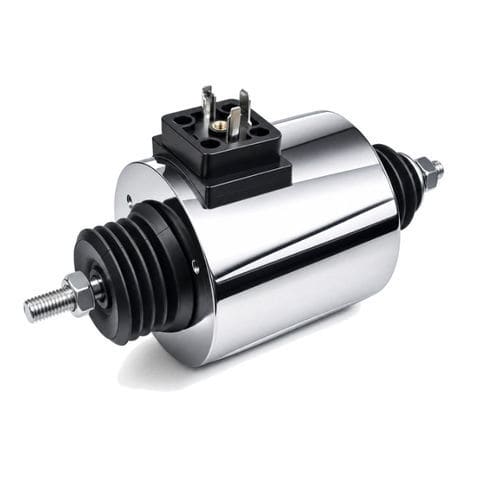
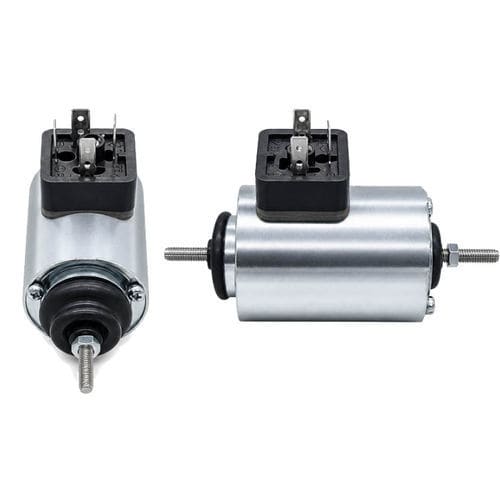
Solenoid, tube
Best For:
Industrial automation
Locking mechanisms
Devices (medical)
Advantages:
Compact construction
High efficiency
Longer lifetime
Solenoid latching
Best for:
Battery-operated applications
Intelligent locks
Energy-saving systems
Advantages:
Power dissipation during switching only
Low power consumption
Electromagnet holder
Best for:
Door systems
Industrial holding applications
Less stressing and more reliable to choose the right type.
2. Work Within Rated Specifications
Always work according to the manufacturer specifications:
Rated voltage
Rated current
Stroke thrust
Duty cycle
Temperature range
The fastest way to ruin the solenoid is working outside of the specifications.
3. Test And Maintain Regularly
Regular testing will help to identify the problem before total failure.
Proof:
Coil temperature
Operating sound
Smoothness of movement
Voltage stability
Mechanical wear
Unexpected downtime of industrial equipment can be prevented by regular maintenance.
4. Improve Solenoid Control Design
Modern control technology can extend the life of solenoids.
Examples:
PWM controlled
Lower average current post-activation.
Voltage reduction
High voltage for starting
Lower voltage for holding.
Smart controller Monitors
Now Temperature
Activation Time
These techniques prevent excessive heating.
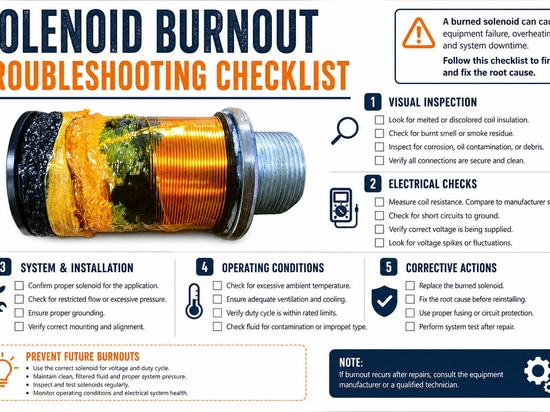
Chapter 4 : Solenoid Burnout Troubleshooting Checklist
Solenoid Burnout Troubleshooting Guide
Before replacing the failed solenoid, it is important to know the cause of failure. The main reason of solenoid burnout is wrong voltage conditions, overheating, mechanical overloading, and improper product selection.
Below you can find the list of common solenoid issues and recommendations on how to solve them.
Check Item Possible Problem Symptoms Recommended Solution
1. Power Supply Voltage Voltage higher than solenoid rating Coil becomes extremely hot, burning smell, sudden failure Confirm rated voltage and use a stable power supply
2. Supply Current Insufficient or excessive current Weak force, slow movement, overheating Check power source capacity and match current requirements
3. Coil Resistance Coil winding damaged or short circuit No movement, abnormal current consumption Measure coil resistance and replace damaged coil
4. Duty Cycle Solenoid energized too long Temperature increases continuously, coil burnout Select a higher duty-cycle model or reduce activation time
5. Operating Temperature Poor heat dissipation or high ambient temperature Reduced force, shortened lifespan Improve ventilation or select heat-resistant design
6. Plunger Movement Mechanical blockage or excessive friction Humming sound but no movement Clean plunger, check alignment, remove obstacles
7. Stroke Requirement Stroke is too long for the selected solenoid Slow operation, insufficient force Select a solenoid with suitable stroke and force rating
8. Load Force External load exceeds rated force Cannot complete movement, overheating Choose a higher-force solenoid model
9. Spring Force Return spring is too strong High current consumption, weak movement Optimize spring force according to application
10. Installation Alignment Solenoid mounted incorrectly Uneven wear, noisy operation Adjust mounting position and ensure proper alignment
11. Electrical Protection No voltage spike protection Controller damage, contact failure Add flyback diode, TVS diode, or protection circuit
12. Environment Condition Dust, moisture, corrosion, vibration Plunger sticking, insulation damage Use suitable protection grade and sealing design
Step 1: Power Supply Checking
Before testing the solenoid, check if:
Is voltage correct?
Is there any problem with the power supply?
Can the power source provide enough current?
Does it spike voltage during switching?
One of the most common reasons of solenoid burnout is the connection of the solenoid to the power source that provides voltage above the rated voltage of the solenoid.
For instance:
Connecting of 12V DC solenoid to 24V power supply could cause overheating and damage to the coil.
Step 2: Coil resistance checking
Check the resistance of the coil using a multimeter.
Possibility outcomes:
Normal resistence
Coil is probably electrically fine.
Infinite resistance (open circuit)
There is a snap of the coil wire.
Internal winding of the coil is damaged.
Low resistance
Short circuit of the coil winding.
If the resistance of the coil is abnormal, the solenoid might require replacement.
Step 3: Checking for overheating
The one of the key symptoms of the solenoid issues is the temperature.
Checking of:
The temperature of the housing during the process of work.
Activation time.
The intercycle cooling time.
Environmental setup.
The reasons of the overheating could be:
Incorrect voltage.
High duty cycle:
Overload
Low ventilation.
If the solenoid is overheated continuously, the coil of the solenoid could fail.
Step 4: Check for mechanical movement
The solenoid coil could be electrically functional, but mechanically malfunction.
Checking of:
Is the plunger moving properly?
Is there any dirt or contamination on it?
Is the stroke stopped?
Is the spring broken?
The coil needs to work harder in case of the mechanical resistance and produces extra heat.
Step 5: Check for the force and stroke requirement
One of the typical mistakes in the design process of the solenoid is its choice based on voltage and size.
The correct selection of the solenoid should consider the following aspects:
The force of thrust.
The traction force.
The length of stroke.
Load state.
The number of the cycles of work.
In case the required force is greater than the force that the solenoid could provide, the coil of the solenoid stays energized and overheats.
Typical Symptoms of Solenoid Failure and Their Solutions
Symptom 1: The solenoid does not move
Causes:
No power source
Burnt wire
Wrong voltage
Mechanical obstruction
Solutions:
✓ Electrical connection check
✓ Measurement of the coil resistance
✓ Checking for plunger movement.
✓ Checking of the rated voltage.
Symptom 2: The solenoid is extremely hot
Possible reasons:
Exceeding the duty cycle
Overvoltage
Solenoid is small
Low heat dissipation
Solutions
✓ Reduction of the activation time
✓ Optimization of cooling process
✓ Choosing of the continuous-duty solenoid
✓ Evaluation of the requirements of the application
Symptom 3: Low solenoid force
Causes:
Low supply voltage
Wrong stroke
Overload
Magnets too far
Solutions:
✓ Checking of the coil terminal voltage
✓ Minimizing of the mechanical load
✓ Choosing a stronger design of the solenoid
Symptom 4: The solenoid starts early and fails later
Causes:
Continuous Overheating
Insulation ageing
High number of operational cycles
The damage from the environment
Solution:
✓ Review of the duty cycle
✓ Improving of thermal management
✓ Choosing parts with high lifetime
Preventative Maintenance Checklist of Solenoid Reliability
Engineers should make regular checks to prevent the future solenoid burnout:
Voltage as per product specification
The current draw is within limits of the rating
Acceptable temperature of the coil
Duty cycle appropriate for the application
Free movement of the plunger
Spring force is correct
Alignment is OK
Presence of the electrical protection devices
The environment is proper for operating
Maintain the records of the routine maintenance
Recommendation (Final)
Most of the solenoid failures could be prevented with proper design, installation and regular check of the product. Don't just replace the failed component in case of solenoid burnout, try to find the root cause of the problem first.
With proper selection of the voltage, force, duty cycle and control method, the solenoids could operate reliably during hundreds of thousands of cycles in the industrial applications.
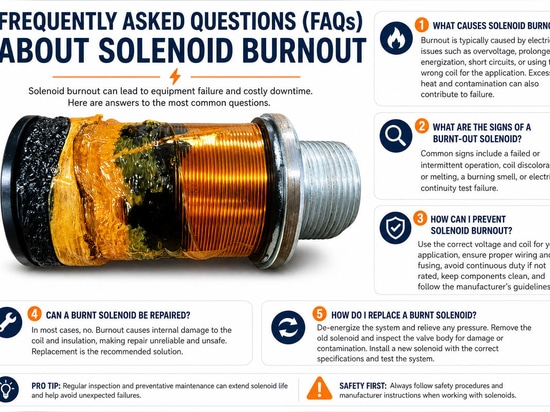
Chapter 5: Frequently Asked Questions (FAQs) About Solenoid Burnout
1 . What are the main causes of solenoid burnout?
Most of the failures of the solenoid happen due to the following issues:
Apply the higher voltage than the rated voltage
Operate beyond the recommended duty cycle
Poor heat sink
Choosing an undersized solenoid
The mechanical obstruction of the plunger
Excessive spring back.
Electrical voltage surges
High ambient temperatures.
Most of the failures of the solenoid are preventable with the proper selection and system design.
2. How to keep a solenoid from burning up?
Following are some tips to avoid solenoid overheating:
Choosing the correct duty cycle rating
Usage of the proper voltage supply
Increase of the air circulation around solenoid
We don't want to have the continuous activation.
Using the PWM or reduced holding current control
In case you need more force, choose a larger solenoid.
3. How do I know if my solenoid coil is bad?
Signs of a bad solenoid coil:
No electromagnetic force.
No plunging action
An unusual resistance measurement
Burning smell from coil
Discoloration of the coil housing
The high current consumption
The measurement of the coil resistance with the multimeter is possible. The abnormal resistance measurement could indicate the coil damage.
4. What is a latching solenoid and how is it different from a regular solenoid?
The regular solenoid requires the constant power for staying in position.
The latching solenoid has the permanent magnet structure which keeps the plunger in the required position after the actuation. It requires power only during switching.
Advantages of Latching Solenoids:
The reduced power consumption
The lower heat production
Increased battery life
Decreased the risk of the solenoid burn out
Wide use in:
Intelligent locks
Battery-operated devices
Portable equipment
Energy-saving systems
5. Can PWM control be used to prevent solenoid burnout?
Yes. With the PWM (Pulse Width Modulation) control, the heat generation could be reduced.
A usual procedure:
Applying of the full voltage momentarily for the initial movement.
Reducing the existing holding by means of PWM
Advantages:
Reduction of the coil temperature
Decreased the energy consumption
Increased the solenoid life
Improvement of the system efficiency
6. How often should solenoids be serviced?
Maintenance frequency depends on the application environment and operating conditions.
In the industrial application, the routine checks should include:
Checking of the coil temperature
The test of plunger travel
The measurement of the voltage
Testing of mechanical alignment
DUST & CONTAMINATION REMOVAL
The preventative maintenance could help to find the problems in time and prevent equipment failure.
7. How to choose the right solenoid to prevent burnout?
The things that should be considered in the process of selection of the solenoid:
Required voltage
Required current
Push and pull power
The length of stroke
Duty-cycle
Operating temperature
Installation area
Life expectancy
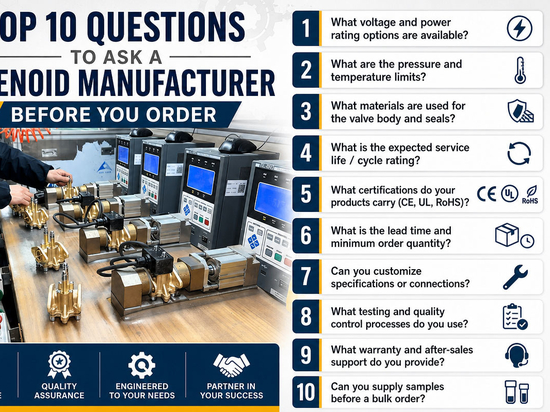
Collaborating with the professional solenoid manufacturer could help to assure that selected model will suit the actual application requirements.
8. What is the normal life span of a good quality solenoid?
The lifespan depends on design, application and operating conditions.
The high quality industrial solenoids could achieve:
Applications with 100,000+ operating cycles
Optimized design for hundreds of thousands of cycles.
Proper control and maintenance could extend the service life.
Selection and operating conditions are the factors determining the lifespan of the solenoid.
9. Why do engineers test solenoids before mass production?
The prototype testing allows to validate:
Actual force output
The temperature increase
The capability of duty cycle (
Mechanical fit-up
The power consumption
Long-term reliability
The mass production testing could decrease the risk of the solenoid burn-out, product failure and expensive redesigns.
Chapter 6 : Conclusions
The solenoid burnout is a typical failure, but a failure which can be prevented. Most of the problems occur due to the incorrect voltage, too many duty cycles, poor heat dissipation, improper sizing and mechanical issues.
To prolong the life of the solenoid:
Select the correct model of the solenoid
Match it to voltage and current ratings
Control the operating temperature
Avoid excessive duty cycles
Protect the electrical circuits
Check correct mechanical installation
In the industrial application, the collaboration with the experienced solenoid manufacturer at the design stage could help to assure better performance, longer service life and reliability.
A correctly selected and controlled solenoid could provide hundreds of thousands of operating cycles.