
#Product Trends
201 Solenoid Troubleshooting Guide: Failures & Solutions
Learn solenoid troubleshooting methods, common solenoid failures, causes, testing steps, and solutions to improve reliability and extend solenoid service life.
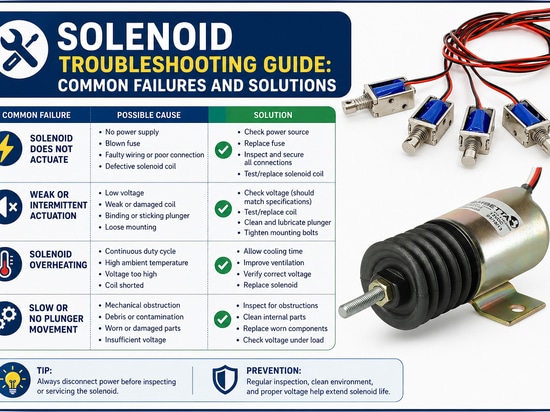
Solenoid Troubleshooting Guide: Common Failures and Solutions
Introduction: The Importance of Solenoid Troubleshooting
Solenoids are a class of electromagnetic actuators used in industrial automation, vehicles, medical, printing and valve equipment, security equipment, and smart control systems.
They provide reliable linear or rotational movements of the actuator thanks to conversion of electrical energy into the mechanical motion.
Solenoids are created to function efficiently but sometimes problems arise due to the wrong choice of the solenoid, incorrect installation, electrical, mechanical or environmental problems.
A thorough solenoid troubleshooting procedure enables one to detect the root cause of the issue and restore to normal operation while minimizing downtime.
The following guide describes the most common types of problems, causes of their appearance and solutions.
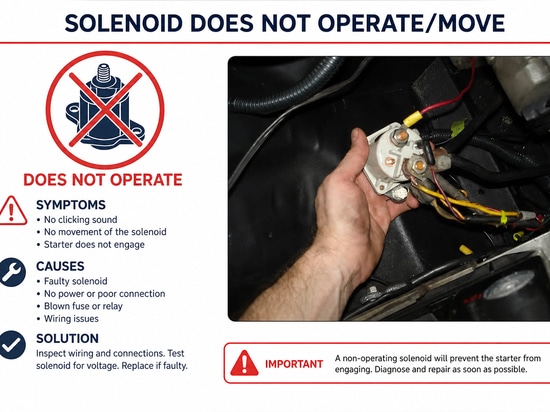
Chapter 1: The Solenoid Does Not Operate/Move
Problem statement
The solenoid receives the control signal but the plunger, armature, or actuator does not move.
It is one of the most frequent solenoid troubleshooting problems.
Potential causes
1.1. Lack of Power Supply
The solenoid requires specific amount of voltage and current to create a magnetic field.
Possible reasons of malfunction:
Electricity supply failure
Wrong voltage connections
Loose wires
Damaged connection
Broken cable
1.2. Incorrect Voltage
Each solenoid has the designated voltage.
Examples of the solenoid voltage:
DC 12V solenoid
DC 24 V solenoid
DC 48V Solenoid Valve
Wrong voltage results in the following:
Magnetic force is insufficient.
Overheating
Damage of the coil.
1.3. Broken Coil
The electromagnetic coil of the solenoid can break due to:
Overvoltage
Duty cycle is too high
High temperature
Lack of insulation
Chapter 2: Troubleshooting steps
Check voltage of the power supply with a multimeter.
Check voltage to the solenoid according to its specifications.
Check resistance of the coil.
Analyze the wiring connections.
Check the solenoid using the power source which is proven to work properly.
_
Solutions
Wiring connections - fix
Coil replacement
Choose the correct voltage model
Improve power supply stability
2.1. Low Pull Force Solenoid
Problem statement
The solenoid operates but cannot create sufficient force to move the load.
In the course of industrial application, the lack of force may lead to:
Valve failure
Mechanical problems with positioning
Equipment malfunctions
Possible reasons
2.2. Low voltage
Low voltage means weak magnetic field.
Example: "
If the 24V solenoid is supplied with 18V, it will not create sufficient pulling force."
2.3 Wrong stroke distance
Increasing the air gap reduces the force of the solenoid.
With increased stroke, the following is required:
Increased power of the coil
Optimization of magnetic design
2.4 High mechanical load
The mechanical load can exceed the capacity of the solenoid.
Verification:
Required pulling force
Springback
2.5 Magnetic cores' problems
Possible reasons:
Incorrect material
Plunger damage
Contamination of the tube
Too big air gap
Solutions
Check the voltage.
Reduce mechanical load
Use solenoid with higher force
Optimize the stroke distance
Cleaning of the internal components
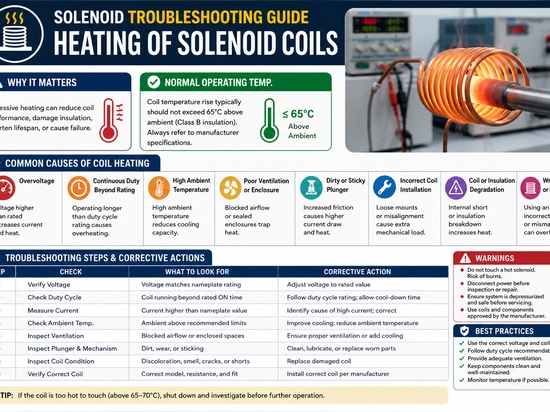
Chapter 3: Solenoid Troubleshooting Guide on Heating of Solenoid Coils
Problem statement
The solenoid gets heated up when it operates.
It can be heated up but overheating will reduce its life span and damage the coil.
Potential reasons
3.1. Incorrect duty cycle
The solenoid designed for intermittent duty cannot be operated continuously.
For example:
10% duty cycle solenoid operated with 100% duty may cause overheating.
3.2. Solenoid operation with voltage exceeding the specified one
The higher the voltage, the higher the current and the higher the temperature is generated.
3.3. Bad Heat Dissipation
Reasons:
Closed installation space
High ambient temperatures
Bad ventilation
3.4. Bad Coil Design
Possible manufacturing problems:
Incorrect wire size
Wrong winding turns
Poor insulation
Solutions
Check the duty cycle
Continuous duty solenoid
Improve heat dissipation
Select the correct coil
Chapter 4: Solenoid Produces Abnormal Clicking, Buzzing, Or Vibration
Description of Problem
The solenoid generates abnormal noises or vibration during operation.
Potential causes
4.1. Mechanical cause
Clicking noise may appear during the high-speed movement when the plunger approaches the final position.
4.2. Loose Fitting
Problems:
Loose mounting screws
Wrong mechanical installation
Vibration of the housing
4.3. Magnetic Vibration AC Solenoid
AC solenoids may produce noise because:
Magnetic vibration
Quality of the shading ring is low
4.4 Contaminated Moving Parts
Dust, oil or any foreign material may influence the movement of the solenoid.
Solutions
Verify Mechanical Installation
Add damping system
Clean the moving parts
Enhance voltage stability
_
4,5. Solenoid Plunger Moves Slowly or Sticks
Problem Statement
The solenoid operates but the plunger moves slowly, abnormally or sticks at all.
Possible Reasons
1. Foreign Material Inside Solenoid
Common foreign materials are:
Dusting
Metallic particles
Oil film
2. Too Much Friction
Reasons:
Poor surface finish
Incorrect tolerance
Wear and tear
3. Incorrect Installation Alignment
Misaligned mechanical components will interfere with smooth movement.
Solutions
Clean the internal components
Check the movement of the plunger
Better lubrication if necessary
Correct installation alignment.
4.6. Solenoid Coil - Open Circuit Failure
Problem statement
There is no current passing through the coil and, thus, the solenoid creates no magnetic field.
Potential Causes
Ripped copper wire
Poor solder joint
Damaged terminals
Manufacturing fault
Testing Approach
Use the multimeter:
Turn off the power.
Check the coil resistance.
Compare with specification.
It can be a permutation of:
Infinite resistance = open circuit
Normal resistance = coil probably good
How You Can Help
Fix the wiring
Change the coil assembly
Improve quality control in manufacturing
4.7. Solenoid coil short circuit damage
Description Of The Problem
The coil resistance is below normal value and the current is too high.
Potential Reasons
Damaged enamel wire insulation
Too high winding pressure
High temperature damage
Moisture contamination
Symptoms
Overheating
Insufficient magnetic force
Burned coil smell
Power supply protection is activated
Solutions
Replace the damaged coil
Improve insulation protection
Temperature management during operation
4.8. Solenoid Does Not Return to Original Position
Problem statement
The plunger does not return to the initial position after removing the power supply.
Possible Reasons
1. Spring failure
Possible problems:
Spring is cracked
Incorrect spring force
Spring fatigue
2. Mechanical resistance
Reasons:
Contaminated soil
Disinformation
Too much friction
3. Incorrect solinoid
The return force may not fit the requirements.
Solutions
Replace the spring
Reduce friction
Choose the correct design of return spring
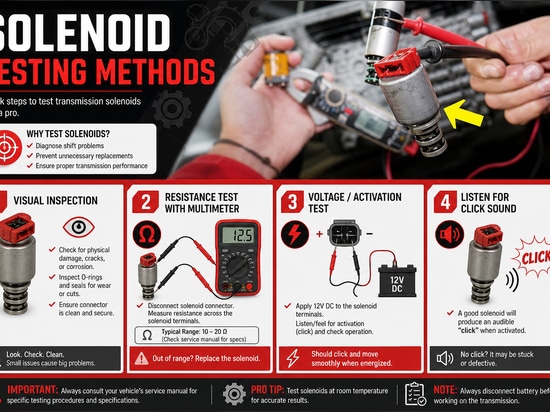
Chapter 5:. Solenoid Testing Methods
To perform the proper troubleshooting, one needs to have appropriate test equipment.
5.1 Electrical Tests
Equipment:
Multimeter ( )
Resistance meter
Insulation tester
Verification:
Coil resistance
Used current
Insulation resistance
5.2 Mechanical Tests
Check:
Stroke distance
Pull force
Return force
Speed of operation
5.3 Life Cycle Tests
Long-term reliability tests include:
Cycle life
Temperature rise
Mechanical wear
Typical industrial requirements:
50,000 cycles
100,000 cycles
1 million cycles
Chapter 6: Prevention of Solenoid Failures
The best approach to troubleshooting solenoids is prevention.
6.1. Selecting the Correct Solenoid
Before purchase, make sure:
Voltage
Force requirement
Stroke distance
Duty cycle
Environment
6.2. Following the Correct Installation
Important factors:
Correct installation
Correct wiring
Protection from damaging elements
6.3. Controlling Operation Conditions
Take care of the following:
Temperature
Humidity
Dust
Vibration
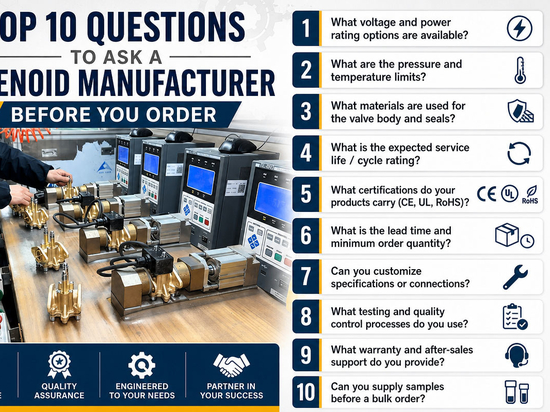
6.4. Selecting a Reputable Solenoid Manufacturer
Professional manufacturer should provide:
Technical support
Customized design
Performance testing
Quality certification
Traceability of production
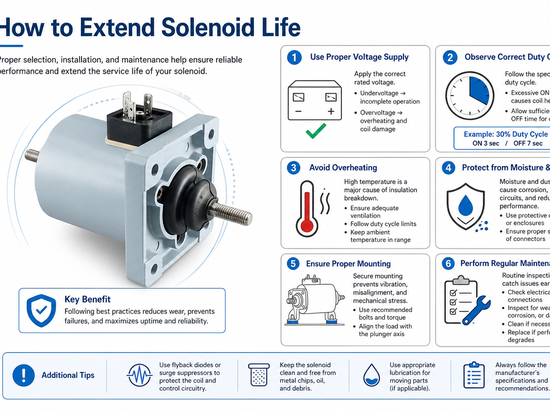
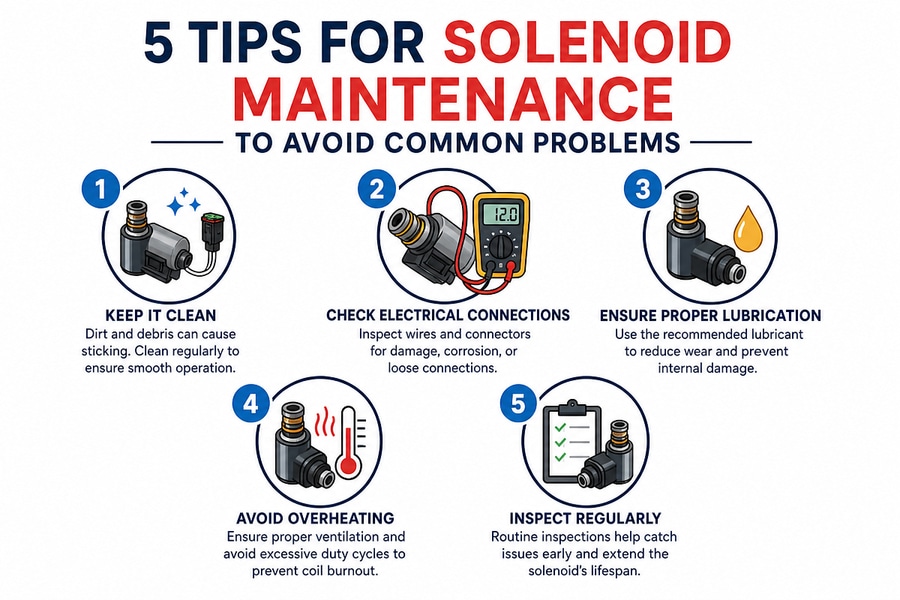
Chapter 7: 5 Tips for Solenoid Maintenance to Avoid Common Problems
Below there are 5 basic tips for maintenance of the solenoids.
7.1. Control of the Operating Voltage
One of the reasons of malfunction is the voltage which does not meet the requirements of the solenoid. If the voltage is too high the coil gets overheated and insulation is affected. Low voltage reduces magnetic field or leads to partial movement.
Remember to control the voltage supply e.g. DC 12V, DC 24V, DC 48V. Regular voltage check can be useful for preventing any possible electrical failures and improving performance.
7.2. Protection from Overheating of Coil
During the work process the coil becomes heated, especially at continuous duty. This can affect the life of the coil and eventually lead to its failure.
In order to avoid this problem you need to:
• Check the requirements for duty cycle • Good ventilation
• Operating temperature monitoring
• Don't use over rated voltage
It is very important to choose the right design of the solenoid for your environment.
7.3. Keep the plunger in good condition and free from any interference.
The solenoid has only one moving part - the plunger. Particles of dust, dirt or rust can jam the mechanism and create extra friction.
Maintenance of the solenoid should include such steps as:
• Cleaning the area of the plunger • Mechanical blocking detection
• Wear of moving parts control
Correct maintenance of the plunger will keep the force and speed of response at a certain level.
7.4. Check the Electrical Connection
Intermittent operation or even total failure can occur due to loose terminals, broken wires or poor connection.
It is recommended to check the following during maintenance:
• Connection by the wire • Condition of the connector.
• Coil resistance:
• Corrosion signs
Good electrical connections will provide a steady current supply and even operation of the solenoid.
7.5. Do not overload the machine
Every solenoid has the defined force and stroke. Excessive loading of the machine can damage the plunger, spring and other internal parts.
Before installation check the following:
• Required pulling or pushing force • Stroke length
• Operation frequency
• Duty cycle
Choice of the appropriate solenoid will eliminate the unnecessary strain and prolong service life.
Solenoid maintenance is a simple way to avoid common failure modes. By controlling voltage, heat, mechanical parts, electrical connections and choosing right loads users can increase reliability and extend the operating life of their solenoids.
Chapter 8: Conclusion
To troubleshoot the solenoid, one should have knowledge of the electrical, mechanical and environment conditions influencing its operation. The most common problems, such as lack of operation, low force, overheating, excessive noises, coil damage and mechanical sticking can be easily solved by the proper testing.
To ensure reliable long-term performance, OEM engineers and equipment manufacturers should select proper solenoid design and work with reputable manufacturer.