#White Papers
How Is Lifting Chain Manufactured? Step-by-Step Process
From alloy steel to finished Grade 80 and Grade 100 lifting chain, explore the key manufacturing and testing stages.
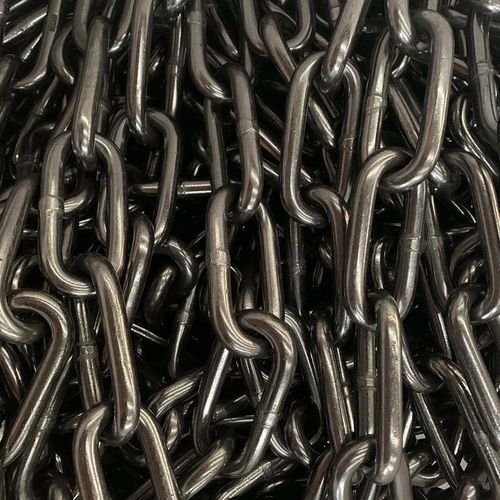
Manufacturing a high-strength lifting chain involves much more than forming and welding steel links. Grade 80 and Grade 100 lifting chains go through a controlled production process designed to achieve the strength, toughness, dimensional consistency, and reliability required for lifting applications.
The process begins with alloy steel selection and inspection. Incoming steel is checked for chemical composition, hardness, surface condition, and dimensional consistency before entering production. Material quality is especially important because it affects how the chain responds to welding and heat treatment.
The steel is then prepared and formed into individual links. Each link is interlocked with the previous one before its ends are joined by electric flash butt welding. The welding process creates a solid joint without adding filler material, after which excess flash is removed and link dimensions are checked.
After forming and welding, the chain undergoes calibration before entering one of the most important stages: quenching and tempering. Heat treatment develops the mechanical properties required from high-strength alloy lifting chain by combining strength and hardness with the toughness needed for demanding lifting service.
The manufacturing sequence can be summarized as:
Raw Material Inspection → Cutting → Link Forming → Flash Butt Welding → Calibration → Quenching & Tempering → Proof Testing → Surface Treatment → Final Inspection
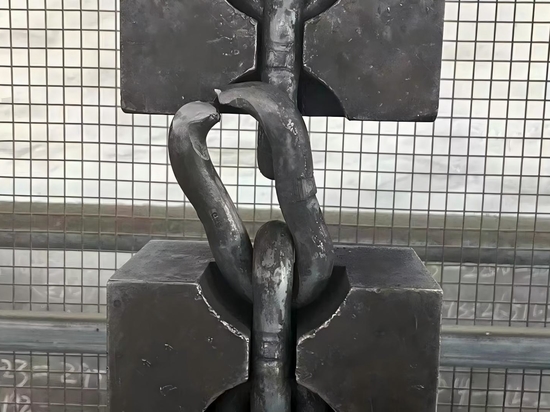
After heat treatment, the chain is calibrated again and proof tested under controlled tensile loading. Additional inspections can include dimensional checks, hardness testing, breaking tests, elongation tests, visual inspection, and other quality-control procedures according to the product specification.
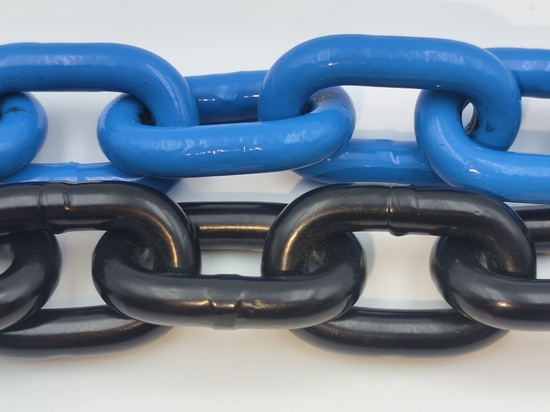
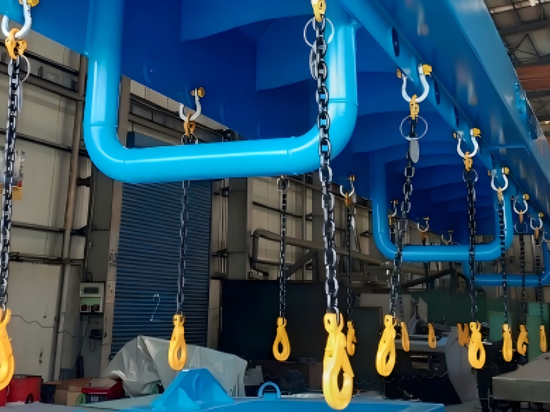
Once testing is complete, the chain is cut to the required customer length and receives the specified surface treatment where applicable. Final inspection verifies dimensions, mechanical performance, surface condition, and traceability before the finished chain is packaged for shipment.
Every stage matters. The performance of a lifting chain is not determined by steel grade alone; it depends on the complete manufacturing system—from material control and weld consistency to heat treatment and final testing.
Understanding this process also helps buyers evaluate lifting chains beyond price. Material quality, controlled welding, heat treatment, proof testing, dimensional consistency, and traceability are all important indicators of a properly manufactured lifting chain.