#Product Trends
From Structural Design to Long-Term Reliability
How Ultrasonic Flow Sensors Reduce Maintenance Costs in Industrial Fluid Systems
1.The Maintenance Challenge in Industrial Fluid Systems
In industrial settings, the maintenance issues associated with flow meters are often underestimated. Many equipment managers may have had similar experiences: after a period of use, the bearings of a turbine flow meter wear out, leading to measurement deviations; the electrodes of an electromagnetic flow meter become fouled, requiring disassembly and cleaning in certain operating conditions; the glass cone of a rotameter gets contaminated by the medium, causing the readings to become blurred. Each maintenance event means downtime, disassembly, cleaning, and recalibration, which not only consumes labor and time but also affects production schedules. For continuously operating production lines, the accumulation of these hidden costs can be substantial.
Why do flow meters require maintenance? The answer ultimately lies in their structure. Mechanical flow meters have internal moving parts, such as impellers or gears, that continuously rotate in the fluid. This rotation inevitably leads to wear, and when the wear accumulates to a certain extent, it results in a decrease in accuracy. The properties of the medium itself can also accelerate this process—liquids containing particles can easily jam rotating parts, viscous media tend to adhere to inner walls and moving components, and certain chemical media can corrode metal structures. These problems cannot be entirely solved by simply upgrading material grades, because as long as relative mechanical motion exists, wear is unavoidable, and in harsh operating conditions, the performance of the instrument can be rapidly affected.
2.Non-Contact Measurement and Straight-Through Design
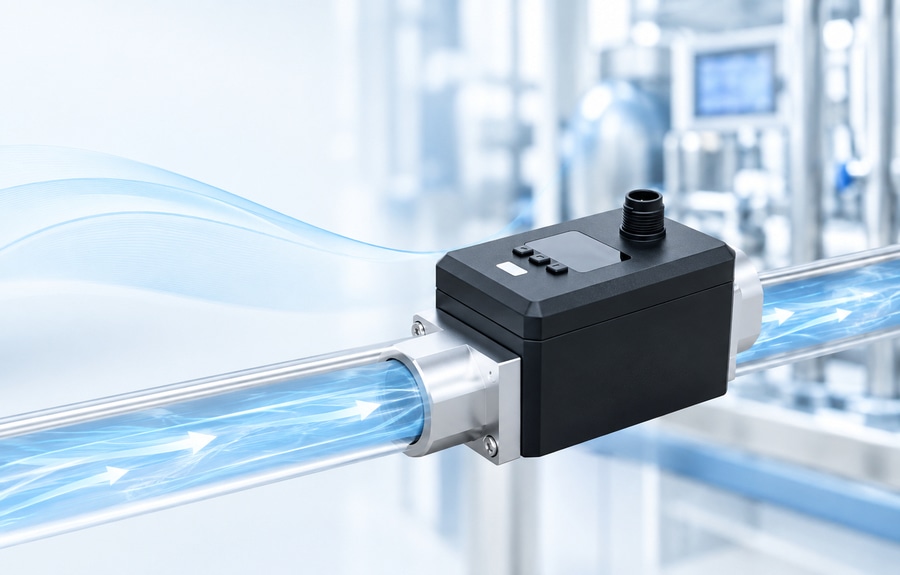
Ultrasonic flow sensors take a different path in their structural design. Their measurement principle dictates that no moving parts are needed inside the sensor. Instead, they calculate the flow velocity by measuring the transit time difference of ultrasonic signals in the fluid. This means that when the fluid passes through the sensor, it is essentially just going through a regular channel, without any moving elements like impellers or bearings that need to withstand continuous fluid friction and impact. This structural difference brings about a fundamental change in maintenance requirements: with no moving parts, typical mechanical failures like impeller jamming do not occur.
XY-TE’s clamp-on ultrasonic flow sensors, such as the CPD and CG series, are installed by directly fixing them to the outer wall of the existing system's tubing. The sensor and the medium have absolutely no contact. No holes need to be drilled in the pipe, and no extra components are introduced inside the pipeline, so the flow state of the medium is not disturbed. These sensors require very low maintenance during their later use, with almost no human intervention needed in daily operation. Once the sensor is fixed on the outer wall of the pipe, it can work for a long time without needing to be disassembled for cleaning due to media contamination or pipe blockage. If the measured tubing needs to be replaced, the sensor can simply be removed from the old tubing and installed on the new one to resume normal use.
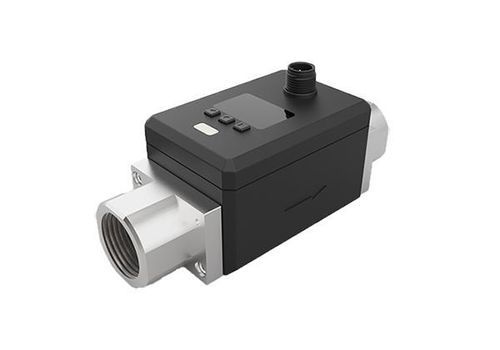
On the other hand, in-line products, such as the TPK, TAD, and TPD series, feature a straight-through internal flow path design with no constrictions, dead zones, or moving parts. As the fluid passes through the sensor, it encounters no obstacles, resulting in very low pressure loss and a significantly reduced possibility of particle deposition and media residue. For equipment that needs to operate for long periods, this structure means that the sensor itself does not become a "bottleneck" in the pipeline, does not need frequent disassembly for cleaning, and will not experience accuracy drift due to internal wear. After installation, it can basically achieve a state of “install and use, stable for the long term.”
3.Optimization of Total Cost of Ownership
Beyond the reliability of the structure itself, the maintenance advantages of ultrasonic sensors are also reflected in the installation process. Clamp-on sensors do not require pipe cutting, flange welding, or production shutdowns for retrofitting, and their installation does not affect the normal operation of the production line. This feature is particularly useful for retrofitting and equipment upgrade projects. Adding flow monitoring points to an old system does not require changing the existing pipeline layout, allowing both the project timeline and construction costs to be effectively controlled.
From a comprehensive cost perspective, the maintenance investment over the entire life cycle of a sensor is a dimension that is often overlooked during selection but is worthy of attention. The initial purchase cost of a flow meter is only a part of its Total Cost of Ownership (TCO); subsequent maintenance, calibration, spare parts replacement, and downtime losses often account for much more. Through structural simplification, ultrasonic sensors compress these subsequent costs to a very low level. For equipment manufacturers and end-users, this means a more controllable maintenance budget.
In the sensor design, XY-TEK always focuses on real-world application scenarios. Low maintenance is not just a slogan; it is a property determined by the structure—no moving parts means no mechanical wear from motion; a straight-through flow path greatly reduces the risk of blockage; and non-obstructive measurement minimizes the impact of media adhesion on the measurement. For industrial systems that require long-term continuous operation, these features mean less intervention, more stable operation, and a lower overall cost.