#Product Trends
Optimizing Automated Dispensing Process
Ultrasonic Flow Sensors in Dispensing Equipment
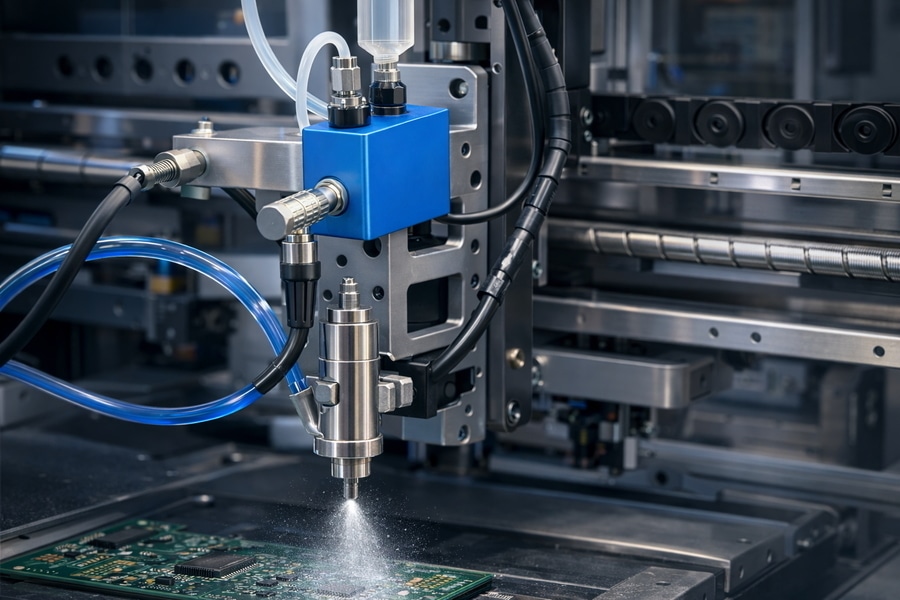
In modern industrial manufacturing and assembly lines, dispensing and fluid distribution may seem like basic processes, yet they are critical to final product quality. From flux spraying in electronics manufacturing and adhesive bonding in medical devices to precision lubrication in automotive components, the performance of fluid dispensing equipment directly affects how well a product is assembled. As automated lines face increasing demands for higher production throughput and yield rates, engineers are raising their expectations for dispensing control accuracy. Finding ways to achieve continuous and reliable monitoring of fluid media under complex industrial conditions has become a key challenge for equipment manufacturers seeking to optimize system design.
1. Fluid Characteristics and Monitoring Challenges in Automated Dispensing
Dispensing processes involve a wide range of fluids — from thin aqueous solvents and diluted lubricating oils to thick epoxy resins and thermal greases — each with vastly different physical properties. In automated production environments, low-to-medium viscosity fluids flow readily, but their flow rates are highly sensitive to nozzle pressure and valve timing. Minor pressure fluctuations or fluid buildup on tubing walls can lead to inconsistent output volumes.
Traditional mechanical flow meters perform well under steady continuous flow conditions. However, when handling fluids containing particulates or corrosive chemicals, their internal moving parts are prone to wear and clogging, and their restrictive flow paths introduce significant pressure drops. Moreover, intermittent dispensing involves frequent start-stop cycles, where the inertia of mechanical components slows system response. The core challenge in dispensing flow monitoring is achieving high-frequency, accurate capture of transient flow rates while minimizing flow restriction and pressure loss.
2. TGU Series Design and Applicability
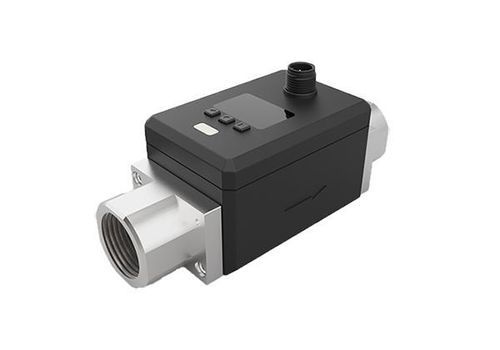
For the compact mounting spaces and small-diameter piping typical of dispensing equipment, the TGU series inline ultrasonic flow sensor addresses both response speed and long-term durability. It features a U-shaped flow channel through which the fluid passes directly. A pair of ultrasonic transducers is positioned on opposite sides of the U-tube, and the extended acoustic path significantly improves signal sensitivity and measurement resolution under low-flow conditions.
Compared with traditional mechanical flow solutions, the key advantage of the TGU series lies in its internal structure: no gears, shafts, or other moving parts. The smooth, unobstructed flow path minimizes additional pressure drop and eliminates the risk of medium contamination caused by mechanical wear debris. In electronics manufacturing and medical device packaging — where cleanliness requirements are stringent — this characteristic is essential for maintaining fluid purity.
3.Consideration of medium compatibility
When evaluating ultrasonic flow monitoring solutions, fluid viscosity is a parameter that engineers must carefully assess. Viscosity introduces acoustic attenuation: under equivalent conditions, higher viscosity results in more pronounced energy loss. If the medium is too viscous — for example, high-viscosity filled adhesives or paste-like materials — ultrasonic signals are heavily absorbed, signal-to-noise ratio drops significantly, and the sensor may fail to extract valid transit-time data. For this reason, the TGU series is designed for low-to-medium viscosity applications such as low-viscosity lubricating oils, industrial cleaning agents, fluxes, and certain UV-curable adhesives, where it maintains good measurement linearity and stability.
4. Bubble Detection and System Error Prevention
Air bubbles in dispensing lines are a hidden source of process risk. Bubble entrainment can occur during supply switching, cartridge replacement, or when tubing seals are inadequate. Bubbles displace fluid volume and lead to abnormal output, resulting in voids, discontinuous coatings, and other defects.
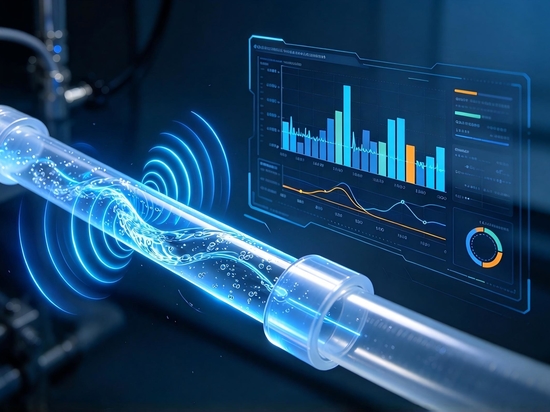
Ultrasonic measurement is sensitive to medium continuity. When a bubble passes through the ultrasonic interrogation zone, the gas-liquid interface reflects and scatters the acoustic signal, producing a characteristic instantaneous attenuation. Based on this principle, the sensor can output real-time signal quality indicators alongside flow data. When signal anomalies indicate bubble passage, the system can trigger an alarm or interlock to pause the dispensing operation. This dual capability — flow monitoring combined with bubble detection — provides automated equipment with a closed-loop error prevention framework, improving process visibility and controllability.
5. Material Compatibility and Long-Term Maintenance Costs
In fine chemical processing and electronics assembly, fluid media often present corrosion risks. The wetted components of the sensor must therefore exhibit strong chemical inertness. The flow channel inside the TGU series uses high-performance engineering plastics with excellent chemical resistance, capable of withstanding most organic solvents and chemical reagents. The channel surface is smooth, reducing medium adhesion and scale buildup.
Thanks to the absence of internal moving parts, the sensor is not subject to mechanical wear, significantly reducing maintenance frequency. For production lines that require frequent batch changes and periodic line flushing, the smooth flow path simplifies cleaning procedures, reducing cleaning fluid consumption and downtime. When assessed from a total-cost-of-ownership perspective, this ultrasonic sensing solution offers meaningful long-term operational advantages over traditional mechanical flow meters.
By integrating an appropriate and capable ultrasonic flow meter, equipment manufacturers gain real-time insight into fluid dynamics, early detection of bubble-related risks, and a measurable reduction in system complexity and maintenance burden. Data-driven process control — where every fluid dispense cycle is accurate and traceable — is an essential step toward the next level of modern automated manufacturing.