#Industry News
Drone Fiber Reel Flying Test
UAV Fiber Reel Flying Test
Recently, our YOEC team successfully carried out a drone fiber reel flying test aimed at verifying the performance stability and reliability of the fiber reel under complex flight conditions.
1. Test Preparation
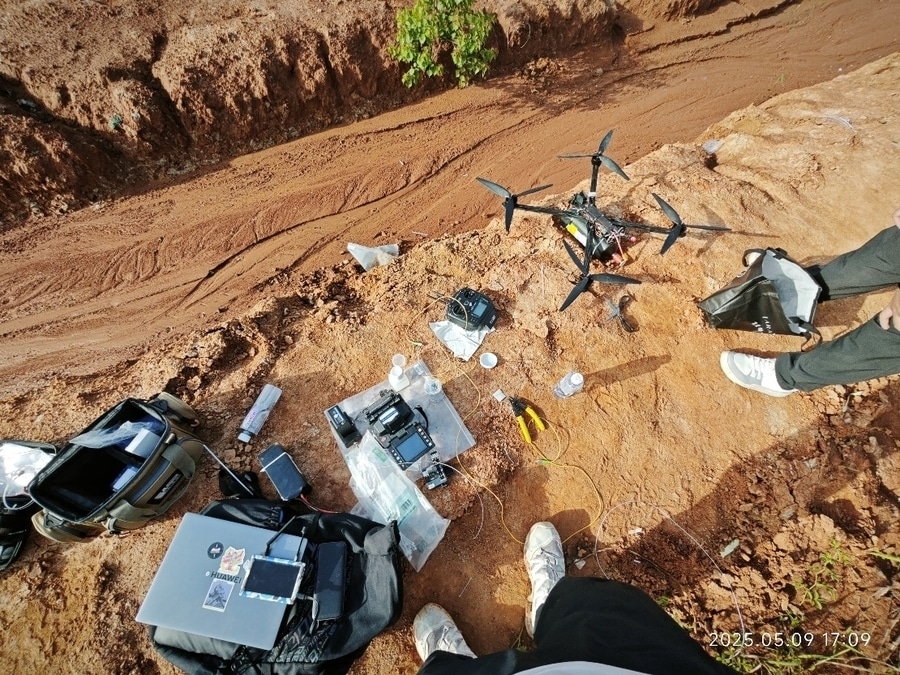
To enable signal transmission between the airborne and ground ends, we first spliced FC patch cords to the trial fiber reel wound with special optical cable. After completing the splicing on both ends, we connected them to the airborne and ground terminals, conducting connectivity tests using both conventional methods and OTDR equipment to ensure smooth optical link transmission.
We also took into account possible on-site contingencies. For example, if a fiber break occurred during testing, we immediately performed splicing on-site. On one occasion, the fiber was damaged during takeoff at the maximum angle of attack, but we promptly repaired it to ensure the continuation of the test.
2. Drone Platform Integration and Installation
Since the fiber reel required for the test was relatively heavy, the original drone was unable to carry it, so we selected a large-payload drone platform for the trial.
During installation, we secured the fiber reel to the drone using straps or cable ties, carefully routing the patch cord to avoid propellers and moving parts, and fixing it with adhesive tape to prevent entanglement or tension. Approximately one meter of fiber was reserved at the output end and fixed to the ground or takeoff platform to ensure smooth fiber release during takeoff.
After installation, we followed a checklist to verify mechanical mounting stability, patch cord connection reliability, balance and trim, and the proper functioning of all electrical control system parameters. Pre-flight checks included power-on inspection, video display verification, GPS satellite acquisition confirmation, and flight environment assessment.
3. Flying Test and Performance
Various types of fiber reels were tested, including high-tensile optical cable, guidance optical cable, and G657A2 optical cable.
For this test, we used a high-tensile optical cable model, which demonstrated excellent performance, achieving a maximum flight speed of 120 km/h and a maximum turning angle of 45°.
During the flight, the fiber reel and drone system worked in stable coordination, with smooth data transmission, providing a solid foundation for future operational applications.
4. Significance of the Test
This flying test not only validated the reliability and compatibility of YOEC’s fiber reel, but also accumulated valuable experience in drone platform integration and on-site maintenance. Going forward, we will continue to optimize fiber reel design and integration solutions to deliver stable, high-performance optical transmission solutions for more complex application scenarios.