
#Product Trends
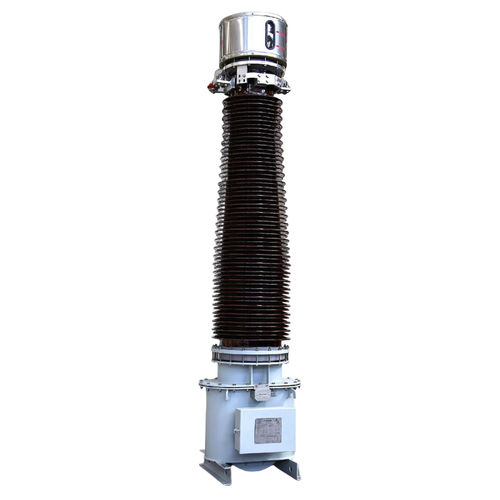
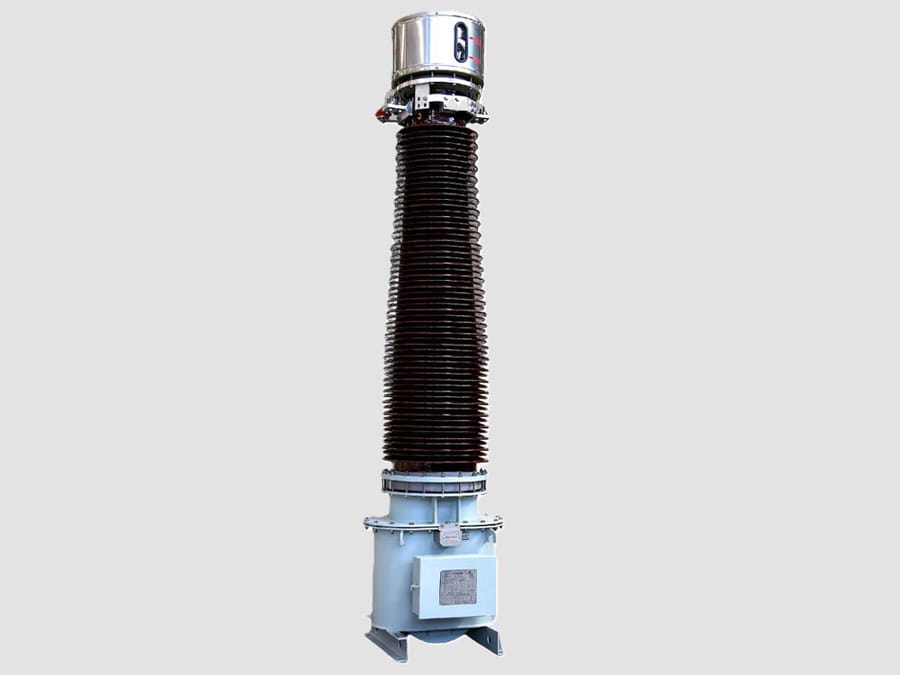
245kV Current Transformer (Hair-pin type)
245kV Current Transformer
245 kV Current Transformer (Hair-pin Type) is an extra-high-voltage (EHV) outdoor instrument transformer used in 220 kV and 245 kV air-insulated substations (AIS). It converts high primary currents into standardized secondary currents (1 A or 5 A) for protection, metering, monitoring, and control while providing complete electrical isolation between the high-voltage primary circuit and low-voltage secondary equipment.
The hair-pin type employs an integral single-turn U-shaped primary conductor, offering high mechanical strength, excellent short-circuit performance, and superior long-term reliability.
Working Principle
A 245 kV hair-pin type current transformer operates on the principle of electromagnetic induction.
When alternating current flows through the U-shaped primary conductor, an alternating magnetic flux is established in the magnetic core. This flux induces a proportional current in the secondary winding while maintaining galvanic isolation.
Construction
A typical 245 kV hair-pin type current transformer includes:
·Integral U-shaped copper or aluminum primary conductor
·High-permeability toroidal magnetic core
·Multiple secondary windings for protection and metering
·Oil-paper insulation system (most common for this voltage level)
·Porcelain or composite hollow insulator
·Oil expansion bellows or conservator
·Capacitive grading system for electric field control
·Secondary terminal box
·Grounding terminal
·Galvanized steel mounting base
·Stainless steel nameplate
Features
·Integral single-turn hair-pin primary conductor.
·Excellent accuracy over a wide operating range.
·Multiple independent secondary cores.
·High dielectric strength suitable for EHV systems.
·Low partial discharge performance.
·High thermal and dynamic short-circuit withstand capability.
·Weather-resistant outdoor construction.
·Long service life with minimal maintenance.
Typical Ratings
·Highest system voltage: 245 kV
·Rated frequency: 50 or 60 Hz
·Primary current: 300–4000 A
·Secondary current: 1 A or 5 A
·Metering accuracy class: 0.1, 0.2, 0.2S, 0.5, 0.5S
·Protection accuracy class: 5P10, 5P20, 10P10, PX, TPX, TPY, TPZ
·Rated burden: 15–60 VA
·Lightning impulse withstand: Typically 1050 kV
·Switching impulse withstand: According to IEC/utility requirements
·Power-frequency withstand: Typically 460 kV (1 min)
·Installation: Outdoor AIS
Advantages
·High accuracy for revenue metering and protective relaying.
·Excellent insulation coordination for 220/245 kV transmission systems.
·Robust single-turn primary conductor with high mechanical strength.
·Multiple secondary cores enable independent metering and protection circuits.
·High resistance to thermal and electromechanical forces during faults.
·Reliable performance in harsh outdoor environments.
Limitations
·Large physical size and weight require substantial support structures.
·Oil-filled insulation systems require periodic inspection and maintenance.
·Higher initial cost than medium-voltage current transformers.
·The secondary winding must never be open-circuited while the primary is energized, because hazardous voltages can develop across the secondary terminals.
Applications
·245 kV hair-pin type current transformers are widely used in:
·220 kV and 245 kV transmission substations
·Transmission line bays
·Power transformer bays
·Busbar differential protection
·Circuit breaker protection
·Revenue and utility metering
·Grid interconnection substations
·Switching stations
·Renewable energy transmission substations
·Industrial extra-high-voltage facilities
Typical Secondary Core Arrangement
·Core 1 Revenue metering 0.2S
·Core 2 Operational metering 0.5
·Core 3 Overcurrent and earth-fault protection 5P20
·Core 4 Transformer or busbar differential protection PX / TPX / TPY / TPZ
·Core 5 Backup protection or disturbance recording 5P20 or PX
Typical Uses
The 245 kV Hair-pin Type Current Transformer is designed for demanding 220 kV and 245 kV transmission networks, where high accuracy and reliability are essential. Typical functions include:
·Revenue and settlement metering
·Overcurrent and earth-fault protection
·Transformer and busbar differential protection
·Fault recording and disturbance analysis
·Supervisory control and data acquisition (SCADA)
·Wide-area monitoring and substation automation
Its single-turn hair-pin primary conductor, advanced insulation system, multiple secondary cores, and high dielectric performance make it a preferred solution for modern extra-high-voltage air-insulated substations, ensuring accurate current measurement and dependable protection throughout the service life of the installation.