#Product Trends
Blocking Agent: How to Test the Integrity of Porous Packaging such as Tyvek? | ASTM F2096.
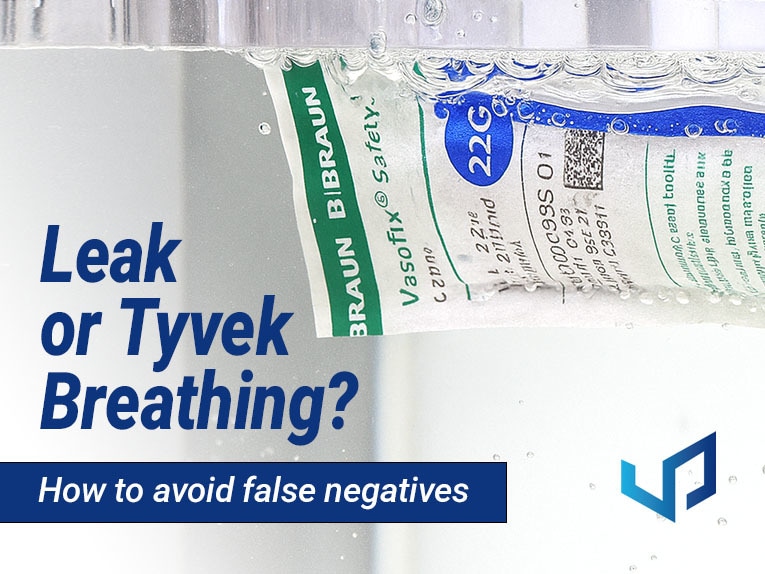
Leak or Tyvek breathing? The key when testing porous sterile packaging.
When you test the seal integrity of a sterile package with Tyvek, its porosity can create isolated bubbles. So how do you avoid mistaking them for a leak? In the next two minutes, I’ll show you a simple adjustment.
Tyvek is that white “paper” you see in many sterile packages. In reality, it's a network of microfibers that allows air and vapor to pass through, but blocks liquids and microorganisms. Excellent for sterility… and a small headache in leak testing.
Several pharmaceutical standards, such as ISO 11607, recommend using the ASTM F2096 test protocol, which employs the internal pressurization–immersion technique, also known as the bubble leak test. F2096 is clear: when the applied pressure exceeds the natural breathability of the porous material, air will escape and may look like a leak. The solution? It’s in the standard itself: apply a blocking agent to seal the Tyvek.
What blocking agent are we talking about?
ASTM F2096 mentions a STERIS product as an example, but any hand-sanitizing foam with at least 62% ethyl alcohol works. When applied correctly, it increases the package’s breathability pressure enough that, at your test pressure, any bubble you see corresponds to an actual leak.
How is it used?
Very simple. Prepare the sample according to your procedure; ensure the porous surface is clean and dry.
Apply the foam in a uniform layer over the entire porous area.
Then, let it dry for approximately 15 to 20 minutes.
Now you’re ready to run your internal pressurization test using your defined parameters.
Record the essentials for full traceability: foam type, brand, lot number, and drying time.
If you want to learn how to define the test pressure and exposure time, we have a dedicated video for that—plus another one specifically on ASTM F2096. Both links are in the description.
If your setup does not allow the recommended blocking agent, you can use glycerin, as indicated in the Mexican Official Standard NOM-BB-5-1991 for sealing the pores of syringe packages.
Recently, a client sent us samples of gauze packaged in cold-seal paper so we could help them define the appropriate test method. In this case, the hand sanitizer foam did not work effectively as a blocking agent, but when we tried glycerin, we obtained excellent results.
A practical recommendation: glycerin is oily, which prevents proper adhesion of the patch used during the internal pressurization test. Therefore, apply the patch before applying the glycerin.
Additionally, in the tests performed on the gauze packages, we determined that testing should be done at a pressure of 15 millibars, for a minimum of two minutes and a maximum of four minutes.
If you’d like to send us your samples, fill out our contact form at devaci.com; we will send you a free demonstration video with our recommendations.