#Product Trends
Preventive medicine during hospital construction work
The certainty of being within environmental safety margins
Carrying out renovation or construction works in a running hospital is an extremely complex and risky task.
Beyond the inconvenience of noise or the reorganisation of spaces, the main threat lies in the dust generated. This dust is not simply dirt; it is a powerful vector for the transmission of pathogens, especially fungal spores such as Aspergillus, a microorganism that is omnipresent in the outdoor environment and can be lethal to patients with weakened immune systems, such as cancer patients, transplant recipients or those admitted to the ICU.
When demolition, excavation or any other activity that removes building materials is carried out, millions of particles and spores that had remained dormant are released into the air. If these particles are not effectively contained, they can quickly spread throughout the hospital via air currents or air conditioning systems, reaching the most sensitive areas and causing outbreaks of invasive aspergillosis and other fungal infections with very high mortality rates. Prevention, in this context, is a matter of life and death.
To mitigate this risk, hospital preventive medicine services must implement a rigorous protocol before, during and after the works.
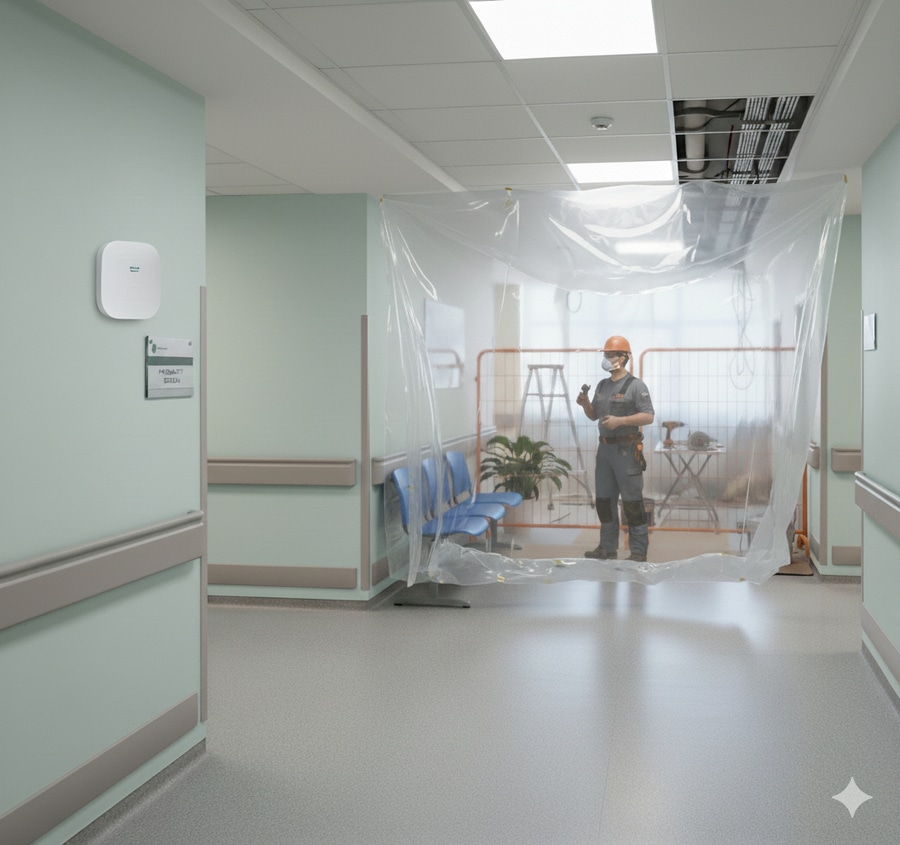
This includes the installation of airtight physical barriers to completely isolate the work area, the creation of negative air pressures to prevent dust from escaping and, fundamentally, an air quality monitoring programme.
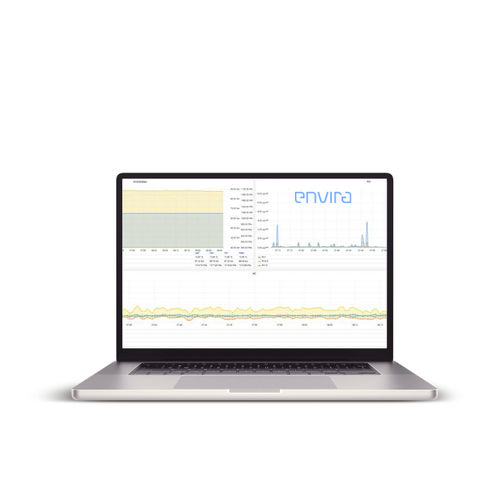
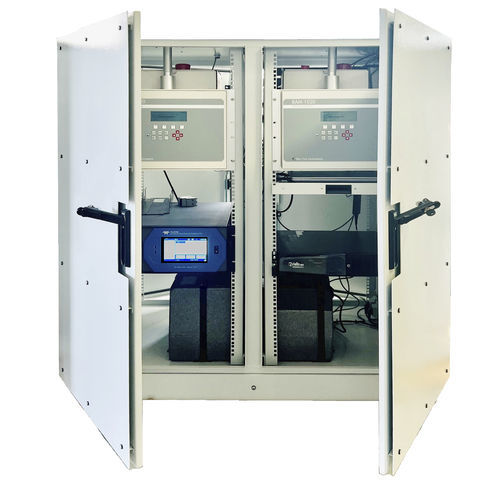
The use of real-time particle monitors in areas adjacent to the work site allows the effectiveness of containment measures to be verified. If particle levels exceed safety thresholds, alarms are activated immediately, allowing corrective action to be taken before the health of the most fragile patients is put at risk.